

The New Cybersecurity Clock: What Mythos and Glasswing Signal

That is the patching trap. Patching is essential hygiene, but it is not a complete defense strategy.
It reduces the number of open doors. It does not decide what happens when someone still gets through one.
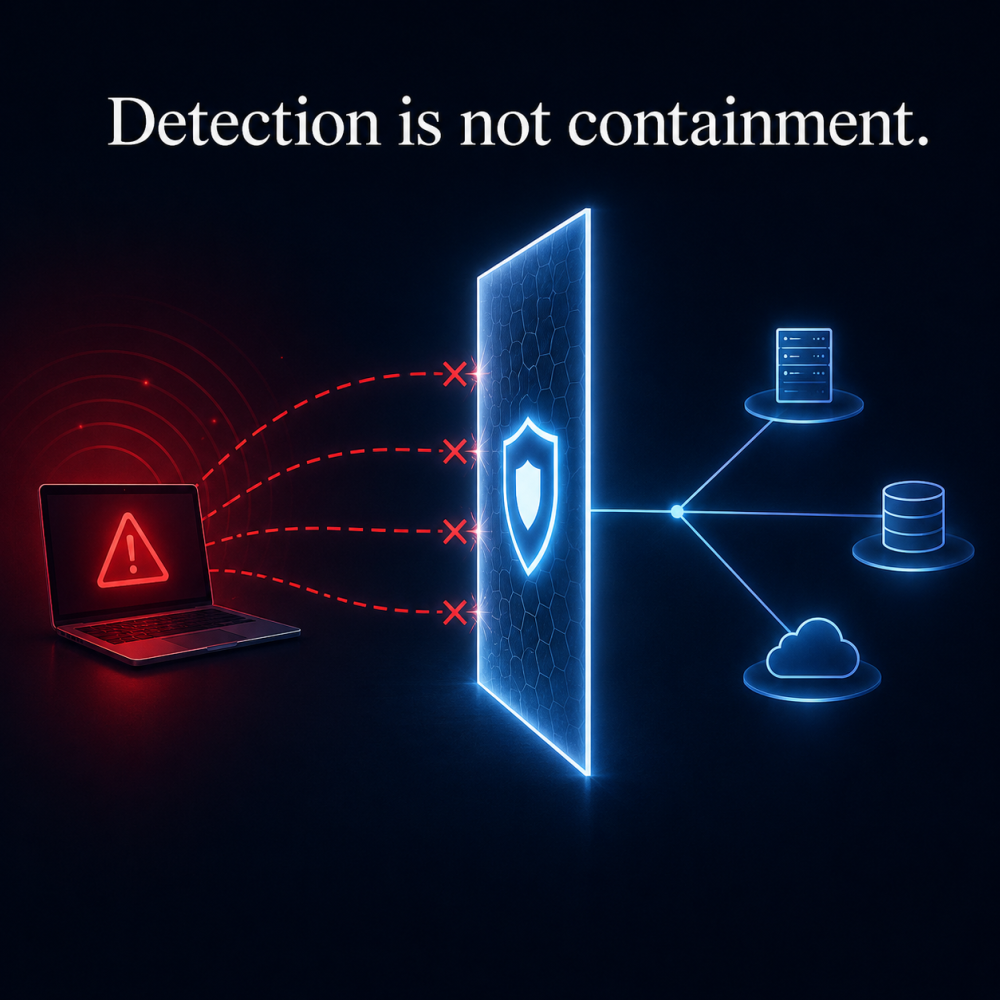
Detection Is Not the Same as Containment
Endpoint detection and response tools are an important part of modern security. They help detect suspicious behavior, investigate incidents, isolate machines, stop malicious processes, and support response teams. No serious security program should dismiss them.
But EDR is often asked to do more than it can realistically do by itself.
Most detection and response processes depend on a sequence: something happens, the tool sees it, the activity is classified, an alert or automated action is triggered, and the response happens quickly enough to matter. That sequence can work well when there is enough time, enough visibility, and enough confidence to act.
Modern attacks put pressure on all three.
Attackers increasingly use legitimate tools, valid credentials, cloud APIs, service accounts, and remote administration utilities. Early activity may not look like obvious malware. It may look like normal work. At the same time, breakout time, the time between initial access and lateral movement, has been shrinking. When attackers can move in minutes or seconds, even a good alert may arrive after the attacker has already reached the next system.
Coverage also matters. EDR is strongest where it is installed, healthy, configured correctly, and able to observe the relevant behavior. But many of the hardest assets to protect are exactly where endpoint coverage may be weak or absent: legacy servers, OT systems, IoT devices, medical devices, unmanaged endpoints, network appliances, containers, cloud services, and non-human identities.
This is the key distinction: EDR helps detect and respond. It is not, by itself, an enterprise containment strategy.
Containment has to be designed into the environment before the alert fires.
The Real Risk Is Movement
A breach usually does not become a crisis because one machine was compromised. It becomes a crisis because the attacker uses that first foothold to move.
A compromised laptop becomes a path to a file share. A developer environment becomes a route to production. A cloud workload becomes a bridge to a database. An IoT device becomes a doorway into the corporate network. A service account becomes a key to multiple systems. A ransomware operator finds backups, encrypts enough assets, and gains leverage.
That movement is the risk.
Attackers do not need every path to be open. They need enough paths to reach something valuable. The flatter and more connected the environment is by default, the more useful any single compromise becomes.
That is why the conversation needs to shift from “Did we detect it?” to “Where could it go before we detected it?”
That question forces a different kind of discussion. It moves the focus from tool activity to business impact. It exposes reachability, privilege, segmentation gaps, identity paths, unmanaged assets, and the practical consequences of a breach.
It also reveals whether the organization has a vulnerability problem, a containment problem, or both.
Assume Breach Is Not Defeat. It Is Discipline.
Assume breach can sound pessimistic, as if the security team has accepted failure. That is the wrong reading.
Assume breach is planning. It recognizes that in a large, complex organization, something will eventually go wrong. A user will click. A credential will be stolen. A vendor will be compromised. A cloud permission will be too broad. A forgotten system will remain exposed. A zero-day will work before a patch is available.
The goal is not to accept the breach. The goal is to prevent one failure from becoming a company-wide event.
Once that mindset is in place, the questions become much more useful. If an attacker compromises a user device, can they reach critical applications? If they compromise a development system, can they reach production? If they compromise a service account, how many environments can it touch? If ransomware starts in one segment, can it reach backups?
These are not narrow technical questions. They are business resilience questions.
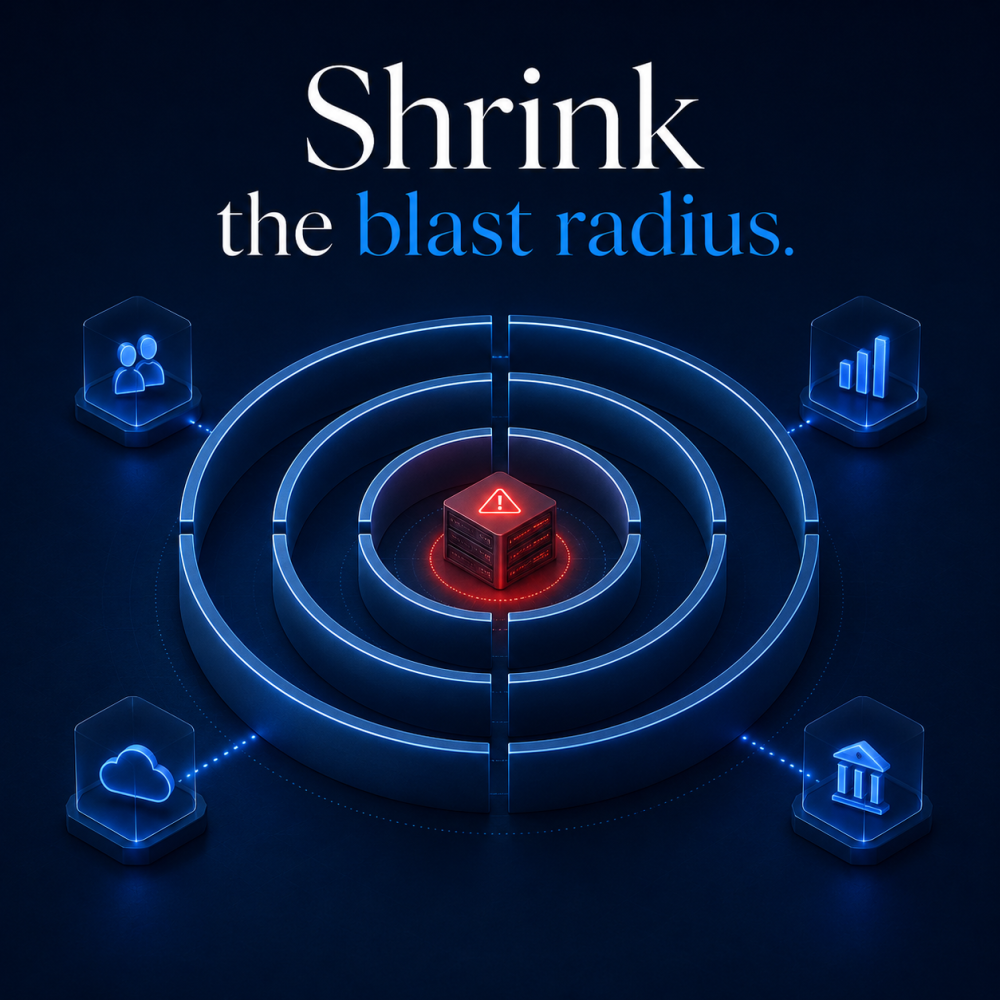
A smaller blast radius means less downtime, less operational disruption, less ransom leverage, less regulatory exposure, and faster recovery. It also means the organization can absorb an incident without turning it into a full-scale crisis.
Zero Trust Is the Containment Model
Zero Trust is often explained in language that makes it sound more complicated than it needs to be. The core idea is simple: do not trust something just because it is already inside the environment.
Every user, device, workload, application, and service should have only the access it needs to do its job. Nothing more. Access should be verified, limited, and continuously reviewed.
That principle matters because attackers benefit from excess access. Flat networks, broad permissions, open ports, shared administrative paths, and overconnected systems turn one compromise into many compromises.
Zero Trust reduces that freedom. It makes access intentional. It limits unnecessary communication. It separates critical systems from ordinary systems. It changes the internal environment from “open unless blocked” to “blocked unless needed.”
In practical terms, Zero Trust gives the building interior walls.
A burglar may still get into one room. But they should not be able to walk into finance, production, the control room, the backup vault, and every sensitive system while everyone waits for an alert to turn red.
That is the difference between detecting an attack and containing one.
The Questions Worth Asking
The goal is not for every leader to become a cybersecurity engineer. The goal is to ask questions that reveal whether the organization is resilient or merely busy.
Instead of asking only, “How many vulnerabilities did we patch?” ask, “Which vulnerabilities are actually reachable, exposed, or tied to critical systems?”
Instead of asking, “Do we have EDR?” ask, “Where do we not have endpoint coverage, and how are those assets contained?”
Instead of asking, “Can we detect lateral movement?” ask, “What lateral movement is technically possible today?”
Instead of asking, “Are we Zero Trust?” ask, “Which critical systems are still reachable by default?”
Instead of asking, “Are backups protected?” ask, “Could ransomware reach or delete them through normal administrative paths?”
Instead of asking, “How fast can we respond?” ask, “What could happen before response begins?”
A few questions are especially useful:
What are our highest blast-radius systems?
Can a compromised laptop reach production?
Can development systems talk to production?
Can user networks reach critical infrastructure?
Which service accounts have broad access?
Where are we relying on detection because we have not yet enforced least privilege?
Which critical systems cannot be patched quickly, and what compensating controls contain them?
How long would it take to isolate a business-critical segment?
What systems could ransomware reach in the first hour?
These questions separate activity from resilience.
Activity is “we patched 3,000 vulnerabilities.”
Resilience is “a compromised laptop can no longer reach production.”
Activity is “we deployed another detection tool.”
Resilience is “our backup environment is isolated from ordinary user and admin paths.”
Activity is “we investigated the alert.”
Resilience is “the attacker had nowhere useful to go.”
What To Do Now
The answer is not to stop patching. The answer is to stop treating patching as the whole strategy.
A practical approach starts with vulnerability management, but prioritizes based on real exposure. Internet-facing systems, known exploited vulnerabilities, critical applications, privileged paths, and assets tied to important business processes should get the most attention.
Next, map how the environment actually communicates. Many organizations do not have a clean view of which users, workloads, devices, applications, and services talk to one another. Without that map, containment is guesswork.
Then reduce unnecessary access. Close unused ports. Restrict administrative pathways. Limit service-to-service communication. Separate user networks from critical infrastructure. Remove broad access that no longer has a business reason.
The hardest assets should not be left for last. Legacy systems, OT, IoT, medical devices, cloud workloads, containers, and unmanaged assets are often where attackers find opportunity. Leaving them for a later phase may feel practical, but attackers also like practical shortcuts.
Finally, measure blast radius. Show progress by proving that fewer critical systems are reachable from any single point of compromise. That is more meaningful than simply counting tools deployed or vulnerabilities closed.
The Bottom Line
Mythos and Glasswing are important because they make a larger shift visible. AI is beginning to change how vulnerabilities are discovered, how quickly attack paths can be tested, and how much pressure defenders will face.
This does not make cybersecurity hopeless. It makes the old assumptions less safe.
Organizations still need to patch. They still need EDR. They still need identity security, monitoring, threat intelligence, cloud security, and response plans. But the next phase of cybersecurity cannot depend only on finding every weakness before an attacker does. That is a race defenders will not always win.
The better strategy is to assume that something will get through, then make sure it cannot spread.
Assume breach.
Shrink the blast radius.
Make sure the attacker has nowhere useful to go.
Contact us to know how ColorTokens can help protect critical systems when prevention alone is not enough.
The post The New Cybersecurity Clock: What Mythos and Glasswing Signal appeared first on ColorTokens.
*** This is a Security Bloggers Network syndicated blog from ColorTokens authored by Harish Akali. Read the original post at: https://colortokens.com/blogs/claude-mythos-glasswing-breach-containment/
