

Identity Is the New Attack Surface: How Infostealers Are Reshaping Enterprise Risk

Blog
Identity Is the New Attack Surface: How Infostealers Are Reshaping Enterprise Risk
Our new guide explores how infostealers are fueling modern identity-based attacks and how organizations can build a proactive defense before stolen access is weaponized.


 Table Of Contents
The New Reality of Identity-Based Threats
A publicly exposed database surfaced in early 2026 containing more than 149 million stolen login credentials. The records were not tied to a single breach or organization. Instead, they had been quietly collected over time from devices infected with information-stealing malware, with each record containing usernames, passwords, session data, and the context needed to use them.
Unlike traditional breach dumps, this data was structured, searchable, and immediately actionable. Credentials were mapped to specific services, session artifacts reflected active logins, and much of the information was recent enough to enable direct access without triggering traditional security controls.
This incident reflects a broader shift in the threat landscape.
More than 11.1 million devices were infected with infostealers last year, fueling a supply of over 3.3 billion stolen credentials, session cookies, cloud tokens, and other forms of identity data now circulating across illicit markets.
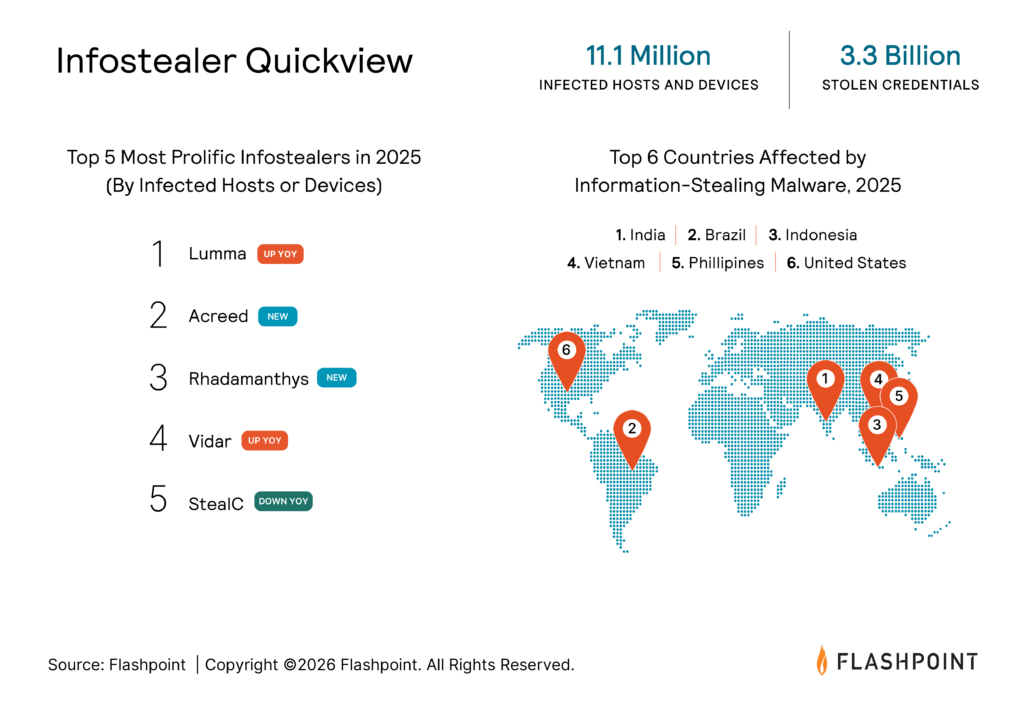
For security teams, the challenge is no longer simply detecting a breach after it occurs. It is understanding when access may already exist — where compromised credentials are circulating, how they are being used, and how quickly they can be weaponized.
That’s why Flashpoint created Identity Is the New Attack Surface: A Guide to Infostealers and Proactive Defense.
Drawing on Flashpoint’s Primary Source Collection (PSC) and analyst-driven intelligence, this guide helps IT, Threat Intelligence, Fraud, and HUNT teams understand how infostealers operate, how stolen identity data fuels real-world attacks, and how organizations can move from reactive response to proactive defense.
The guide explores:
- How today’s most active infostealers power modern attack chains
- How threat actors weaponize stolen credentials, cookies, and session data
- How organizations can operationalize infostealer intelligence for proactive defense
- How to evaluate infostealer intelligence providers and detection capabilities

Why Identity Has Become the Preferred Attack Surface
For years, security teams focused on vulnerabilities, malware delivery, and network intrusion as the primary paths to compromise. Increasingly, however, threat actors are taking a different
Modern infostealers such as Lumma, StealC, Vidar, Acreed, and Rhadamanthys provide attackers with something more valuable than initial access: usable identity. These malware families collect credentials, browser artifacts, session cookies, application data, and host metadata that help threat actors understand how a victim authenticates and what systems they can access.
A single infected device can expose credentials, browser artifacts, session cookies, application data, host metadata, and access to enterprise SaaS platforms. Together, these artifacts create a detailed profile of how a user authenticates, what systems they access, and how those systems trust that identity.
This is what makes infostealer data so valuable.
“For years, organizations have invested heavily in detecting malware, blocking exploits, and hardening infrastructure. Meanwhile, attackers have increasingly shifted to a simpler strategy: logging in with valid identities.
Infostealers have fundamentally changed the economics of access. Threat actors no longer need to compromise a network directly when billions of credentials, session cookies, and authentication artifacts are already circulating in underground ecosystems. The challenge for defenders has risen from preventing compromise to identifying where access already exists and how quickly it can be weaponized.”
Ian Gray, Vice President of Intelligence at Flashpoint
Identity data is inherently reusable. A stolen credential can be tested across multiple services. A session cookie can potentially allow attackers to hijack authenticated sessions. Browser and host metadata can help threat actors recreate a victim’s environment and bypass security controls designed to detect suspicious logins.
What begins as a single infection can quickly evolve into access across multiple systems, applications, and organizations.
What Is an Identity-Based Attack?
Identity-based attacks occur when threat actors use legitimate credentials, session cookies, authentication tokens, or other identity artifacts to gain access to systems and applications. Rather than exploiting a vulnerability or deploying malware inside a target environment, attackers authenticate as trusted users using stolen identity data.
This shift is one of the primary reasons infostealers have become so valuable. Modern infostealer logs often contain far more than usernames and passwords. They may also include browser cookies, session information, host metadata, application data, and other artifacts that help attackers understand how a user authenticates and what systems they can access. When combined, this information enables account takeover, fraud, lateral movement, and other forms of identity-based abuse.
From Credential Theft to Identity Exploitation
The way threat actors operationalize stolen data is evolving just as rapidly as the data itself.
Historically, attackers often had to manually review stolen credentials and determine which accounts were worth pursuing. Today, that process is increasingly automated.
Infostealer logs can be aggregated, tested, and prioritized at scale, allowing threat actors to rapidly identify valid access across enterprise systems, SaaS platforms, VPNs, and cloud environments.
Flashpoint identifies this as a hybrid threat: the convergence of large-scale identity compromise and automated exploitation.
Once valid access is identified, attackers can move quickly. Credentials may be reused across services. Session data can be leveraged for account takeover. Access can be sold to ransomware operators, fraud actors, or other criminal groups. In many cases, exposure itself becomes part of the attack lifecycle rather than merely a precursor to it.
The result is a threat landscape where stolen identity data is not simply stored and sold. It is continuously tested, validated, reused, and operationalized.
Turning Exposure Into Actionable Intelligence
For defenders, prevention remains important. But prevention alone is no longer enough.
Organizations must also be able to identify when credentials, session cookies, and other identity artifacts have already been exposed and are circulating within underground ecosystems.
The earliest opportunity to intervene is often after data has been exfiltrated but before attackers have successfully operationalized it.
Achieving that visibility requires more than traditional breach feeds or aggregated datasets.
Flashpoint’s Primary Source Collection approach provides direct visibility into the forums, marketplaces, Telegram channels, malware repositories, and illicit communities where infostealer activity originates. Rather than relying solely on recycled breach data, Flashpoint continuously collects from the environments where stolen identity data is first shared, sold, and operationalized.
However, collection alone is not enough.
Raw infostealer logs are noisy, fragmented, and difficult to operationalize at scale. Flashpoint transforms these logs into structured intelligence through a multi-stage workflow that includes:
- Source ingestion from underground ecosystems
- Normalization and de-duplication of collected data
- Automated parsing and enrichment of credentials, cookies, host metadata, and malware attribution
- Structured output that supports alerts, investigations, and integrations across existing security workflows
This process helps defenders understand not only what was exposed, but who may be affected, how exposure occurred, what systems may be at risk, and how quickly action is required.
Building a Proactive Defense Across the Identity Layer
The rise of infostealers has fundamentally changed how organizations should think about attack surface management.
The attack surface is no longer limited to infrastructure, endpoints, or internet-facing applications. It now includes the digital identities of employees, partners, vendors, and customers.
Security teams need visibility into the identity layer itself — understanding where exposure exists, how attackers are leveraging stolen data, and what actions should be taken before access is exploited.
By combining direct visibility into underground ecosystems with structured, actionable intelligence, organizations can identify compromised accounts earlier, uncover infection trends, prioritize response efforts, and reduce the likelihood of downstream compromise.
Download Identity Is the New Attack Surface: A Guide to Infostealers and Proactive Defense to learn how your organization can build a proactive defense program across the identity layer.
Key Infostealer Statistics
According to Flashpoint research:
- More than 11.1 million devices were infected with infostealers in the last year.
- Over 3.3 billion credentials, session cookies, cloud tokens, and identity artifacts are circulating across illicit markets.
- Flashpoint analysts identified 30+ active infostealer strains being sold across underground ecosystems.
- Flashpoint’s credential database contains 48+ billion credentials, including more than 1 billion tied to infostealer activity.
- More than 4.2% of infostealer-exposed credentials include browser cookies that may support session hijacking.
- Flashpoint can collect and parse some infostealer logs within one to two days of infection.
Frequently Asked Questions (FAQ)
FAQ: Infostealers and Identity-Based Threats
What is an infostealer?
An infostealer is a type of malware designed to collect sensitive information from an infected device. Depending on the strain, this can include usernames and passwords, browser cookies, session tokens, saved payment information, cryptocurrency wallets, system metadata, and other identity-related artifacts.
How do infostealers work?
Infostealers infect a victim’s device and collect information such as credentials, browser data, session cookies, autofill information, cryptocurrency wallet data, and system metadata. The stolen information is packaged into files known as infostealer logs, which can then be sold, shared, or operationalized by threat actors.
What information can infostealers steal?
Depending on the malware family, infostealers can collect usernames and passwords, session cookies, authentication tokens, browser history, saved payment information, cryptocurrency wallet data, system information, installed applications, and other identity-related artifacts. The goal is to provide attackers with enough information to access accounts and impersonate legitimate users.
What are the most common infostealers?
The infostealer ecosystem changes rapidly, but Flashpoint analysts currently track strains such as Lumma (also known as LummaC2/Remus), StealC, Vidar, Acreed, and Rhadamanthys among the most prominent malware families driving credential theft and identity-based attacks.
Why are infostealers so dangerous?
Infostealers provide attackers with more than credentials. Modern infostealer logs often contain the context needed to use stolen data, including session information, browser artifacts, and device metadata. This allows threat actors to perform account takeovers, move laterally within environments, and gain access to business-critical systems. According to Flashpoint’s 2026 Global Threat Intelligence Report, more than 11.1 million devices were infected with infostealers last year, contributing to a pool of over 3.3 billion stolen credentials, session cookies, cloud tokens, and other identity artifacts.
What is an infostealer log?
An infostealer log is a package of data collected from an infected device. Logs may contain credentials, cookies, browser data, application information, host metadata, and other artifacts that help attackers understand how a victim authenticates and what systems they can access.
Can infostealers bypass multi-factor authentication (MFA)?
In some cases, yes. While multifactor authentication remains a critical security control, stolen session cookies and authenticated session data can sometimes allow threat actors to hijack existing sessions without needing to complete the MFA process themselves. Flashpoint found that more than 4.2% of infostealer-exposed credentials in its dataset were associated with browser cookies, highlighting the growing importance of session-based risk.
How do threat actors obtain infostealer logs?
Infostealer logs are frequently bought and sold across illicit marketplaces, forums, Telegram channels, and other underground communities. Many are distributed through Malware-as-a-Service (MaaS) offerings that make infostealer capabilities accessible to a wide range of threat actors. Flashpoint analysts identified more than 30 unique infostealer strains actively offered for sale across underground ecosystems.
How can organizations detect credential exposure from infostealers?
Organizations can monitor underground sources where stolen data is shared and sold, identify exposed credentials associated with their domains, and investigate related artifacts such as cookies, host metadata, and malware attribution. The earlier exposure is identified, the greater the opportunity to remediate before attackers operationalize access. Flashpoint collects and parses some infostealer logs within one to two days of infection, helping organizations detect exposure closer to the point of compromise.
What should organizations do if employee credentials appear in an infostealer log?
Organizations should immediately assess the scope of exposure, reset affected credentials, invalidate active sessions, review authentication activity, investigate the infected device, and determine whether additional accounts or systems may have been impacted.
How is Flashpoint’s approach to infostealer intelligence different from traditional breach monitoring?
Many organizations rely on aggregated breach feeds or credential dumps that may be weeks or months old by the time they are discovered. Flashpoint’s Primary Source Collection (PSC) approach provides direct visibility into the forums, marketplaces, Telegram channels, and underground communities where stolen identity data is first shared, sold, and operationalized.
In addition to collecting raw infostealer logs, Flashpoint parses and enriches the data with context such as malware attribution, session cookies, host metadata, browser artifacts, and affected identities. Today, Flashpoint’s credential database contains more than 48 billion credentials, including over 1 billion tied to infostealer activity, providing organizations with actionable intelligence rather than raw exposure data.
Request a demo today.
The post Identity Is the New Attack Surface: How Infostealers Are Reshaping Enterprise Risk appeared first on Flashpoint.
*** This is a Security Bloggers Network syndicated blog from Threat Intelligence Blog | Flashpoint authored by Flashpoint. Read the original post at: https://flashpoint.io/blog/proactive-defender-guide-infostealers/
