Barracuda Networks Enlists AI to Protect Email Systems

Barracuda Networks today added an email protection capability that makes use of artificial intelligence (AI) to correlate cross-domain signals to continuously identify, investigate and eliminate risk.
Based on the BarracudaONE platform, the Integrated Email Protection capability makes it possible to triage threat activity, correlate signals across environments and execute real-time clawback of malicious messages discovered in Microsoft 365 and Google Workspace inboxes to streamline remediation efforts.
Brian Downey, senior vice president for product management at Barracuda Networks, said, collectively, these capabilities will enable cybersecurity teams to rely on AI to mitigate email threats at machine speed at a time when adversaries are increasingly using AI to launch more sophisticated attacks.
Just as importantly, as end users rely more on AI agents to read, send and manage email, the Integrated Email Protection platform will enable cybersecurity teams to monitor and, if necessary, prevent malicious emails from being both sent and received, added Downey. AI agents represent a significant expansion of the overall attack surface as malicious prompts are embedded into emails sent to AI agents, noted Downey.
It’s also only a matter of time before business email compromise (BEC) attacks are expanded to include AI agents that provide access to business workflows, he added.
Designed to be deployed in minutes using application programming interfaces (APIs) that integrate with messaging platforms, Barracuda Networks has also integrated its platform with the Barracuda IQ engine to provide access to threat intelligence.
Additionally, the Integrated Email Protection platform can be managed via Barracuda Bailey, a conversational AI assistant that Barracuda Networks already makes available to cybersecurity teams.
Finally, Integrated Email Protection is also integrated with tools that Barracuda Networks provides to create reports.
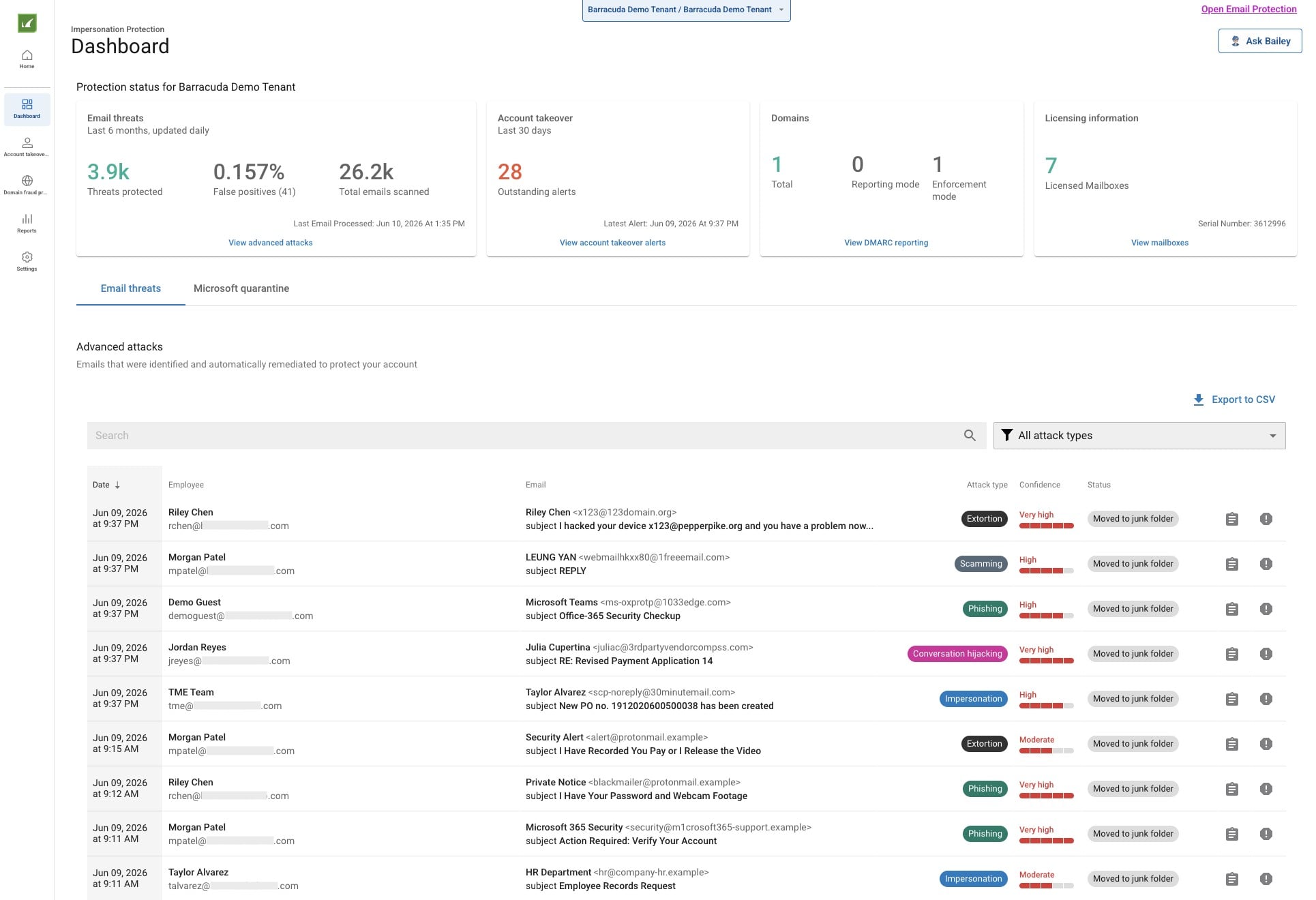
In general, it’s clear that cybersecurity teams are already struggling to combat a growing wave of more sophisticated attacks that are being driven by AI. New findings released today by Barracuda Research detail how a single phishing email can be used to steal an identity and bypass multifactor authentication (MFA) to compromise an endpoint in a few minutes. The report also notes that one in seven compromised accounts is now used to launch additional attacks.
It’s not clear how cybersecurity teams will prioritize threats in the AI era, but the one thing that is clear is resources will remain limited relative to the scope of the attacks that might be launched. A recent Futurum Group report projects the global cybersecurity market is projected to reach $521.7 billion by 2031 at a 7.6% compound annual growth rate (CAGR) from an estimated $335.8 billion in spending that occurred in 2025.
The one thing that is certain is adversaries have, in comparison, access to almost unlimited resources that could be applied in any number of ways to wreak havoc. However, given how much success they have enjoyed over the years using phishing attacks delivered via email, it’s safe to say that much of their investments in AI will be applied to an attack vector they already know how to easily exploit.