
Home » Security Bloggers Network » The hidden cost of compliance theater: what your audit score doesn’t tell the board

The hidden cost of compliance theater: what your audit score doesn’t tell the board

The post The hidden cost of compliance theater: what your audit score doesn’t tell the board appeared first on TrustCloud.
That gap is where compliance theater lives. It is a polished performance of compliance, but it lacks the underlying strength. It can produce clean dashboards, tidy control evidence, and impressive reports, while the organization still struggles with weak ownership, shallow testing, poor remediation, and real-world gaps that never show up in the final score.
Boards often see the score and assume the risk is under control. In reality, the score may only confirm that a process was completed, not that it worked. The hidden cost is paid later, when a vendor issue becomes a breach, a policy becomes shelfware, or a control passes on paper but fails during an incident.
Why compliance theater keeps winning
Compliance theater thrives because it is easy to measure and easier still to present. It gives leaders something concrete to point to: a percentage, a pass/fail result, a certificate, or a completed checklist. Those outputs are comforting because they suggest progress without forcing difficult questions about substance.
Organizations also lean into theater because compliance work is often treated as a destination rather than a discipline. Teams rush toward audit deadlines, gather evidence in a burst, and then relax once the report is filed. That rhythm rewards appearance over durability. If the audit window is the main event, then passing the audit becomes the goal, even when the broader risk picture remains unresolved.
There is also pressure from the top. Boards and executives need concise updates, and a score is simple to digest. But easy-to-read does not mean risk-free. When compliance becomes a communication exercise instead of an operating discipline, the organization starts optimizing for the report instead of the reality.
What an audit score really measures
An audit score typically assesses the presence of documented controls and the sufficiency of evidence demonstrating their adherence during a review period. That is useful, but it is not the same thing as proving the organization is resilient. Control can exist, be documented, and still be weak in practice.
For instance, a company might have an access review control that it marks as complete every quarter. If reviewers simply click approve without checking actual access rights, the control may look successful while allowing unnecessary privilege to build up. The score tells you the process happened. It does not indicate whether the process was effective.
This distinction matters because many boards interpret a satisfactory score as proof of strong security or strong governance. In truth, the score may only reflect compliance with the minimum expected behavior. It rarely captures urgency, quality of execution, timeliness of remediation, or whether the control would hold up under pressure.

Looking for automated, always-on IT control assurance?
TrustCloud keeps your compliance audit-ready so you never miss a beat.
The board sees green, but risk stays red
The greatest danger of compliance theater is that it creates false confidence. When reports are mostly green, leaders assume issues are being handled. Yet the same organization may still have unresolved critical findings, stale exceptions, weak asset inventory, or no clear ownership for key controls.
That gap between the board view and the operational view is where risk grows. A board may receive a polished summary that says the environment is “generally compliant,” while the security team knows that major remediation items have been open for months. A vendor risk program may show high completion rates even though deep reviews are only done for a small subset of suppliers.
In those situations, the board is not being lied to so much as misled by the structure of the reporting. If the only visible metric is score, then everything becomes a matter of optics. The real story, which is usually more mixed and more uncomfortable, gets flattened into a traffic light.
How theater shows up in everyday work
Compliance theater rarely looks dramatic. It usually appears as small habits that become normal over time. People copy last year’s answers because deadlines are tight. Control owners sign off on work they have not really reviewed. Evidence is assembled after the fact instead of captured as work happens. Exceptions are accepted because no one wants to slow down delivery.
Another common pattern is overdocumentation with underexecution. Teams produce impressive policies, detailed procedures, and dense control narratives, but the actual operating cadence is inconsistent. There may be a formal process for everything, but no one has time to follow it properly. The documentation becomes a performance layer that masks operational weakness.
You also see theater in “audit mode” behavior, where teams scramble only when external review is near. That burst of activity can produce a strong score, but it often reveals that the organization does not have a living control environment. A healthy program works in quiet months too. If the system only comes alive during audit season, it is not really a system. It is a production.
Read the “Powerful attestation of compliance: Key considerations for regulatory success” article to learn more!
The hidden costs no one puts on the slide
Compliance theater often looks efficient on the surface, but it hides a set of costs that rarely make it into the board presentation. A clean audit score can create the illusion of control, while teams underneath are spending valuable time, energy, and attention on activities that do not actually reduce risk. The real problem is that these hidden costs accumulate quietly and weaken the organization in ways that are harder to measure than a failed control or an audit exception.
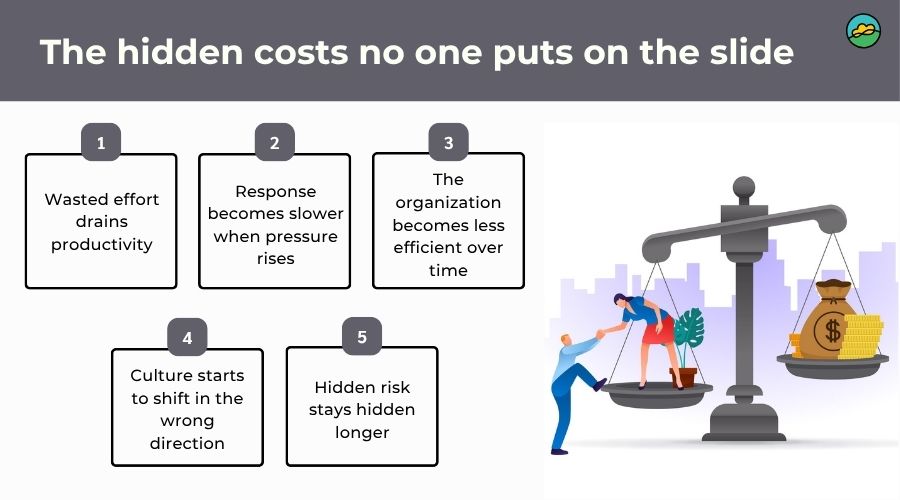
1. Wasted effort drains productivity.
Teams spend hours collecting, formatting, and re-collecting evidence that could have been captured once and reused across reviews, audits, and assessments. Instead of focusing on meaningful risk reduction, employees get trapped in repetitive follow-ups, status updates, and evidence chases. This creates a large opportunity cost because skilled people are pulled away from strategic work that would strengthen controls, improve processes, or reduce exposure. Over time, the organization pays twice: once for the compliance activity itself and again for the lost value of the work that never got done.
2. Response becomes slower when pressure rises.
A compliance program that is built for appearances often lacks the operational discipline needed during a real incident. If ownership is unclear, evidence is scattered, and exception handling is weak, the organization may look organized during an audit but struggle badly in a crisis. Under stress, people waste time searching for the latest playbook, confirming who has approval rights, or figuring out which process is actually current. That delay can turn a manageable issue into a much larger operational or security event. A good audit score does not help much if the team cannot act quickly when it matters most.
3. The organization becomes less efficient over time.
When compliance work is driven by optics, teams often create duplicate processes, redundant documentation, and fragmented workflows just to satisfy different reviewers. That means more manual effort, more confusion, and more room for inconsistency. Instead of building a streamlined system that supports business operations, the organization builds layers of paperwork around the work. This makes the compliance function heavier and more expensive every year, even if the risk posture does not improve. The cost is not only financial; it is also a loss of focus and clarity.
4. Culture starts to shift in the wrong direction.
Employees notice very quickly when appearance matters more than substance. If they see that leadership rewards polished evidence over real control effectiveness, they begin treating compliance as a burden rather than a business safeguard. That mindset is dangerous because it spreads through teams and becomes normalized. Once people believe compliance is just a checkbox exercise, they are less likely to invest care, challenge weak processes, or report issues early. Rebuilding that culture later is difficult because trust and accountability take much longer to restore than they do to damage.
5. Hidden risk stays hidden longer.
The biggest danger of compliance theater is that it can mask actual weaknesses for months or even years. A program may appear mature on paper while control failures continue underneath, unnoticed by leadership. Because the signals are focused on completion rather than effectiveness, serious issues may not surface until an incident, customer escalation, or regulatory review forces them into view. By then, the cost is much higher because the organization is reacting under pressure instead of correcting problems early. In that sense, the hidden cost of compliance theater is not just inefficiency; it is delayed truth.
In the end, the costs no one puts on the slide are often the ones that matter most. Wasted effort, slower response, lower morale, and weakened culture all add up to a program that looks successful but performs poorly when tested. The real value of compliance comes from building resilient, repeatable, and operationally useful controls, not from making the audit story look polished.
Why boards miss the warning signs
Boards are not usually looking for theater. They are trying to make decisions with limited time and limited technical detail. The problem is that the reporting they receive often compresses complexity into overly neat summaries. A board packet may highlight the latest score, a handful of completed actions, and a simple risk statement, but omit the underlying quality of those controls.
Another reason boards miss the warning signs is that the metrics are often backward-looking. A score tells you what was found during a review, not what is emerging now. It may reflect a point in time when the process looked fine, while new vendors, new systems, and new threats are already changing the picture. By the time the board sees the report, the environment may have moved on.
There is also a psychological factor. Humans like clean narratives. A strong score provides reassurance and a sense of control. Challenging that story means asking harder questions about weak spots, exceptions, and operational maturity. Those questions are more useful, but they are also less comfortable.
Read the “Unlock powerful global compliance success in 2026” article to learn more!
What better reporting looks like
Better reporting doesn’t eliminate scores, but it goes beyond that. It connects compliance status to real-world operational risk. Instead of simply saying a control passed, it explains how recently it was tested, whether it was effective, whether exceptions exist, and what would happen if it failed tomorrow.
Boards benefit from seeing trends rather than snapshots. How many critical issues are open? How long do they stay open? Are the same teams or control areas repeatedly failing? Are exceptions increasing faster than remediation? Is third-party risk rising even while internal scores stay high? These questions reveal whether the organization is improving or merely maintaining appearances.
Good reporting also separates confidence from evidence. If management believes control is strong, what proof supports that belief? If a process is “working well,” how do we know? These are uncomfortable questions, but they are the right ones. They push the conversation from compliance status to business resilience.
The difference between “pass” and “protect”
A control that passes an audit is not always a control that protects the business. That is the heart of the problem. Passing means the control met the criteria used in the review. Protecting means it actually reduces exposure when conditions change, people make mistakes, or attackers test the system.
For example, a phishing awareness program may score well because training was assigned and completed. But if the content is stale, the simulations are predictable, and follow-up is weak, then the business may still be highly vulnerable to credential theft. The score says the program exists. The risk is that it may not be enough.
This is true across many areas of GRC. Policies can be approved and still ignored. Vendor reviews can be completed and still miss meaningful concentration risk. Risk registers can be updated and still fail to influence decisions. The difference between pass and protect is whether the control changes actual behavior and actual outcomes.
Industry’s first AI-native security assurance platform
Built for the AI era and designed to integrate GRC and cybersecurity, TrustCloud nullifies the reactive, bureaucratic, workflow-based, check-the-box GRC exercises and empowers CISOs to see everything, achieve accuracy, gain quick time-to-value, and build trusted business impact reporting.
How to spot theater before it becomes a problem
One sign of theater is when the same issues keep returning with different wording. If remediation looks active but nothing materially changes, the program may be optimizing for closure rather than correction. Another sign is when there is too much reliance on manual last-minute effort. Strong programs reduce surprise; theatrical programs depend on it.
You should also watch for controls that are technically complete but functionally shallow. A signed policy is not evidence of adoption. A completed checklist is not evidence of effectiveness. A management attestation is not evidence that the control was truly exercised. If the proof sounds thin, it probably is.
A healthy program usually has some friction in the reporting. Real risk management is not perfectly smooth. It contains nuance, exceptions, and tradeoffs. If everything always looks clean, that can be a warning sign in itself.
What leaders should ask instead
Leaders should ask questions that reveal depth, not just status. What changed since the last review? Which controls are most likely to fail under pressure? Where are the exceptions concentrated? Which issues are recurring, and why? What would happen if we had to defend this control during an incident, not just during an audit?
They should also ask how much of the program is automated, continuously monitored, or embedded into daily operations. If every piece of evidence still depends on manual collection, the program may be more fragile than it appears. If remediation depends on heroic follow-up, the organization may be managing by effort instead of by design.
Most importantly, leaders should ask what the score does not show. This question paves the way for a more candid discussion. It creates space for the uncomfortable truth that a strong audit result and a weak operating posture can coexist.
Read the “What security leaders need to know about zero trust identity management in 2026” article to learn more!
Making compliance real again
The answer is not to abandon compliance. The goal is to make compliance useful again. That starts by tying controls to actual risk and operational outcomes. If a control does not change behavior, reduce exposure, or improve decision-making, it may be more paperwork than protection.
It also means shifting from event-driven compliance to continuous assurance. Evidence should be captured closer to the work, not reconstructed months later. Exceptions should be tracked with urgency, not buried in trackers. Owners should understand not just what they are responsible for but why it matters.
Finally, organizations need to reward honesty. Teams should feel safe surfacing gaps early instead of hiding them to protect a score. A mature program is not one with no findings. It is one that can see findings clearly, prioritize them properly, and address them before they become incidents.
Summing it up
The board does not need a prettier score. It needs a truer story. That story should explain how controls behave in practice, where the pressure points are, how quickly issues are fixed, and whether the business can absorb a failure without serious damage.
Compliance theater is dangerous because it makes an organization feel safer than it is. It turns governance into performance and risk into presentation. The hidden cost is not just wasted effort. It is the gap between what the report says and what the business would actually face in a crisis.
A satisfactory audit score is useful. A believable operating posture is better. The board should not ask only whether the company passed. It should ask whether the company is ready.
FAQs
What is compliance theater, and why is it dangerous for organizations?
Compliance theater is the practice of looking compliant on the surface without building real security, governance, or risk resilience underneath. It usually shows up as green dashboards, polished audit evidence, and perfectly documented policies that never truly influence day-to-day behavior. The danger is that leaders, boards, and even customers may mistake these surface-level signals for actual protection. When that happens, the organization can feel “safe” while serious control gaps remain hidden.
This creates false confidence, which is one of the most damaging outcomes because it delays meaningful corrective action. In practice, compliance theater can make teams focus on passing audits instead of reducing risk. That means time, money, and attention get spent on evidence collection and checkbox activities rather than strengthening controls, improving detection, or fixing process weaknesses. It also encourages shallow compliance habits, where people treat policies as paperwork instead of operating standards. Over time, this can weaken security culture and make the organization more vulnerable to incidents, regulatory scrutiny, and reputational damage.
Why does a strong audit score not always mean the board is protected?
A strong audit score only tells the board that a defined set of requirements was met at a point in time. It does not necessarily show whether controls are effective in real operations, whether they are consistently followed, or whether they can withstand changing threats. This is especially important because boards care about enterprise risk, not just audit outcomes. A company can pass an audit while still having gaps in monitoring, weak incident response, poor vendor oversight, or employees who do not follow procedures in practice. Audit scoring also tends to compress complex realities into a simple pass/fail or percentage metric, which can hide nuance.
For example, a control may exist on paper but be rarely tested, or a policy may be approved but not embedded into workflows. Those blind spots matter because attackers, outages, and internal failures do not care whether a checklist was completed. Boards need visibility into control health, risk trends, recurring exceptions, and how quickly the organization detects and responds to issues. In other words, audit scores are useful, but they are not a substitute for continuous assurance and real operational risk reporting.
How can organizations move from checkbox compliance to real assurance?
Organizations can move beyond checkbox compliance by treating compliance as a continuous risk-management practice rather than a periodic audit project. That starts with aligning controls to actual business risks, not just to what an auditor will ask for. Instead of collecting evidence manually at the end of the year, teams should build repeatable processes that validate whether controls are working throughout the year. Continuous monitoring is especially valuable because it helps detect control drift early, before it turns into a larger problem. Leaders should also focus on fewer, better metrics that reflect operational reality, such as time to remediate findings, control failure rates, policy adoption, and incident response readiness.
Another important step is simplifying the control environment so teams are not juggling multiple overlapping tools and disconnected workflows. When compliance, security, and risk management are integrated, the organization can use one control to serve several frameworks and reduce wasted effort. Just as important, boards should ask for risk narratives, trend data, and evidence of control effectiveness rather than only asking whether the audit was passed. That shift changes compliance from a performance exercise into a credible assurance function that supports the business.
The post The hidden cost of compliance theater: what your audit score doesn’t tell the board first appeared on TrustCloud.
*** This is a Security Bloggers Network syndicated blog from TrustCloud authored by Shweta Dhole. Read the original post at: https://www.trustcloud.ai/grc/the-hidden-cost-of-compliance-theater/
