
Home » Security Bloggers Network » Access control policy template that unlocks effortless compliance and security

Access control policy template that unlocks effortless compliance and security

The post Access control policy template that unlocks effortless compliance and security appeared first on TrustCloud.
Access control often feels like the invisible shield keeping your company’s data safe until it’s not there, and suddenly you’re scrambling over a breach or an audit surprise. I’ve seen teams waste hours untangling who had access to what, especially when growing fast or juggling contractors.
This article delves into the fundamentals of access control policies and provides a comprehensive guide on creating and implementing an effective policy within your organization. Drawing on industry best practices and real-world examples, the content explores how access control frameworks safeguard sensitive data, ensure regulatory compliance, and support overall organizational efficiency. Whether you are updating an existing policy or creating a new one, the principles and examples shared here will help you establish clear procedures to manage access while mitigating risks.
Think of it as your blueprint for deciding who gets the keys to the kingdom without handing them out like candy.
What is an access control policy?
An access control policy is a set of guidelines determining who can gain access to various resources in an organization. It defines the responsibilities of users, administrators, and other stakeholders, outlining procedures for managing account permissions, monitoring usage, and handling incidents. Essentially, this policy serves as a blueprint ensuring that every individual in the organization has the appropriate level of access according to their role, thereby protecting critical data and infrastructure from unauthorized exposure.
Why bother with an access control policy
Nobody wakes up wanting to write policies, but skip this one and you’re playing defense against insiders, ex-employees, or hackers piggybacking on weak permissions. An access control policy spells out rules for who touches what systems, data, or even office doors. It covers authentication (proving you are who you say), authorization (what you can do once in), and ongoing checks to keep things tight.
Done right, it slashes breach risks; studies show 80% of them tie back to compromised credentials or poor access management. For businesses chasing SOC 2, ISO 27001, or even basic GDPR, this policy checks boxes like least privilege and user reviews, turning compliance from a headache into a habit. Plus, it speeds up onboarding: new hires get just enough access on day one, with no more guesswork.

Looking for automated, always-on IT control assurance?
TrustCloud keeps your compliance audit-ready so you never miss a beat.
Key principles of effective access control
Robust access control is the cornerstone of cybersecurity and compliance frameworks like SOC 2, HIPAA, and DORA. When designing an access control policy, adhering to foundational principles ensures a balanced system that minimizes risks while maintaining operational efficiency. These principles, least privilege, need-to-know, role-based access control (RBAC), and separation of duties, guide organizations in granting precise permissions, preventing unauthorized access, and mitigating breach impacts.
- Least Privilege
This principle mandates granting users only the minimum permissions required to perform their specific tasks, avoiding excess access that could lead to unintended data exposure or exploitation. By enforcing least privilege, organizations reduce the attack surface, limit lateral movement during breaches, and comply with regulations like NIST and ISO 27001. Regular audits and automated tools help dynamically adjust privileges as roles evolve, ensuring security without hindering productivity. - Need-to-Know
Building on least privilege, need-to-know restricts access to information strictly essential for a user’s role, preventing overexposure of sensitive data. This layered defense limits damage from insider threats or compromised accounts, aligning with frameworks like GDPR and HIPAA. Implementation involves data classification, contextual access rules, and just-in-time provisioning to balance usability with protection. - Role-Based Access Control (RBAC)
RBAC assigns permissions based on predefined user roles rather than individuals, simplifying management in large-scale environments. Admins map roles to job functions, e.g., “HR Manager” gets payroll views but not financial audits, enabling scalable enforcement, easy onboarding/offboarding, and audit trails. It supports compliance audits and integrates seamlessly with identity providers like Okta or Azure AD. - Separation of Duties (SoD)
SoD divides critical tasks among multiple users or roles to eliminate single points of failure and curb fraud risks, such as one person approving and executing payments. Common in financial controls under SOX or PCI DSS, it requires cross-checks and workflow approvals. Tools like automated policy engines monitor conflicts, fostering accountability while streamlining reviews. - Data Classification Integration
Effective access control incorporates data classification to tag information by sensitivity (e.g., public, confidential, or restricted), enabling principle-aligned policies. This ensures least privilege and need-to-know are applied contextually across cloud, on-prem, and SaaS environments, supporting zero-trust models and reducing non-compliance fines. - Continuous Monitoring and Auditing
Principles demand ongoing oversight through logging, anomaly detection, and periodic reviews to validate adherence. AI-driven tools flag privilege creep or violations in real-time, enabling proactive remediation. This sustains compliance with evolving regs like NIS2, turning access control into a dynamic, resilient defense mechanism.
By embedding these principles into access control policies, organizations achieve a secure, compliant posture that scales with growth. Regular training, automation via platforms like TrustCloud, and periodic reassessments ensure they remain effective against emerging threats, empowering teams to focus on innovation rather than vulnerabilities.
Read the “Access control policies for strong data security in 2026” article to learn more!
Components of an access control policy template
An effective access control policy should be clear, comprehensive, and adaptable. Some of the fundamental components include:
- Purpose statement and scope
Begin by defining the objectives of the policy and its overall scope, including which systems, data, and physical locations are covered. - User roles and responsibilities
Clearly map out each role within the organization and assign access levels accordingly. Updating these roles regularly is key to maintaining security integrity. - Access rights and permissions
Describe the different levels of access, from read-only to full administrative rights and how they apply to various roles. - Account management procedures
Clarify procedures for user account creation, updates, deletion, and routine security reviews to ensure active accounts are still necessary. - Security controls and monitoring
Outline how the organization will monitor system access and implement security measures, such as automated alerts and audit trails. - Compliance requirements
Reference the legal and industry-specific regulations relevant to your business and detail how the policy meets these standards. - Incident response procedures
Provide guidelines for responding to access breaches or disputes. A clear incident response plan helps minimize damage and facilitates quick recovery.
Practical steps for designing and implementing the policy
Creating an access control policy is an evolving process that must adapt alongside changes in technology and organizational structure. Consider these steps when crafting your policy:
Step 1
Assess your current environment: Conduct an in-depth review of how access is currently managed and document any vulnerabilities, inconsistencies, or outdated practices.
Step 2
Set clear objectives: Define what you hope to achieve with your policy. Common goals include protecting sensitive data, streamlining IT management, and ensuring regulatory compliance.
Step 3
Engage with stakeholders: Involve representatives from IT, human resources, legal, and other departments. Their input is invaluable in understanding real-world usability and compliance requirements.
Step 4
Draft the policy: Use available templates and resources to create an initial draft. For example, you may refer to trusted resources like the access control policy templates available in this guide to incorporate industry best practices.
Step 5
Test and review: Before a full rollout, implement the policy in a controlled setting. Run pilot programs, simulate breach scenarios, and solicit feedback from users to iron out any issues.
Step 6
Communicate and provide training: Ensure everyone in the organization understands the new protocols. Regular training helps to reinforce the principles behind the access controls, ensuring users are both compliant and vigilant.
Step 7
Monitor and maintain the policy: Set up periodic reviews and audits to ensure the policy stays up-to-date with internal changes and evolving external threats. Adapting the policy regularly will help maintain robust security over time.
Prove how your enterprise security program protects your business and drives growth
Showcase financial liability reduction with IT risk quantification, cut costs while automating 100s of manual security and GRC workflows, and accelerate revenue by earning regulator, auditor and customer trust.
Real-life scenarios and successful implementations
Understanding how access control policies work in practice can be greatly enhanced by looking at real-world examples. Below are several scenarios detailing how organizations have effectively implemented access control policies:
Example 1: Multilevel access control in a financial institution
A prominent financial institution faced the dual challenge of protecting sensitive trading systems and ensuring compliance with industry regulations. Recognizing the growing threat landscape, the institution undertook a comprehensive risk assessment to identify vulnerabilities and outline necessary access controls.
The organization adopted a role-based access control (RBAC) system anchored in the concept of least privilege. Employees were segmented into distinct groups such as customer service representatives, loan officers, and branch managers. In doing so, each role was assigned the minimum access rights needed for daily tasks.
For instance, while customer service representatives could access basic account information, only senior roles had permissions to view detailed financial data and execute transactions. Two-factor authentication was deployed across the board, and a centralized dashboard monitored access patterns in real time. Thanks to clear role definitions and automated controls, the institution witnessed a marked decrease in unauthorized access and a smoother compliance audit process.
Example 2: Enhancing data security in a healthcare setting
A mid-sized healthcare organization was struggling with outdated access practices that exposed patient records to potential breaches, putting them at odds with HIPAA guidelines. The organization overhauled its approach by integrating modern identity and access management (IAM) tools.
The revamped policy segregated access privileges based on job functions. For instance, doctors were granted full access to patient histories, including diagnostic reports and treatment protocols, whereas nurses were provided read-only access to patient records necessary for immediate care. Administrative staff, on the other hand, accessed scheduling information and registration data but did not have access to personal health information.
This tailored access not only ensured compliance with regulatory mandates but also significantly improved data security. Automated periodic reviews and a robust audit trail meant that any anomalous activity was quickly investigated, mitigating the risk of data breaches even in a high-pressure, fast-paced environment.
Example 3: Flexible cloud-based access management in a tech company
A dynamic tech company, known for its agile project management, recognized that conventional access systems were insufficient for its ever-changing team structures. The organization needed a system that allowed fluid adjustments without compromising security.
They deployed a cloud-based access management system that seamlessly integrated with their HR databases. This integration meant that when an employee’s role changed, the system automatically adjusted the access permissions accordingly. During time-sensitive projects, temporary access rights were granted and then revoked once the project concluded.
For example, a team working on a confidential product update received elevated access privileges for a limited period. Once the project was delivered, the system automatically reverted permissions to predefined levels. This dynamic approach not only preserved efficiency but also significantly mitigated risks by avoiding permanent over-privileging of employees. Automated de-provisioning further reduced the risk of abandoned accounts becoming security vulnerabilities.
Read the “Empower employees with seamless access to policies & procedures to unlock compliance & efficiency” article to learn more!
Overcoming challenges during policy implementation
Even with a clear strategy, implementing an access control policy often comes with its fair share of challenges. Some common issues include:
- Complex policies that confuse end users; the more straightforward the document, the higher the likelihood that employees will adhere to it.
- Integration difficulties with legacy systems that may not support modern authentication or access controls.
- Human errors, such as misassigning permissions, which can create security gaps.
Addressing these challenges requires a mix of technical solutions and robust training programs. Simplifying the language used in your policy, adopting phased integration with older systems, and implementing regular reviews can all contribute to more effective implementation and ongoing management.
Access control policy template
An access control policy defines the rules and procedures for managing and controlling access to an organization’s information technology resources, systems, and data.
Tools and techniques for effective policy management
Modern technologies offer several tools that can support your access control policy. These range from automated software solutions to continuous monitoring platforms.
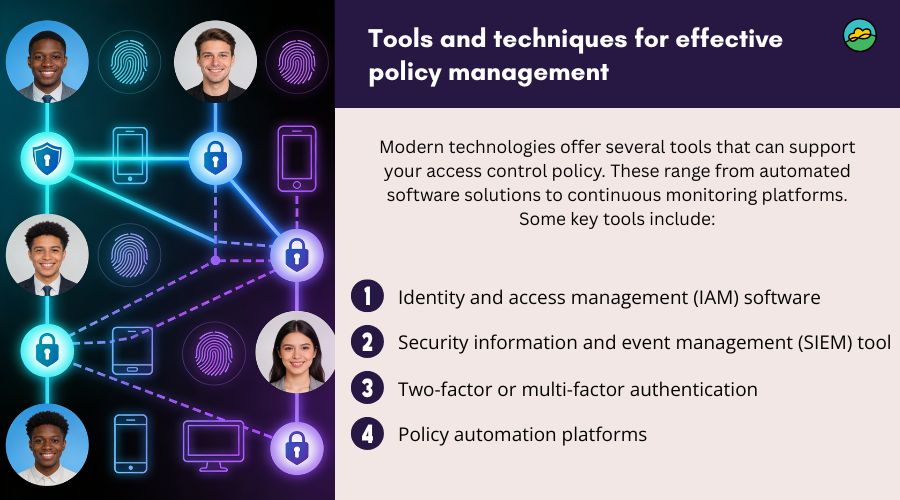
Some key tools include:
- Identity and access management (IAM) software
Automating user provisioning, de-provisioning, and regular permission reviews reduces human error and maintains a tight control over access rights. - Security information and event management (SIEM) tools
These systems provide real-time monitoring and logging of access events. With SIEM, organizations can identify and alert on unusual activity quickly, facilitating proactive incident management. - Two-factor or multi-factor authentication
An additional layer of security ensures that even if a password is compromised, unauthorized access is still prevented. - Policy automation platforms
These solutions help keep your policies current by integrating changes from evolving business needs and technology trends, automatically updating procedures and permissions as necessary.
By leveraging these tools, organizations can reduce the administrative burden, minimize the risk of human error, and more effectively enforce the access control policy. Continuous monitoring and periodic audits further enhance the overall security posture.
The future of access control
Innovation in technology is continuously reshaping how organizations manage access. Advances such as biometric authentication, behavior analytics, and machine learning algorithms are starting to influence how access rights are granted and monitored. These technologies promise more personalized and dynamic control mechanisms, adjusting in real time based on user behavior and environmental factors.
However, these innovations also bring challenges in ensuring user privacy and managing the complexities of data integration. As a result, organizations must remain agile, continuously assessing and updating their policies to align with technological advancements. One constant remains: the need for clarity and accountability in managing access to sensitive data and systems.
The role of training and communication
No matter how robust an access control policy is, its success relies heavily on the people behind it. Regular training and clear, accessible communication are key elements in ensuring that every employee understands their obligations.
Organizations should develop ongoing training sessions, user-friendly guides, and interactive workshops that highlight the importance of access control and demonstrate how to properly manage credentials. Open channels of communication encourage employees to report any irregularities or suggest improvements, an essential factor in creating a collaborative security culture.
Ultimately, a well-informed workforce acts as the first line of defense, reducing the risk of accidental breaches and ensuring that security protocols are consistently followed.
Summing it up
An effective access control policy is much more than a set of written rules; it is a dynamic framework designed to protect organizational assets while keeping pace with evolving threats and operational demands. By establishing clear guidelines for access rights based on roles, responsibilities, and risk assessments, organizations can secure their data, ensure compliance, and streamline internal processes.
The examples presented, from a financial institution’s meticulous role-based access to a healthcare provider’s careful segregation of sensitive information and a tech company’s dynamic cloud-based provisioning, illustrate that there is no one-size-fits-all solution. Instead, each organization must tailor its approach based on its unique requirements, regulatory landscape, and risk profile.
Getting started is easier than you might think. Resources like the access control policy templates available in this guide provide an excellent foundation for developing your own policy framework.
Frequently asked questions
What is the purpose of an access control policy?
An access control policy defines the rules for who can access systems, applications, data, and resources within an organization. Its main purpose is to ensure that only authorized users can gain access and only to the information or tools they genuinely need to perform their work. This reduces the risk of accidental exposure, unauthorized changes, insider misuse, and external breaches.
A strong policy also creates consistency. Instead of granting access ad hoc or based on convenience, the organization follows a clear framework for requesting, approving, reviewing, and revoking access. This is especially important in environments where employees, contractors, vendors, and third parties all interact with sensitive information. In practice, an access control policy supports security, operational efficiency, and compliance by making access decisions predictable, auditable, and aligned with business needs.
What are the key principles behind effective access control?
Effective access control is built on a few core principles that keep access both secure and practical. The first is least privilege, which means users are given only the minimum permissions needed to do their jobs. The second is need-to-know, which limits access to specific information unless that information is required for the person’s role. Together, these principles reduce the likelihood of unnecessary exposure.
Role-based access control, or RBAC, is another major principle. It simplifies administration by assigning permissions to roles rather than to individual users one by one. Separation of duties is equally important because it prevents one person from having too much control over a sensitive process. When these principles are applied together, organizations can reduce fraud risk, limit mistakes, and create a more manageable and scalable access control framework.
Why do organizations need to review access regularly?
Regular access reviews are essential because access needs change over time. Employees switch teams, take on new responsibilities, leave the company, or temporarily receive elevated permissions for special tasks. Without periodic review, users may keep access they no longer need, which creates privilege creep and increases security risk. Old permissions are often one of the easiest ways for attackers or insiders to misuse systems.
Reviews also help organizations stay compliant and accountable. They make it easier to verify that access decisions still match job responsibilities and that approvals were properly documented. In addition, review cycles can uncover inactive accounts, excessive permissions, and conflicts of interest that may have gone unnoticed. By reviewing access on a scheduled basis, organizations can maintain tighter control, improve audit readiness, and respond more quickly to changes in business structure or risk exposure.
The post Access control policy template that unlocks effortless compliance and security first appeared on TrustCloud.
*** This is a Security Bloggers Network syndicated blog from TrustCloud authored by Shweta Dhole. Read the original post at: https://www.trustcloud.ai/grc/access-control-policy-template-that-unlocks-effortless-compliance-and-security/
