

How to Assess Your Organization’s Cyberfraud Protection Maturity & Readiness

The post How to Assess Your Organization’s Cyberfraud Protection Maturity & Readiness appeared first on Blog – Datadome.
As fraudsters leverage AI, and even AI agents, to become faster, smarter, and execute at greater scales, staying ahead requires more than siloed teams and endpoint solutions. It calls for a unified approach that brings together cybersecurity and fraud teams.
That’s why we created the CISO’s Guide to Cyberfraud Protection. In it, you’ll find practical strategies and benchmarks to advance your defenses and integrate your cybersecurity and fraud teams to act as one.
One of the key tools we share inside the guide is the Cyberfraud Protection Maturity Model—a framework that helps you understand where you stand today and what to prioritize next. The model serves as both a diagnostic tool and a roadmap for CISOs. It enables leaders to accurately assess their current posture, identify capability gaps, and prioritize the investments and operational changes that will deliver the greatest impact in the shortest time.
The faster you move from basic, siloed defenses toward an integrated, AI-driven posture, the more resilient you become against evolving fraud schemes, from automated credential stuffing to complex multi-vector attacks.
In this blog, we’ll take you inside that model and show how it can guide your team to graduate from fragmented responses to a proactive, unified defense that is more equipped to face AI-powered cyberfraud.
Understanding the four maturity stages of cyberfraud protection
Every organization sits somewhere on the cyberfraud protection curve. The model includes four key tiers of maturity: Basic, Reactive, Tactical, and Proactive.
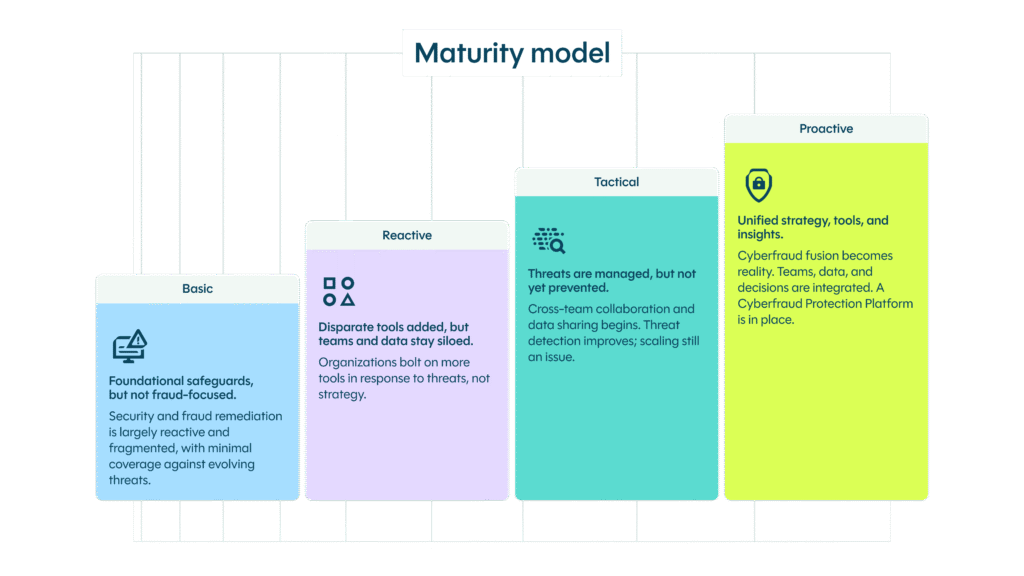
Stage 1: Basic – Foundational controls, minimal specialization
At the starting line, cyberfraud defenses look a lot like general IT security. Web application firewalls, CIAM, and basic bot filtering are in place, but they’re built to block broad threats, not the targeted, multi-step fraud schemes of today. There’s no dedicated cyberfraud team or tooling, and investigations happen manually, often long after an incident. Visibility is limited, leaving attackers ample room to operate unnoticed.
Stage 2: Reactive – Disparate, departmental tools
As fraud attempts rise, departments begin adding their own defenses. Payment fraud tools here, an advanced WAAP deployment there. But these solutions operate in silos, with little cross-team intelligence sharing. Security and fraud teams work in parallel rather than together, which slows investigations and creates exploitable blind spots.
Stage 3: Tactical – Collaboration and point solution alignment
This is where the pieces start to connect. Fraud and security teams begin sharing data, correlating signals, and aligning their investigative workflows. AI-driven detection models start catching anomalies earlier. Tooling expands to include real-time behavioral analytics, KYC solutions, and integrated bot and fraud platforms. The shift from independent action to coordinated defense is underway, but full unification is still on the horizon.
Stage 4: Proactive – Cyberfraud fusion as a unified function
A Proactive level of maturity is the point at which your organization has adopted a truly resilient posture. Fraud, security, and operations function as one fused team with shared KPIs and clear executive accountability. Threat signals flow into unified dashboards, intent-based detection becomes standard, and AI-driven automation intercepts attacks before they reach customers. At this stage, defenses aren’t just faster, they’re predictive.
Key accelerators for moving up the curve
Organizations rarely move from basic to proactive protection by chance. The ones that advance quickly make intentional, high-impact changes that alter how fraud and security teams work, how intelligence flows, and how decisions are made.
1. Break down the silos
Fraud and security teams that operate in silos leave dangerous blind spots. Attackers exploit these disconnects, using tactics that may appear benign to one team but signal clear risk to the other. By merging workflows, creating joint investigation protocols, and sharing alerts in real time, organizations eliminate these gaps. The result is faster decision-making and a unified defense posture that forces adversaries to face coordinated resistance at every step.
2. Turn AI into a force multiplier
The speed and scale of modern cyberfraud require defenses that operate at machine pace. Leading organizations deploy AI and machine learning to identify subtle anomalies and intent across traffic patterns, transactions, and user behaviors, then automate policy actions that cut off risky sessions instantly. This not only reduces exposure from hours to seconds, but also frees analysts to focus on complex, high-value cases instead of repetitive triage.
3. Put all the signals in one place
When fraud indicators are scattered across tools and teams, the complete threat picture never emerges. Consolidating fraud and security telemetry into a single platform or dashboard allows analysts to see connections between events that would otherwise appear unrelated. A failed login in one system, a suspicious payment attempt in another, and a bot traffic spike on a third platform might each seem small in isolation, but together, they tell the story of a coordinated attack.
4. Adopt a shared vision & unified leadership
Progress often stalls when ownership is unclear or distributed. Assigning full accountability for cyberfraud protection to a single executive—often the CISO—creates a clear mandate for resources, priorities, and cross-functional alignment. This leadership ensures fraud prevention isn’t competing for attention but is integrated into the organization’s broader risk strategy, with KPIs tied directly to business outcomes.
How to use the maturity model as a CISO
The value of a maturity model lies in its ability to turn complexity into clarity. For CISOs, it can be both a mirror and a map that shows where you are today and how to get where you need to be.
Begin by anchoring in reality. Resist the urge to rate your program higher than it is; the best leaders treat this process as a candid, cross-functional conversation between fraud, security, and operational teams. A clear-eyed assessment will reveal the true limits of your current defenses.
From there, treat gaps as opportunities, not shortcomings. Look for the changes that unlock multiple wins at once: an integrated fraud and security dashboard that consolidates signals, for example, can speed investigations, sharpen decision-making, and improve collaboration in one move.
Finally, don’t assess in isolation. Comparing your maturity to peers, especially within your sector, can help you frame risk in competitive terms, make the investment case to your board, and set a realistic yet ambitious trajectory for advancement.
The payoff of reaching a Proactive maturity level
Reaching the Proactive stage is less about building an impenetrable wall and more about creating a defense that moves faster than the adversary. By this point, fraud and security aren’t just coordinated, they’re fused into a single, intelligence-driven function. Threat signals from every corner of the business are captured, correlated, and acted upon in real time.
This maturity pays dividends beyond risk reduction. Investigations resolve faster, customer experiences stay seamless, and the organization spends less time firefighting and more time focusing on growth. It also forces attackers to reconsider—when they know detection and disruption happen before monetization is possible, they move on to softer targets.
Proactive isn’t a finish line; it’s a posture. The threat landscape will keep shifting, but the combination of unified data, shared accountability, and AI-driven decision-making keeps you ahead. And in cyberfraud defense, being ahead is everything.
Ready to see where your organization stands and how to accelerate progress? Explore the full Cyberfraud Protection Guide for the complete maturity model, practical benchmarks, and proven strategies to move up the curve.
*** This is a Security Bloggers Network syndicated blog from Blog – DataDome authored by Paige Tester. Read the original post at: https://datadome.co/bot-management-protection/how-to-assess-your-organization-cyberfraud-protection-maturity/
