
Home » Security Bloggers Network » Predictive risk assessment: Preventing security incidents

Predictive risk assessment: Preventing security incidents

Organizations are facing an increasing array of security challenges these days that can disrupt operations, lead to significant financial losses, and damage reputations. Traditional reactive security measures are no longer sufficient. Instead, a strategic focus on proactive security is essential. Predictive risk assessment stands at the forefront of modern security approaches, offering a comprehensive framework for identifying vulnerabilities before they are exploited. This article provides a detailed analysis of predictive risk assessment, outlines actionable steps for implementation, and illustrates industry-specific scenarios to guide leaders in preventing security incidents effectively.
The evolution of risk assessment in the digital age
Historically, risk management in cybersecurity was a reactive endeavor, primarily focused on understanding past incidents and implementing remediation strategies. This backward-looking approach often resulted in a perpetual cycle of patching vulnerabilities and responding to breaches after they occurred. However, the increasing sophistication of cyber threats has necessitated a paradigm shift from reactive defense to proactive prevention.
Predictive risk assessment represents this shift. By leveraging advanced analytics, machine learning, and real-time data, organizations are now able to forecast potential security incidents and strategically mitigate future risks. This forward-thinking method not only enhances security posture but also optimizes resource allocation, ensuring that businesses invest in measures that yield the highest return in risk reduction.
Understanding predictive risk assessment
At its core, predictive risk assessment is the process of identifying and analyzing potential security threats before they materialize into actual incidents. Unlike traditional methods that focus solely on historical data, predictive risk assessments integrate both current and emerging data points. This comprehensive analysis includes:
- Threat Intelligence: Integrating external intelligence data—such as global threat feeds, industry vulnerability reports, and information on emerging attack vectors—enables organizations to anticipate potential risks.
- Behavioral Analytics: Monitoring user activity and network behavior to identify anomalies that may indicate a breach or an insider threat.
- Environmental Monitoring: Evaluating changes in the technological environment, including software updates, new hardware integrations, or changes in system configurations that might introduce vulnerabilities.
- Historical Data Analysis: Analyzing previous incidents to identify trends and recurring vulnerabilities that might signal future risks.
This multi-dimensional approach facilitates a nuanced understanding of an organization’s security posture, highlighting not only what has happened previously but also what could occur in the future under varying scenarios.
Actionable steps for implementing predictive risk assessment
Effective implementation of predictive risk assessment does not occur overnight. It requires careful planning, coordination across multiple departments, and a comprehensive strategy that aligns with the organization’s overall business objectives.
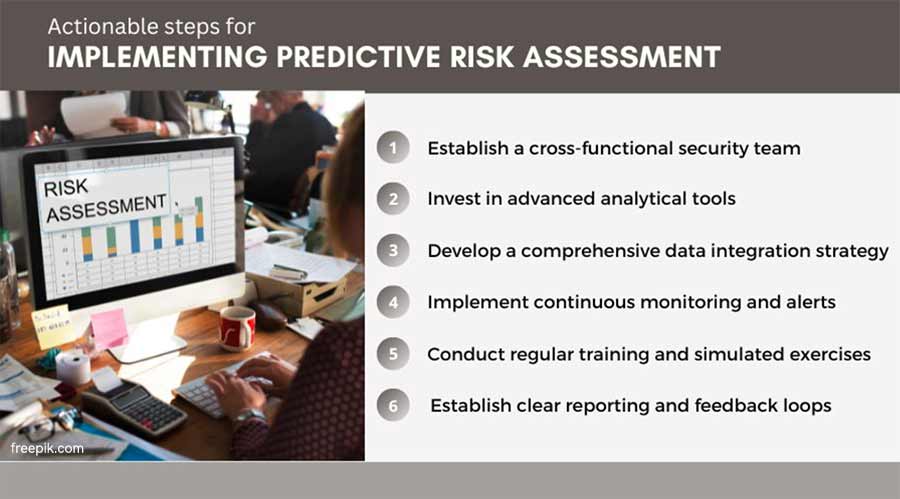
Below are the actionable steps designed to help leaders adopt this essential security practice.
1. Establish a Cross-Functional Security Team
Effective predictive risk assessment is a collaborative effort. Establishing a cross-functional team that includes IT security professionals, data analysts, risk management specialists, and business unit leaders is critical. This diverse team can integrate various perspectives, from technical details to strategic business implications, ensuring a holistic view of potential risks.
Action Points:
- Create a dedicated task force with clearly defined roles and responsibilities.
- Facilitate regular meetings and information-sharing sessions to align on emerging threats and vulnerabilities.
- Ensure that the team is equipped with the necessary training on advanced risk assessment tools and methodologies.
2. Invest in Advanced Analytical Tools
Modern predictive risk assessments depend heavily on robust technological support. Organizations should invest in state-of-the-art data analytics platforms, machine learning algorithms, and behavioral analytics tools that can process large volumes of data in real time. These tools should be capable of identifying patterns that suggest potential security incidents.
Action Points:
- Evaluate and procure technologies that integrate threat intelligence with in-house data.
- Implement machine learning models that are continuously trained on new threat data.
- Ensure integration between predictive analytics tools and existing security information and event management (SIEM) systems.
3. Develop a Comprehensive Data Integration Strategy
The reliability of predictive risk assessments is highly dependent on the quality and breadth of the data being analyzed. Organizations must develop a data integration strategy that consolidates data from various sources such as network logs, incident reports, user activity, and external threat intelligence feeds.
Action Points:
- Implement centralized data repositories to aggregate data from disparate sources.
- Adopt standardized data formats to ensure seamless integration and analysis.
- Regularly audit data sources to maintain high data quality and relevance.
4. Implement Continuous Monitoring and Real-Time Alerts
Predictive risk assessment is most effective when paired with continuous monitoring. This allows organizations to detect deviations from normal operational parameters and to generate real-time alerts when unusual activity is identified. By adopting a proactive stance, organizations can initiate immediate investigations and interventions before potential threats escalate.
Action Points:
- Deploy continuous monitoring tools that provide comprehensive oversight of network traffic and user behavior.
- Configure real-time alert systems that notify security teams of anomalies or significant deviations from the norm.
- Set up clear escalation protocols to ensure timely responses to triggered alerts.
5. Conduct Regular Training and Simulated Exercises
The human element plays a pivotal role in predictive risk assessment. Regular training sessions and simulated exercises can help security teams better understand emerging threats and improve their response strategies. By simulating a range of scenarios, teams can identify weaknesses in existing protocols and refine their proactive measures.
Action Points:
- Organize periodic training sessions focused on the latest threat vectors and risk assessment techniques.
- Conduct simulated security exercises and table-top drills to test the effectiveness of predictive measures.
- Review and update crisis management and incident response plans based on learnings from simulations.
6. Establish Clear Reporting and Feedback Loops
Transparency and communication are vital to the success of any predictive risk assessment initiative. Establishing clear reporting structures ensures that all stakeholders are informed of potential risks and current assessments. Feedback loops not only help in refining predictive models but also in updating the organization’s overall security strategy.
Action Points:
- Create structured reporting systems that provide regular updates to executive leadership.
- Incorporate feedback from incident post-mortems to refine predictive models and response strategies.
- Document lessons learned and use them to inform future predictive risk assessments.
Industry-specific examples and scenarios
Predictive risk assessment is not a one-size-fits-all solution. Different industries face unique security challenges, and the application of predictive measures must be tailored accordingly. The following examples illustrate how various sectors are leveraging predictive assessments to prevent security incidents.
Financial Services
The financial services industry is a prime target for cyber attackers due to the lucrative nature of the assets involved. Banks, investment firms, and insurance companies are continuously exposed to threats ranging from sophisticated phishing scams to advanced persistent threats (APTs) aimed at compromising sensitive financial data.
Consider a multinational bank that has integrated predictive risk assessment into its cybersecurity framework. By continuously analyzing transaction patterns, access logs, and global threat intelligence data, the bank was able to identify anomalies indicative of a coordinated cyber attack targeting its customer databases. Early detection through real-time alerts allowed the bank to initiate an immediate investigation, isolate affected systems, and prevent data exfiltration.
This example underscores the importance of predictive risk assessment in industries where the cost of compromised data can be catastrophic. The key takeaway for financial institutions is the need to integrate proactive security measures and advanced data analytics into existing risk management protocols.
Healthcare
Healthcare organizations face unique challenges due to the sensitive nature of patient data and the critical dependency on uninterrupted operations. Ransomware attacks, data breaches, and insider threats present a constant risk, making predictive risk assessment indispensable in this domain.
A major hospital network implemented a predictive risk assessment system to monitor the flow of data across its electronic health record (EHR) system. By leveraging machine learning to analyze user access patterns and network traffic, the hospital network flagged unusual activities that led to the early detection of a ransomware attempt. The predictive system enabled rapid containment, preserving both patient data and ensuring continuity of care. In this scenario, the integration of predictive analytics not only protected sensitive information but also underscored the role of proactive measures in safeguarding public health infrastructure.
Manufacturing
Manufacturing companies are increasingly interconnected through Industrial Internet of Things (IIoT) devices and automation systems, which introduce new vulnerabilities. Cyber incidents in manufacturing can lead to production downtime, compromised intellectual property, and substantial financial losses.
A leading manufacturing firm adopted a predictive risk assessment strategy to monitor its operational technology (OT) networks and smart factory systems. The system continually analyzed patterns in device communications and equipment performance data. When an anomaly was detected in a critical assembly line’s sensor data, the predictive system raised an alert. A subsequent investigation revealed that a sophisticated cyber intrusion was attempting to disrupt production operations. Through immediate intervention, the firm was able to neutralize the threat, avoiding costly downtime and preserving the integrity of its production processes.
This example highlights the applicability of predictive risk assessment in environments where even a brief security incident can have far-reaching operational and financial implications. It reinforces the principle that proactive security measures are vital regardless of the industry.
Benefits of embracing predictive risk assessment
Organizations that adopt predictive risk assessment strategies enjoy several significant benefits. These benefits not only improve the security posture but also contribute to broader organizational goals such as operational efficiency, regulatory compliance, and long-term resilience.
- Enhanced Threat Visibility: By forecasting potential security incidents, organizations gain enhanced visibility into emerging threats and can prioritize resources accordingly.
- Reduced Incident Response Time: Early detection through continuous monitoring allows for swifter incident response and containment, thereby reducing the overall impact of security breaches.
- Cost Efficiency: Investing in predictive measures often leads to cost savings by reducing the frequency and severity of incidents, minimizing downtime, and avoiding regulatory fines associated with data breaches.
- Improved Compliance: Many industries are required to meet stringent regulatory mandates. Predictive risk assessments can help organizations stay ahead of compliance requirements by maintaining proactive security postures.
- Resilience and Business Continuity: A proactive approach ensures that disruptions are minimal, thereby supporting continuous business operations even in the face of evolving threats.
Strategic considerations and future directions
While predictive risk assessment is an indispensable tool for contemporary security, its success relies on strategic foresight and the willingness to invest in future-oriented technologies. Leaders must consider several key factors as they evolve their security strategies:
- Evolving Threat Landscape: Cyber threats continuously evolve. Predictive risk assessment systems must be flexible and adaptive, incorporating new sources of intelligence and emerging threat vectors as they appear.
- Scalability and Integration: As organizations grow, the systems used for predictive risk analysis must scale correspondingly. Integration with legacy systems, cloud environments, and emerging technologies such as IoT requires a carefully planned strategy.
- Data Privacy and Ethical Considerations: The collection and analysis of large volumes of data can raise privacy concerns. Leaders must balance proactive data analysis with ethical considerations and compliance with data protection regulations.
- Continuous Improvement: Predictive risk assessment is not a one-time project. It requires continuous refinement, regular updates, and a dynamic approach to retain its relevance in the face of evolving risks.
Looking ahead, advancements in artificial intelligence and machine learning are expected to further enhance the capabilities of predictive risk assessment systems. These technologies will enable even higher levels of accuracy in threat forecasting, allowing organizations to automate risk prioritization and dynamically adjust their security postures in real time.
Final thoughts
In an era marked by relentless cyber threats and evolving security challenges, predictive risk assessment offers a transformative approach to safeguarding organizations. Embracing this proactive strategy empowers leaders to anticipate threats, allocate resources effectively, and build resilience that extends beyond reacting to incidents. As illustrated by industry-specific examples from finance, healthcare, and manufacturing, a well-implemented predictive risk assessment framework provides the expertise and agility required to prevent potentially catastrophic security breaches.
Leaders are advised to begin the journey by establishing cross-functional security teams, investing in cutting-edge analytical tools, and integrating robust data strategy with continuous monitoring and training. Such measures, combined with strategic foresight, create a security landscape in which risks are not merely managed reactively but are anticipated and prevented before they can disrupt business operations.
Ultimately, predictive risk assessment is not just a technological upgrade—it is a strategic shift towards proactive security governance. The benefits are clear: enhanced threat visibility, reduced incident response times, cost efficiency, and increased operational resilience. With these advantages, organizations are better equipped to navigate the complexities of modern cybersecurity and secure a competitive edge in the digital age.
By continuously refining and integrating predictive capabilities into the security framework, organizations can achieve a state of preparedness that not only meets current challenges but is also resilient enough to counter future threats. As we move forward, the adoption of predictive risk assessment will prove to be an indispensable pillar in the foundation of robust, enduring security strategies.
The post Predictive risk assessment: Preventing security incidents first appeared on TrustCloud.
*** This is a Security Bloggers Network syndicated blog from TrustCloud authored by Tejas Ranade. Read the original post at: https://www.trustcloud.ai/risk-management/predictive-risk-assessment-preventing-security-incidents/
