

Eliminating Information Asymmetry in the Attack Chain With GenAI

Appdome
Eliminating Information Asymmetry in the Attack Chain With GenAI
In the rapidly evolving landscape of mobile app security, staying ahead of attackers requires more than robust defense mechanisms. It demands a comprehensive understanding of the entire attack chain, from initial breach attempts to final threat resolution. One of the significant challenges in this domain is the information asymmetry between attackers and defenders. Attackers often have the advantage, exploiting gaps in knowledge, communication, and specific elements of the attack that are tailored to exploit the environment of their target. Appdome’s Threat Resolution Center is designed to bridge this gap, providing a unified solution that empowers organizations to fully understand and mitigate mobile threats using Generative AI (GenAI) to resolve mobile threats faster, as explained in this blog post by one of Appdome’s creators. In this post I’ll explain the concept of information asymmetry in mobile app attacks and how important it is to limit the attacker’s advantage.
Understanding Information Asymmetry in the Attack Chain
Information asymmetry in cybersecurity refers to the unequal distribution of information between attackers and defenders. Attackers meticulously plan their strategies against mobile apps, often leveraging advanced tools and techniques like Frida, Magisk, method hooking and many other techniques to evade detection. They exploit vulnerabilities, gain unauthorized access, and navigate systems with a level of stealth that leaves defenders scrambling to catch up, or even worse, unaware of their malicious actions. This disparity in information creates a reactive environment for defenders, where they are perpetually many steps behind the attackers.
What is the Cyber Kill Chain or Cyber Attack Chain?
The cyber attack chain, also known as the cyber kill chain, encompasses the stages an attacker follows to achieve their objectives. It includes reconnaissance, weaponization, delivery, exploitation, installation, command and control, and actions on objectives. At each stage, attackers gather information, refine their tactics, and adapt their methods to avoid detection. Defenders, on the other hand, must identify and respond to threats at any point in this chain, often with limited visibility into the attackers’ activities.
- Reconnaissance: Attackers gather information about their target to identify weaknesses. This stage involves scanning networks, researching public data, using social engineering and reverse engineering mobile apps to gather intelligence.
- Weaponization: Attackers create malicious payloads, such as malware or exploit kits, or even fake apps or clones tailored to exploit the identified vulnerabilities.
- Delivery: The malicious payload is delivered to the target through various means, such as phishing emails, fake apps on app stores, malicious websites, or infected attachments.
- Exploitation: The delivered payload exploits the vulnerability to gain access to the target system.
- Installation: Attackers install malicious software on the compromised system to establish a foothold.
- Command and Control: The installed malware establishes communication with the attackers’ command and control servers to receive instructions, updates via backdoors.
- Actions on Objectives: Attackers achieve their objectives, which may include data theft, privilege escalation, lateral movement within the network (as in Solar Winds), or account takeovers (ATOs).
At each stage of the attack chain, attackers have the advantage of planning and executing their actions with precision, stealth and time on their side. Defenders, however, must detect and respond to these actions in real-time, often severely lacking in information. This is where information asymmetry becomes a critical challenge.
How Appdome Threat Resolution Center Bridges the Information Gap
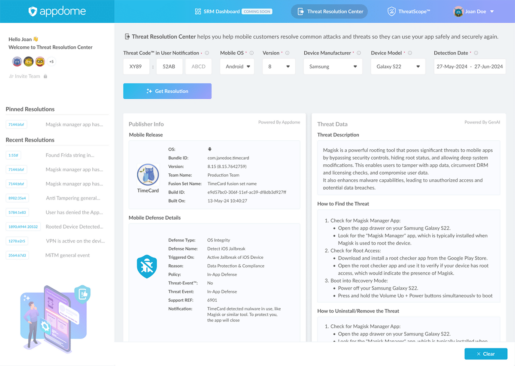
Appdome’s Threat Resolution Center is built to address this imbalance by offering a holistic view of the attack chain. As Appdome’s CEO explains, the first step in resolving a mobile threat is understanding it. Generative AI (GenAI) provides detailed descriptions of malware, spyware, or other malicious entities on Android or iOS devices, shedding light on their behavior, infection methods, and potential impacts.
The second step is finding the threat. GenAI offers tailored, step-by-step instructions for identifying malicious entities, such as checking for unusual app permissions or scanning for hidden files. This makes the process accessible even to those with limited technical knowledge.
Finally, resolving the threat involves removing or disabling it without resorting to resetting the device. GenAI excels at giving clear, customized instructions for threat removal, ensuring effective and straightforward remediation based on the device’s specific characteristics.
Appdome’s Threat Resolution Center (TRC) provides organizations with full visibility into mobile threats and attacks against their apps. By embedding telemetry within the app, TRC captures and analyzes all threat data, giving a complete picture of the mobile attack chain. This comprehensive visibility allows organizations to understand and respond to millions of potential threats effectively.
TRC automates the threat resolution process, swiftly handling detected threats with consistent and effective responses, minimizing attackers’ opportunities. When users are alerted to a threat, the app generates a unique “ThreatCode,” which the support team uses to produce detailed, specific instructions for threat removal. This system enhances communication and ensures prompt resolution.
Moreover, TRC facilitates enhanced collaboration among security teams through shared insights and tools, fostering a unified approach to threat management. By providing contextual threat intelligence tailored to the organization’s mobile app environment, TRC delivers actionable insights specific to the app’s infrastructure, user behavior patterns, and known vulnerabilities, ensuring that security measures are relevant and effective.
Leveraging RAG-based Generative AI in Threat Resolution
A key innovation within TRC is its integration of Retrieval-Augmented Generation (RAG) based Generative AI. RAG-based Generative AI enhances TRC’s capability to resolve mobile threats by combining the strengths of traditional search-based retrieval with the power of generative models. Here’s how RAG-based Generative AI elevates TRC:
- Enhanced Threat Analysis: RAG-based Generative AI leverages extensive threat data and contextual information to generate detailed and accurate analyses of detected threats. By retrieving relevant data from vast databases and combining it with generative models, TRC can provide nuanced insights into the nature of threats and their potential impact.
- Automated and Accurate Response Recommendations: The generative capabilities of RAG-based AI allow TRC to produce highly specific and actionable response recommendations tailored to each unique threat scenario. Instead of relying solely on predefined response templates, TRC can generate customized instructions based on real-time threat data, ensuring that responses are precise and effective.
- Adaptive Learning and Improvement: RAG-based Generative AI continuously learns from new threat data and evolving attack patterns. This adaptive learning ensures that TRC’s response recommendations remain current and effective, even as attackers develop new tactics and techniques. The AI’s ability to update and refine its knowledge base in real-time enhances TRC’s resilience against emerging threats.
- Efficient Threat Communication: The integration of RAG-based Generative AI streamlines the communication process between users and support teams. By generating clear and concise instructions based on the ThreatCode provided by users, TRC ensures that support teams can quickly and accurately assist users in resolving threats. This efficiency reduces the time and effort required to address threats, improving overall user experience and security outcomes.
Real-World Impact
Consider an organization facing a sophisticated vishing (voice phishing) attack targeting mobile users. Without TRC, the security team might only discover the threat after significant damage has been done, struggling to piece together the attack chain and respond effectively. With TRC, enhanced by RAG-based Generative AI, the organization benefits from early detection, a clear understanding of the vishing attack’s progression, and automated tools to neutralize the threat before it escalates. This proactive stance not only mitigates immediate risks but also strengthens the organization’s overall security posture.
In another scenario, imagine a financial institution targeted by a low and slow credential stuffing attack. The attackers start by decompiling and disassembling the mobile app, conducting dynamic analysis using tools like Frida, Magisk, and ADB for reconnaissance. They use emulators to scale the attack, attempting to exploit vulnerabilities and gain unauthorized access to user accounts. Other solutions, such as Web Application Firewalls (WAFs), may only address part of the problem by blocking some credential stuffing attempts at the web layer. However, they often overlook the holistic threat landscape, leaving the mobile app itself vulnerable to other forms of attack.
With TRC, the institution gains a comprehensive view of the attack chain, from the initial reconnaissance to the scaled emulation-based attacks. Enhanced by RAG-based Generative AI, TRC’s real-time visibility and automated response mechanisms detect and mitigate the credential stuffing attempts across all layers, including the mobile app, network, and backend systems. By integrating threat intelligence and contextual insights, TRC ensures that the entire attack chain is addressed, leaving no room for attackers to exploit vulnerabilities.
Conclusion
In the battle against mobile threats, eliminating information asymmetry is crucial. Appdome’s Threat Resolution Center (TRC), powered GenAI, provides comprehensive visibility and automated responses to bridge the gap between attackers and defenders. By delivering real-time threat monitoring, tailored response recommendations, and enhanced collaboration tools, TRC empowers organizations to proactively manage and resolve mobile threats. This transformative approach ensures that organizations stay ahead of attackers, turning the reactive nature of traditional security into a proactive and intelligence-driven strategy. With TRC, your organization can confidently navigate the evolving threat landscape and strengthen its mobile security posture.
Eliminating Information Asymmetry in the Attack Chain With GenAI
Alan Bavosa.
*** This is a Security Bloggers Network syndicated blog from Appdome DevSec Blog | Secure Android & iOS App Better authored by Alan Bavosa. Read the original post at: https://www.appdome.com/dev-sec-blog/eliminating-information-asymmetry-in-the-attack-chain-with-genai/
