

A CRTL Review

A few months ago (August 18 to be precise),
@Rastamouse’s
Zero-Point Security released the course Red Team Ops II,
or RTO-2 for short:
RTO-2
is meant to be a follow-up to the
RTO
course, focusing on advanced OPSEC tactics, including
bypassing modern enterprise Windows endpoint controls.
This means that RTO-2 is an advanced course, and it’s
recommended to have taken and passed at least the RTO
exam to try this course and the associated certification.
By the time of this writing, RTO-2 is listed at £399.00
which includes lifetime access to the course contents
and an exam voucher. You can pay an extra (£425.00 in total)
for 40 hours of lab access, which is highly recommended.
In this post, I will give you an overview of the course
contents and will relate my experience on the exam that
gave me the title of Certified Red Team Lead.
Red Team Ops II
Early this year, I took and completed the RTO course
and associated
CRTO exam,
after which I gave a
talk
(in Spanish) on how to pass it.
RTO focused on how to perform Red Team operations
on a multi-forest AD environment using Cobalt Strike.
OPSEC (Operations Security) notes and tips are given
throughout the course but the main focus is not that.
RTO-2 was born to compliment RTO on the OPSEC realm.
Currently, the RTO-2 course is divided into seven chapters:
- C2 Infrastructure
- Windows APIs
- Process Injection
- Defense Evasion
- Attack Surface Reduction
- Windows Defender Application Control
- EDR Evasion
The chapter C2 Infrastructure presents a way to have
a versatile, resilient and secure C2 architecture,
including the use of redirectors, custom Apache
redirect rules to avoid detection of the C2 infrastructure,
SSL certificates for Beacon and strategies for
beaconing failover. This is very useful for real
engagements on mature corporate environments and, thus,
something a Red Team operator should be aware of.
The chapters Windows APIs and Process Injection
are both heavily focused on offensive tooling
development. First, there’s an overview of commonly
used Windows APIs used for offensive purposes,
how to call those functions from C++
and how to make use of unmanaged APIs from managed
languages like C# and VBA by the use of P/Invoke
and D/Invoke. Then, in the Process Injection
chapter, those capabilities are used to inject code into
processes using a wide range of techniques, from
injecting arbitrary code into the current process
to injecting code into a remote process or using
undocumented functions on ntdll.dll to create
a new executable section on a running process and
inject the shellcode in it, and even creating a new
suspended benign process, queuing an Asynchronous Procedure
Call with the desired shellcode and dispatching it on a
new thread. They are a couple of fun chapters.
The chapter Defense Evasion explains capabilities
used for endpoint controls to detect anomalous
behavior and the way to bypass them. Cobalt Strike
provides some interesting OPSEC features out of the box,
like PPID spoofing, command line spoofing, avoiding
RWX sections, at-rest Beacon memory encryption
and thread stack spoofing. There is also mention
of what is and how to bypass Event Tracing for
Windows (ETW), which is a Windows mechanism that
is used to give EDRs feedback on events dispatched
from user-mode, without the need of API hooking.
The next chapter describes Attack Surface Reduction,
which is composed of a set of rules that can be enforced
by a GPO to prevent common techniques used
by attackers. The rules include blocking API calls from
Office macros, creating child processes from Office
applications, blocking processes originating from
PSExec and WMI, and blocking credential stealing from
the LSASS process (which is a complement to mitigations
like PPL and Credential Guard). Those rules can be
used together, providing a defense-in-depth protection.
However, they are based mainly on blacklists
and the chapter describes ways to bypass some of them.
Then comes the chapter Windows Defender Application Control
or WDAC, which is about the protection
that allows for the specification of what applications
can be run on a machine, based on things like its path,
digital signature and file hash. As this is a
security boundary,
WDAC bypasses are actually fixed by Microsoft.
However, misconfigurations can allow an attacker to
circumvent the control to gain further access to the
machine. So, this chapter teaches us a way to find common
scenarios which can be abused.
And finally, the chapter EDR evasion provides
an overview of how modern EDRs work and some
bypasses, including API unhooking, indirect
syscalls and unregistering kernel callbacks. A
fun chapter that even includes kernel-mode
exploits to bypass EDR controls.
As you can see, the course contents is very technical.
By the way,
there are a lot less videos than on the RTO
course, as a certain level of prior knowledge is assumed
to pass it through. However, it is an absolutely
valuable material, given the fact that you have
lifetime access to the course and related
updates to its contents.
Lab
The RTO-2 course comes with a companion lab
in Cyber Ranges (formerly Snaplabs) that can be accessed for up to 40 hours.
In the lab, you can practice everything
that’s presented in the written material. It’s composed
of several machines with different configurations:
- 2 Attacking machines
- 2 Redirectors
- 1 DC
- 1 CA
- 3 Workstations
Exam
After I was enrolled in RTO-2, it took me about three
weeks to complete the material twice (yes, twice) because
there were a lot of new concepts for me to digest.
The course fee includes an exam attempt. You can schedule it
on the platform anytime after you start the course, where
you can pick a start day and hour.
For example, I scheduled the exam to start on November 21 at
9 a.m.
For the exam, you are given 72 hours or
five days (whatever happens first) to obtain four
flags on a given set of machines in an AD environment.
Unlike CRTO (in which you need 6 out of 8 flags to pass),
you must collect all the flags to pass this exam.
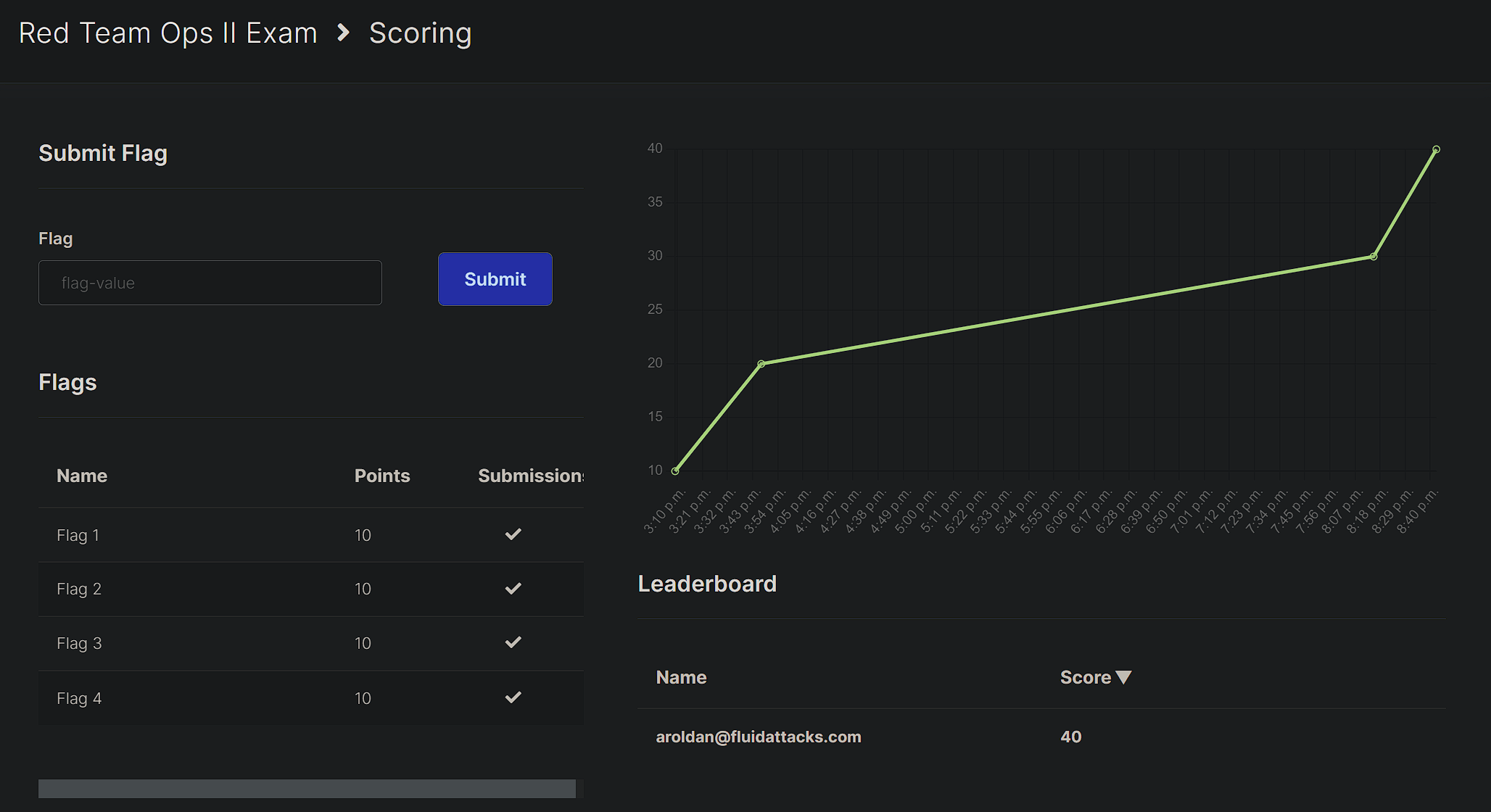
You must enter the flags in a scoring system
provided with the exam which checks the value and
gives the points. You don’t need to write a report, just
enter the flags. In the end, it took me around
11 hours to complete the exam:

However, as the exam is designed to last five days, you must
wait until the fifth day to get the certification.
Exam tips
Here are some of the things that helped me to complete
the exam:
- Follow the indications given on the course and practice
them in the lab. Just reading will not give you the
required skills to complete the exam (at least it didn’t for me). - Bear in mind there are things that are not covered in the
course material. You need to be comfortable using
tools like Visual Studio Community, not only for
compiling tools but also for debugging them. - Practice C# development. If you understand
how a C# assembly works, that’s also a plus. - Although RTO-2 is based on defense evasion and
advanced OPSEC tactics, you must be comfortable with
things like AD enumeration, pivoting, lateral movement,
user impersonation, Kerberos attacks, etc., and
have experience using Cobalt Strike. The RTO course
will give you that. - Technically speaking, you are not strictly required
to use Cobalt Strike for everything in the exam, but you
must know how to use other tools that may fulfill
the same needs. - There are some exercises proposed in the course. I
suggest to complete them as that would give you
confidence when dealing with unexpected requirements
during the exam. - Last but not least, enumeration and reconnaissance
are key to knowing what kind of beast you are
dealing with.
Exam results
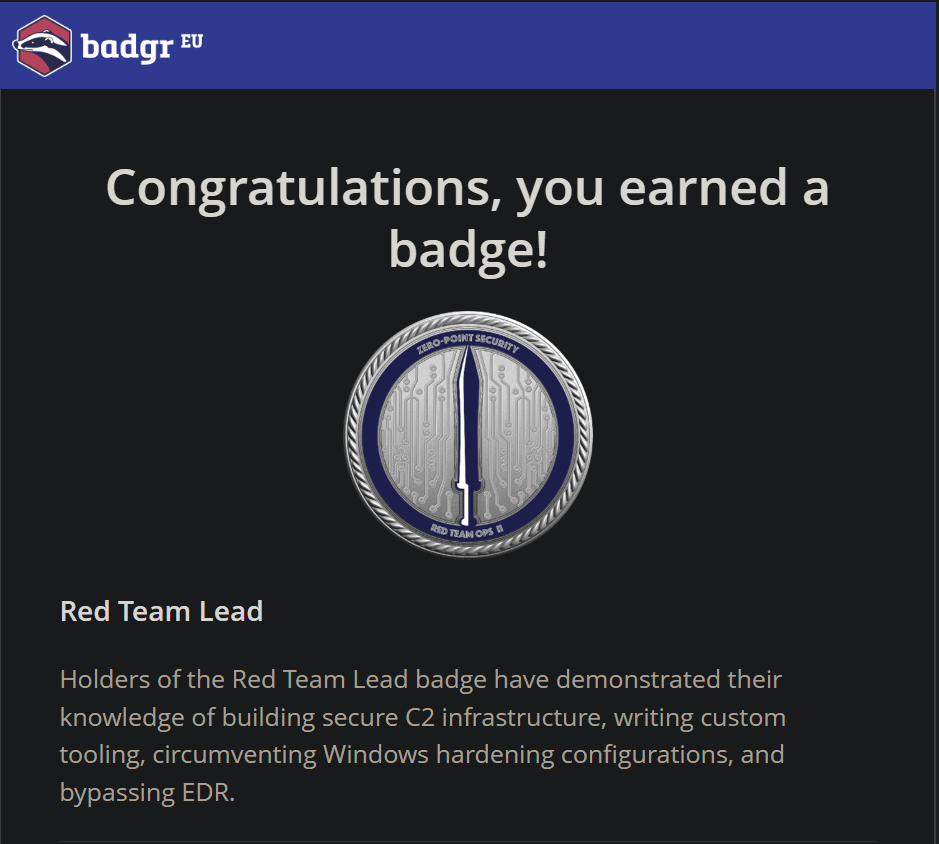
After the five days of the exam time passed, I received
and email with the certification:
Comparison
I’ve taken several certifications to date related to
Red Teaming, including eCPTXv2, CRTE, CRTP, CRTO,
PNPT and OSCP. Most of them are focused on exploiting
misconfigurations and vulnerabilities, some of them in
realistic AD environments. As RTO-2 is heavily focused
on defense evasion, the certifications that come closer
to it are eCPTXv2 and CRTE, the former includes some
of the contents found in RTO-2 like evasions on ETW,
EDRs and things like syscall unhooking and stealth
Office macros.
Attack Surface Reduction and
Windows Defender Appplication Control are the chapters
that were new to me.
Conclusions
Red Team Ops II is a very nice course dealing with modern
controls on mature enterprise infrastructures. It will
also prepare you to win in engagements with restricted
environments.
The exam is fun (s/fun/HARD AS HELL/g), but I think that the
72 hours/five days given are enough to go through all the stages:
from rage, sadness and stress to, finally, joy.
*** This is a Security Bloggers Network syndicated blog from Fluid Attacks RSS Feed authored by Andres Roldan. Read the original post at: https://fluidattacks.com/blog/crtl-review/
