

Sunday, June 14, 2026

Security Boulevard Logo

Security Boulevard

The Home of the Security Bloggers Network

Community Chats Webinars Library
  • Home
    • Cybersecurity News
    • Features
    • Industry Spotlight
    • News Releases
  • Security Creators Network
    • Latest Posts
    • Syndicate Your Blog
    • Write for Security Boulevard
  • Webinars
    • Upcoming Webinars
    • Calendar View
    • On-Demand Webinars
  • Events
    • Upcoming Events
    • On-Demand Events
  • Sponsored Content
  • Chat
    • Security Boulevard Chat
    • Marketing InSecurity Podcast
    • Techstrong.tv Podcast
    • TechstrongTV - Twitch
  • Library
  • Related Sites
    • Techstrong Group
    • Cloud Native Now
    • DevOps.com
    • Security Boulevard
    • Techstrong Research
    • Techstrong TV
    • Techstrong.tv Podcast
    • Techstrong.tv - Twitch
    • Devops Chat
    • DevOps Dozen
    • DevOps TV
  • Media Kit
  • About
    • Sponsor

  • Analytics
  • AppSec
  • CISO
  • Cloud
  • DevOps
  • GRC
  • Identity
  • Incident Response
  • IoT / ICS
  • Threats / Breaches
  • More
    • Blockchain / Digital Currencies
    • Careers
    • Cyberlaw
    • Mobile
    • Social Engineering
  • Humor
Analytics & Intelligence Security Bloggers Network 

Home » Cybersecurity » Analytics & Intelligence » Modern Threat Detection: Making Impossible Travel Possible

SBN

Modern Threat Detection: Making Impossible Travel Possible

by Emile Antone on February 16, 2022

This blog was co-authored by Obsidian Senior Security Researcher Jody Forness and Machine Learning Engineer Marcus McCurdy.

The security industry can be rife with vendors who tout the advanced machine learning and artificial intelligence capabilities behind their model-based detections. This can make it difficult for customers to discern whether or not these capabilities actually play a major role in the solution—or if they’re really just a small piece. At Obsidian, our security researchers and detection engineers work continuously to develop new models, improve our existing ones, and enable our customers to stay ahead of account compromise threats. Creating accurate, high-fidelity models is at the core of Obsidian’s threat detection solution. Specifically, the Obsidian impossible travel model has played an integral role in identifying malicious activity amidst the noise in SaaS environments. 

The impossible travel model represents years of research and development into SaaS architecture and user behavior—there were many iterations, thousands of false positives, and plenty of blood, sweat, and tears. In this article, we’ll shine some light on the development of the Obsidian cross-service impossible travel model and share a recent story where this detection helped one of our customers identify and promptly mitigate a particularly tricky Microsoft compromise in real-time.

Creating Obsidian’s Impossible Travel Model

The concept of “impossible travel,” the detection of two geographically disparate events from a single account, is a great idea whose execution is an absolute nightmare. SaaS environments are riddled with VPNs, weird server configurations, and mobile connections that bounce around. Even Microsoft’s impossible travel detection is triggered mistakenly by activity originating from Microsoft’s own infrastructure!

A successful impossible travel model should do more than just calculate the speed and distance between two different data points—it requires broad historical data from each service across the organization and targeted historical data for each user. This historical data enables the model to create clusters around geographic locations that are typical for individual users and the wider organization: home connections, favorite coffee shops, and office locations, for example.

But what exactly does a “common” location look like when the structure, geographic distribution, and data access patterns vary so wildly across different organizations? Some businesses are geographically disparate with massive presences in specific regions and proportionally smaller presences all over the world. This challenged our team to determine which regions should be clusters and which are just noise. Another common issue we encountered was dealing with users with very limited historical data which wouldn’t serve as a sufficient baseline. The key was pre-qualifying users based on their history in an application: is there enough historical data for this user to create meaningful clusters of activity?

It was important to our team that impossible travel detections were high-fidelity and fired off with as few false positives as possible in order to combat the alert fatigue that has long plagued security teams across the board. This meant being selective about the data we ingested and potentially excluding things like traffic from whitelisted VPNs, traffic that didn’t meet activity thresholds, and clusters that weren’t “dense” enough. After all, our team was looking to eliminate as much noise as possible while still flagging malicious activity. (It’s why at Obsidian, the title of “Machine Learning Engineer” means you’re one of the smartest people I’ve met in my ten years as a security professional!)

In January 2022, we released a new iteration of the impossible travel model that utilized improved frequent location filtering. This was an improvement not only to the underlying model, but to the cross-service compromise detection which baselines user behavior in one SaaS platform in order to detect account takeovers in another. And, sure enough, we were able to identify this exact type of compromise in a customer environment in short order.

Case Study: Mitigating Compromise with Cross-Service Detection

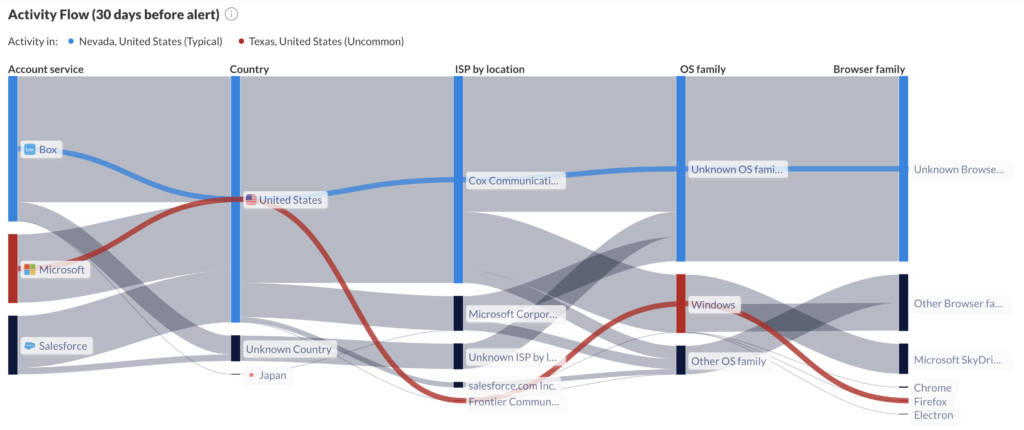
On January 12, 2022, Obsidian triggered a cross-service impossible travel alert in a customer environment which indicated that a user had logged in with a rare IP provided by Frontier Communications, also an unusual ISP for this user and organization. The user agent string came from Firefox, which was divergent from the user’s typical browser of Chrome or Safari.

The customer reached out after their initial investigation and we were able to confirm their suspicion that this was a malicious event. Because Obsidian had sufficient history of this user’s normal behavior in Box, we were able to look across services to identify the connections in Microsoft 365 as aberrant.

So what exactly did we detect? This was an account compromised through a by-the-book phishing attack. Details of the session stood out as immediately suspicious: different user agent strings and an atypical ISP. Activity was further confirmed as malicious when we identified the creation of several mail inbox rules designed to hide the attacker’s original phishing email. Then, we discovered something more sinister—a possible MFA bypass attack.
While the company believed they had multi-factor authentication enabled in Microsoft 365, the attacker was likely able to exploit a little-known basic authentication protocol known as BAV2ROPC which allowed them to use credentials to request an OAuth token. Microsoft issued an advisory about this and has recommended that basic authentication be disabled entirely. Obsidian was able to not only help our customer quickly understand the details and scope of the attack, but also identify the posture deficiencies which were exploited to make it possible.

Obsidian’s work is never done, and we’re working on an OAuth abuse model that would identify similar incidents across connected applications. Until then, a word of advice: stay vigilant and cover your SaaS.

The post Modern Threat Detection: Making Impossible Travel Possible appeared first on Obsidian Security.

*** This is a Security Bloggers Network syndicated blog from Obsidian Security authored by Emile Antone. Read the original post at: https://www.obsidiansecurity.com/blog/modern-threat-detection-impossible-travel/

February 16, 2022February 16, 2022 Emile Antone Account Compromise, Data Science & AI, impossible travel, machine learning, Microsoft 365 impossible travel, SaaS Security
  • ← The Trap Waiting in Line
  • Prioritizing Cybersecurity Throughout All Web Development Sprints →

Techstrong TV

Click full-screen to enable volume control
Watch latest episodes and shows

Tech Field Day Events

Upcoming Webinars

Agentic Software Delivery in 2026: How To Bridge The Gap Between AI Ambition and Delivery Confidence
The Cost of Exposure: Managing the Operational Risks of Executive Security Incidents
Untangling the EU Cyber Resilience Act
The Software Supply Chain Just Got Harder to See
Building a Resilient Security Culture in the AI Era with AWS & Datadog

Podcast

Listen to all of our podcasts

Secure by Design

2 weeks ago | Jack Poller

Senator Sanders Wants to Own AI Companies — and Hand America’s Adversaries the Keys

3 weeks ago | Jack Poller

NIST’s Nine: The PQC Signature Race Moves to Round Three

3 weeks ago | Jack Poller

The Quantum Arms Race: Why Washington Just Wrote a $2 Billion Check to Nine Companies

4 weeks ago | Jack Poller

Beyond Moore’s Law: The Hyper-Acceleration of Autonomous AI Cyber Capabilities

1 month ago | Jack Poller

The Exception Economy: When Security Teams Stop Protecting and Start Negotiating

Press Releases

GoPlus's Latest Report Highlights How Blockchain Communities Are Leveraging Critical API Security Data To Mitigate Web3 Threats

GoPlus’s Latest Report Highlights How Blockchain Communities Are Leveraging Critical API Security Data To Mitigate Web3 Threats

C2A Security’s EVSec Risk Management and Automation Platform Gains Traction in Automotive Industry as Companies Seek to Efficiently Meet Regulatory Requirements

C2A Security’s EVSec Risk Management and Automation Platform Gains Traction in Automotive Industry as Companies Seek to Efficiently Meet Regulatory Requirements

Zama Raises $73M in Series A Lead by Multicoin Capital and Protocol Labs to Commercialize Fully Homomorphic Encryption

Zama Raises $73M in Series A Lead by Multicoin Capital and Protocol Labs to Commercialize Fully Homomorphic Encryption

RSM US Deploys Stellar Cyber Open XDR Platform to Secure Clients

RSM US Deploys Stellar Cyber Open XDR Platform to Secure Clients

ThreatHunter.ai Halts Hundreds of Attacks in the past 48 hours: Combating Ransomware and Nation-State Cyber Threats Head-On

ThreatHunter.ai Halts Hundreds of Attacks in the past 48 hours: Combating Ransomware and Nation-State Cyber Threats Head-On

Subscribe to our Newsletters

Most Read on the Boulevard

Zscaler Launches Industry-First Zero Trust Security for Agentic AI
Anthropic’s Mythos Can Serve Up N-Day Exploits in Minutes or Hours
Linux Kernel Bug Caused by Single Character Opens Path to Root Access
ServiceNow Fixes Flaw That Could Lead to Unauthorized Access to Instances
HackerOne Unveils Agentic AI Platform to Discover and Validate Vulnerabilities Faster
Microsoft’s June 2026 Patch Tuesday Addresses 198 CVEs ( CVE-2026-49160, CVE-2026-50507)
ServiceNow Breach Explained: API Exposure, Risks & Security
Atomic Arch npm Campaign Adds Malicious Dependency
ServiceNow Discloses Security Incident Exposing Customer Data
Top 8 AI App Dev Platforms in 2026

Industry Spotlight

Anthropic Mythos AI Model Strikes Fear in Trump Administration, U.S. Banks
Cloud Security Cybersecurity Data Privacy Data Security Featured Incident Response Industry Spotlight Malware Mobile Security Network Security News Security Awareness Security Boulevard (Original) Social - Facebook Social - LinkedIn Social - X Spotlight Threats & Breaches Vulnerabilities 

Anthropic Mythos AI Model Strikes Fear in Trump Administration, U.S. Banks

April 12, 2026 Jeffrey Burt | Apr 12 Comments Off on Anthropic Mythos AI Model Strikes Fear in Trump Administration, U.S. Banks
The Day the Security Music Died
AI and Machine Learning in Security Cybersecurity Featured Industry Spotlight Security Boulevard (Original) Social - Facebook Social - LinkedIn Social - X Spotlight 

The Day the Security Music Died

April 8, 2026 Alan Shimel | Apr 08 Comments Off on The Day the Security Music Died
The Lock, Not the Alarm: How Palo Alto’s Koi Acquisition Rewrites Endpoint Security
Featured Industry Spotlight Security Boulevard (Original) Social - Facebook Social - LinkedIn Social - X Spotlight Uncategorized 

The Lock, Not the Alarm: How Palo Alto’s Koi Acquisition Rewrites Endpoint Security

February 18, 2026 Jack Poller | Feb 18 Comments Off on The Lock, Not the Alarm: How Palo Alto’s Koi Acquisition Rewrites Endpoint Security

Top Stories

ServiceNow Fixes Flaw That Could Lead to Unauthorized Access to Instances
Cloud Security Cybersecurity Data Privacy Data Security Featured Identity & Access Incident Response Mobile Security Network Security News Security Awareness Security Boulevard (Original) Social - Facebook Social - LinkedIn Social - X Spotlight Vulnerabilities 

ServiceNow Fixes Flaw That Could Lead to Unauthorized Access to Instances

June 11, 2026 Jeffrey Burt | 2 days ago 0
Zscaler Launches Industry-First Zero Trust Security for Agentic AI
AI and ML in Security Cybersecurity Featured News Security Boulevard (Original) Social - Facebook Social - LinkedIn Social - X Spotlight Zero-Trust 

Zscaler Launches Industry-First Zero Trust Security for Agentic AI

June 10, 2026 Jon Swartz | 3 days ago 0
Anthropic’s Mythos Can Serve Up N-Day Exploits in Minutes or Hours
Cloud Security Cybersecurity Data Privacy Data Security Featured Incident Response Malware Mobile Security Network Security News Security Awareness Security Boulevard (Original) Social - Facebook Social - LinkedIn Social - X Spotlight Threat Intelligence Vulnerabilities 

Anthropic’s Mythos Can Serve Up N-Day Exploits in Minutes or Hours

June 9, 2026 Jeffrey Burt | 4 days ago 0

Security Humor

Randall Munroe’s XKCD 'Soniferous Aether'

Randall Munroe’s XKCD ‘Soniferous Aether’

Download Free eBook

[su_panel border="0px solid #ddd" radius="0" text_align="center" padding-top="0px" padding-bottom="0px"]
The State of Cloud Native Security 2020
[/su_panel]

Security Boulevard Logo White

DMCA

Join the Community

  • Add your blog to Security Creators Network
  • Write for Security Boulevard
  • Bloggers Meetup and Awards
  • Ask a Question
  • Email: [email protected]

Useful Links

  • About
  • Media Kit
  • Sponsor Info
  • Copyright
  • TOS
  • DMCA Compliance Statement
  • Privacy Policy

Related Sites

  • Techstrong Group
  • Cloud Native Now
  • DevOps.com
  • Digital CxO
  • Techstrong Research
  • Techstrong TV
  • Techstrong.tv Podcast
  • DevOps Chat
  • DevOps Dozen
  • DevOps TV
Powered by Techstrong Group
Copyright © 2026 Techstrong Group Inc. All rights reserved.
×

Insert/edit link

Enter the destination URL

Or link to existing content

    No search term specified. Showing recent items. Search or use up and down arrow keys to select an item.