

Tuesday, June 16, 2026

Security Boulevard Logo

Security Boulevard

The Home of the Security Bloggers Network

Community Chats Webinars Library
  • Home
    • Cybersecurity News
    • Features
    • Industry Spotlight
    • News Releases
  • Security Creators Network
    • Latest Posts
    • Syndicate Your Blog
    • Write for Security Boulevard
  • Webinars
    • Upcoming Webinars
    • Calendar View
    • On-Demand Webinars
  • Events
    • Upcoming Events
    • On-Demand Events
  • Sponsored Content
  • Chat
    • Security Boulevard Chat
    • Marketing InSecurity Podcast
    • Techstrong.tv Podcast
    • TechstrongTV - Twitch
  • Library
  • Related Sites
    • Techstrong Group
    • Cloud Native Now
    • DevOps.com
    • Security Boulevard
    • Techstrong Research
    • Techstrong TV
    • Techstrong.tv Podcast
    • Techstrong.tv - Twitch
    • Devops Chat
    • DevOps Dozen
    • DevOps TV
  • Media Kit
  • About
    • Sponsor

  • Analytics
  • AppSec
  • CISO
  • Cloud
  • DevOps
  • GRC
  • Identity
  • Incident Response
  • IoT / ICS
  • Threats / Breaches
  • More
    • Blockchain / Digital Currencies
    • Careers
    • Cyberlaw
    • Mobile
    • Social Engineering
  • Humor
CISO Suite Governance, Risk & Compliance Security Bloggers Network 

Home » Cybersecurity » CISO Suite » Why fraudsters pretend to have better credentials than they actually do

SBN

Why fraudsters pretend to have better credentials than they actually do

by NuData on December 15, 2021

The average login credential attack now has a nearly one in 10 chance of succeeding — a fivefold increase from just one year ago. But how do fraudsters do it and why does it matter? Our latest case study has all the details.

The jump in successful login credential attacks poses a growing threat to organizations’ ability to guard their users’ accounts. But it also raises the question: Are bad actors actually using better credentials at login or are they just getting better at pretending? By identifying how bad actors are sneaking past your defenses, you’ll be better prepared to mitigate future attacks.

What is the risk posed by credential success rates?

The majority of our clients’ login threats are credential stuffing attacks — when a bad actor inputs pairs of stolen usernames and passwords in an attempt to compromise user accounts. But most of the stolen credentials fraudsters use are outdated or inaccurate. This means they have to test countless credentials just to get a single hit, with a traditional correct credential rate between 0.5% and 2%.

But don’t let seemingly low rates of correct credentials fool you. A single automated attack could easily input millions of credentials, resulting in thousands of correct hits that lead to compromised accounts.

As you can imagine, the outcome worsens as the percentage of correct login credentials increases. And the percentage of successful credentials used in attacks appears to be rising quickly, with some success rates averaging even higher than 10%. In fact, we recently identified an attack that appeared to have a 40% correct credential rate.

We knew this didn’t necessarily mean the attacker used a high-quality dataset. They were likely just pretending to have lots of accurate username-and-password pairings.

Before we get to how they did it, let’s talk about the why.

Remember, it’s a big deal if the average credential success rate of an attack reaches even 2%. To compare, a legitimate user only occasionally mistypes their passwords, giving them a 70-90% success rate. This is why many companies protect their login pages with simple rules that flag login attempts with a low proportion of successful logins as potential fraudsters. It’s the security equivalent of a “you must be this tall to ride” sign at a theme park.

Bad actors who pretend to have high credential success rates can sneak past security because they look like regular users – they look tall enough for the ride. But it’s not a flawless disguise. With the right tools to identify fraud at login, spotting credential-rate fakers is as easy as spotting two kids in a trenchcoat trying to sneak into Space Mountain.

How fraudsters artificially raised the credential success rate to 40%

Yes, it happened. We saw (and mitigated) a large attack with a 40% credential success rate. Call us suspicious, but we quickly guessed this was an attempt to bypass the basic security rules based on the login success rate we just talked about. So we considered other ways the attacker could have reached this 40% number.

The signs pointed to an attack that didn’t start at login, but at account creation instead. This is one of the first steps fraudsters take to fake high-quality credentials: They create a lot of new accounts that they control. In the case study, we’ll take a deeper dive into the rest of the process, which we’ve laid out below.
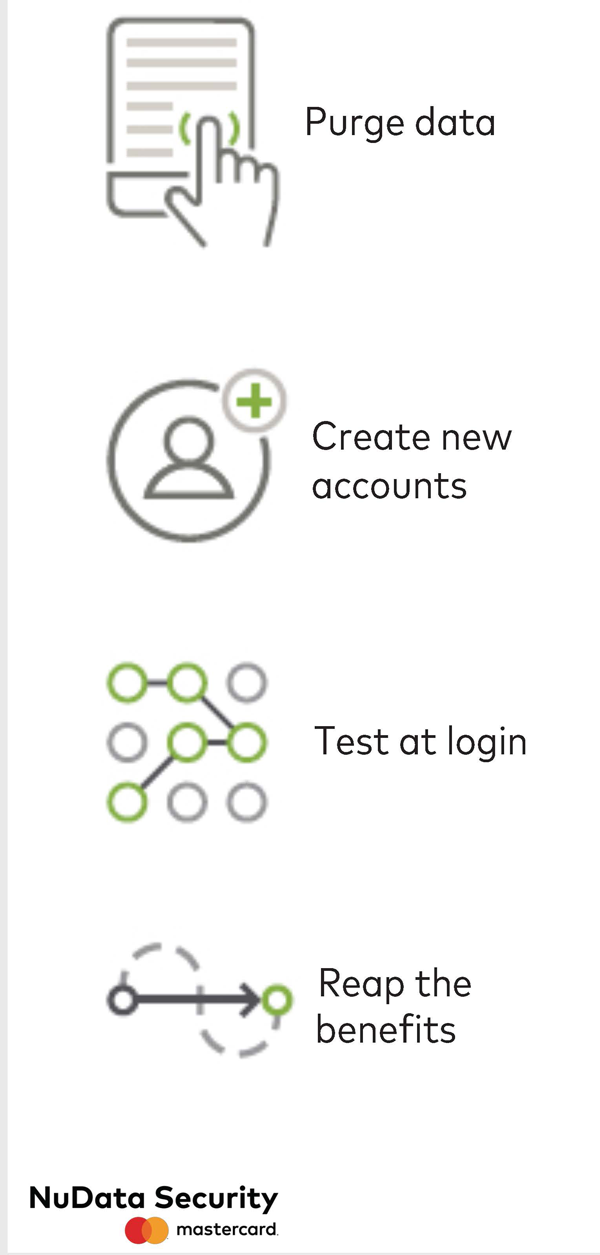
Purge data, Create new accounts, Test at login, Reap the benefits

Mitigating credential stuffing with behavioral biometrics

The case study shows how the client used NuData’s behavioral biometrics technology to flag and mitigate tens of thousands of login attempts by analyzing inherent user behavior (e.g., typing cadence or the location of their device) paired with other analytics.

With the increase in attacks with correct credential, it’s important for companies to understand how they evolve to try o bypass common security tools.

Check out the full story on our case study:

Credential Stuffing Attack Mitigation

The post Why fraudsters pretend to have better credentials than they actually do appeared first on NuData Security.

*** This is a Security Bloggers Network syndicated blog from NuData Security authored by NuData. Read the original post at: https://nudatasecurity.com/resources/blog/why-fraudsters-pretend-to-have-better-credentials-than-they-actually-do/

December 15, 2021December 15, 2021 NuData account takeover, Blog, bot detection, credential stuffing, Resources, risk management
  • ← The Incydr Architecture Then, Now, & Next: Our New Data Storage Fabric
  • EDR vs. MDR Services: Which is Right for You? →

Techstrong TV

Click full-screen to enable volume control
Watch latest episodes and shows

Tech Field Day Events

Upcoming Webinars

Agentic Software Delivery in 2026: How To Bridge The Gap Between AI Ambition and Delivery Confidence
Untangling the EU Cyber Resilience Act
The Software Supply Chain Just Got Harder to See
Building a Resilient Security Culture in the AI Era with AWS & Datadog
Toxic Flows: When Your Agent Skill Becomes a Supply Chain Attack

Podcast

Listen to all of our podcasts

Secure by Design

2 weeks ago | Jack Poller

Senator Sanders Wants to Own AI Companies — and Hand America’s Adversaries the Keys

3 weeks ago | Jack Poller

NIST’s Nine: The PQC Signature Race Moves to Round Three

3 weeks ago | Jack Poller

The Quantum Arms Race: Why Washington Just Wrote a $2 Billion Check to Nine Companies

4 weeks ago | Jack Poller

Beyond Moore’s Law: The Hyper-Acceleration of Autonomous AI Cyber Capabilities

1 month ago | Jack Poller

The Exception Economy: When Security Teams Stop Protecting and Start Negotiating

Press Releases

GoPlus's Latest Report Highlights How Blockchain Communities Are Leveraging Critical API Security Data To Mitigate Web3 Threats

GoPlus’s Latest Report Highlights How Blockchain Communities Are Leveraging Critical API Security Data To Mitigate Web3 Threats

C2A Security’s EVSec Risk Management and Automation Platform Gains Traction in Automotive Industry as Companies Seek to Efficiently Meet Regulatory Requirements

C2A Security’s EVSec Risk Management and Automation Platform Gains Traction in Automotive Industry as Companies Seek to Efficiently Meet Regulatory Requirements

Zama Raises $73M in Series A Lead by Multicoin Capital and Protocol Labs to Commercialize Fully Homomorphic Encryption

Zama Raises $73M in Series A Lead by Multicoin Capital and Protocol Labs to Commercialize Fully Homomorphic Encryption

RSM US Deploys Stellar Cyber Open XDR Platform to Secure Clients

RSM US Deploys Stellar Cyber Open XDR Platform to Secure Clients

ThreatHunter.ai Halts Hundreds of Attacks in the past 48 hours: Combating Ransomware and Nation-State Cyber Threats Head-On

ThreatHunter.ai Halts Hundreds of Attacks in the past 48 hours: Combating Ransomware and Nation-State Cyber Threats Head-On

Subscribe to our Newsletters

Most Read on the Boulevard

Oracle Issues Emergency Guidance as PeopleSoft Flaw Linked to Widespread Data Theft
Futurum Group Report Sees Cybersecurity Spending Reaching $521.7B by 2031
Google Sues Chinese Threat Group Using Gemini AI in Phishing Scams
Ten Great Cybersecurity Job Opportunities
Perry Machine and the Case of the Privileged Prompt – Courts Consider Whether AI Legal Advice is Privileged
Top 8 AI App Dev Platforms in 2026
CISA BOD 26-04: Frequently asked questions about the new risk-based patching directive
Top 8 AI App Security Software in 2026
Shai-Hulud Campaign Evolution: Miasma, Hades, and AI Scanner Evasion
Iranian Cyber Group Handala Claims Cal Water Hack

Industry Spotlight

Anthropic Mythos AI Model Strikes Fear in Trump Administration, U.S. Banks
Cloud Security Cybersecurity Data Privacy Data Security Featured Incident Response Industry Spotlight Malware Mobile Security Network Security News Security Awareness Security Boulevard (Original) Social - Facebook Social - LinkedIn Social - X Spotlight Threats & Breaches Vulnerabilities 

Anthropic Mythos AI Model Strikes Fear in Trump Administration, U.S. Banks

April 12, 2026 Jeffrey Burt | Apr 12 Comments Off on Anthropic Mythos AI Model Strikes Fear in Trump Administration, U.S. Banks
The Day the Security Music Died
AI and Machine Learning in Security Cybersecurity Featured Industry Spotlight Security Boulevard (Original) Social - Facebook Social - LinkedIn Social - X Spotlight 

The Day the Security Music Died

April 8, 2026 Alan Shimel | Apr 08 Comments Off on The Day the Security Music Died
The Lock, Not the Alarm: How Palo Alto’s Koi Acquisition Rewrites Endpoint Security
Featured Industry Spotlight Security Boulevard (Original) Social - Facebook Social - LinkedIn Social - X Spotlight Uncategorized 

The Lock, Not the Alarm: How Palo Alto’s Koi Acquisition Rewrites Endpoint Security

February 18, 2026 Jack Poller | Feb 18 Comments Off on The Lock, Not the Alarm: How Palo Alto’s Koi Acquisition Rewrites Endpoint Security

Top Stories

SailPoint Acquires Entro to Continuously Detect and Monitor Non-Human Identities
AI and Machine Learning in Security AI and ML in Security Cybersecurity Featured News Security Boulevard (Original) Social - Facebook Social - LinkedIn Social - X Spotlight 

SailPoint Acquires Entro to Continuously Detect and Monitor Non-Human Identities

June 16, 2026 Michael Vizard | 8 hours ago 0
Google Sues Chinese Threat Group Using Gemini AI in Phishing Scams
Cloud Security Cybersecurity Data Privacy Data Security Endpoint Featured Identity & Access Mobile Security Network Security News Security Boulevard (Original) Social - Facebook Social - LinkedIn Social - X Spotlight Threat Intelligence Threats & Breaches 

Google Sues Chinese Threat Group Using Gemini AI in Phishing Scams

June 14, 2026 Jeffrey Burt | Yesterday 0
ServiceNow Fixes Flaw That Could Lead to Unauthorized Access to Instances
Cloud Security Cybersecurity Data Privacy Data Security Featured Identity & Access Incident Response Mobile Security Network Security News Security Awareness Security Boulevard (Original) Social - Facebook Social - LinkedIn Social - X Spotlight Vulnerabilities 

ServiceNow Fixes Flaw That Could Lead to Unauthorized Access to Instances

June 11, 2026 Jeffrey Burt | Jun 11 0

Security Humor

Randall Munroe’s XKCD 'Soniferous Aether'

Randall Munroe’s XKCD ‘Soniferous Aether’

Download Free eBook

[su_panel border="0px solid #ddd" radius="0" text_align="center" padding-top="0px" padding-bottom="0px"]
The State of Cloud Native Security 2020
[/su_panel]

Security Boulevard Logo White

DMCA

Join the Community

  • Add your blog to Security Creators Network
  • Write for Security Boulevard
  • Bloggers Meetup and Awards
  • Ask a Question
  • Email: [email protected]

Useful Links

  • About
  • Media Kit
  • Sponsor Info
  • Copyright
  • TOS
  • DMCA Compliance Statement
  • Privacy Policy

Related Sites

  • Techstrong Group
  • Cloud Native Now
  • DevOps.com
  • Digital CxO
  • Techstrong Research
  • Techstrong TV
  • Techstrong.tv Podcast
  • DevOps Chat
  • DevOps Dozen
  • DevOps TV
Powered by Techstrong Group
Copyright © 2026 Techstrong Group Inc. All rights reserved.
×

Insert/edit link

Enter the destination URL

Or link to existing content

    No search term specified. Showing recent items. Search or use up and down arrow keys to select an item.