

A New Red Team Expert

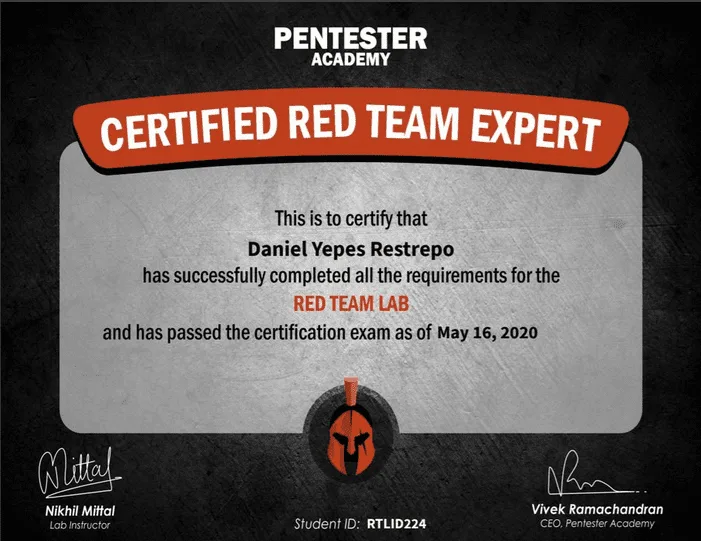
Figure 1. Certificate
Daniel Yepes is a Computer Engineer who has been working at Fluid Attacks
as Security Analyst for over two years. A few days ago,
he was certified as a Red Team Expert from
Pentester Academy.
This is a site founded in 2011
by Vivek Ramachandran that “furthers the careers
of [cybersecurity] professionals worldwide with in-depth training,
attack-defense products and informative content that address the
ever-evolving landscape of online threats.”
Daniel completed the Advanced Red Team
Lab, the second in
difficulty out of three labs. These labs are offered at Pentester
Academy at different prices ($299-699) depending on the access
period’s length. Well, he didn’t actually perform the lab, but the
Certification Exam associated with that lab; we’d better let him tell us
about his experience.
- I decided to take the Red Team Expert exam without taking the Red
Team Professional one (the first on the list). You don’t have to do
them in order. I wanted to be adventurous and beat my brains out,
and I did. I had already taken this exam in October last year, but I
failed. At that time, I paid for three months’ access to the lab
(which I didn’t do because of personal matters) before the test;
this last time, I only paid for the test. 48 hours are allowed
to take the exam and another 48 hours to prepare the report. I
ended up using all the time for the former, and almost 24 hours
for the latter.
- So, I just took the exam that comes with the lab. When you do the
lab, you have to perform the stated objectives. There are around
60 flags you have to find there; these constitute proof that you
reached each target. The lab is necessary for one not to feel
overburdened in the exam and end up taking it several times. What I
did was ask questions and do research. I asked people who had
already accomplished it to give me some tips. However, it’s much
better to do the lab and know what you’ll be dealing with, unless
you already have a lot of experience.
Before we continue with Daniel, let’s summarize something shared about
the Advanced Red Team Lab on the Pentester Academy
website. In short, this
lab is focused on threats and attacks to network infrastructure managed
with Windows Active Directory. The exercises constitute simulation of
real attack-defense events. The user is asked to achieve an enterprise
admin of multiple forests position just starting with a non-admin user
account, exploiting software vulnerabilities and overlooked domain
features. The user faces some challenges in this lab, among which are
the following: “active directory enumeration, local and forest privilege
escalation, network pivoting, application whitelisting bypass, active
user simulation, Kerberos delegation issues, SQL Servers, [and]forest trusts.”

Figure 2. Advanced Red Team Lab (image taken
from pentesteracademy.com)
Why did you decide to get this “Certified Red Team Expert” (CRTE)
certificate?
- I decided to get this certificate because I found the subject very
interesting to reinforce/learn new techniques for different
projects. In some of them there were environments with Active
Directory. This is a centralized system to manage objects, such as
users, machines, permissions, etc. In that ecosystem, you can find
things like antivirus,EDRs, monitoring systems, databases, file
servers, among others. The intention in such projects is to reach a
target without being detected. In the process are presented some
valuable techniques/tools to avoid security controls, to perform a
lateral movement, privilege escalation, and persistence by abusing
the misconfiguration of some services. It also helps to reinforce
the idea that obtaining Domain Admin is not the primary objective
but part of the way to achieve a final goal.
- I had already obtained the
OSCP(Offensive
Security Certified Professional) certificate. The most notable
difference between theOSCPand theCRTEcertifications is the
focus. TheOSCPis very much based on the exploitation of services
from public vulnerabilities. TheCRTE, including theCRTP
(Certified Red Team Professional), is more focused on understanding
in depth some components of an active directory and identifying and
abusing the misconfigurations that are present there.
What is the knowledge you believe is required to obtain this
certificate?
- The knowledge I think someone should have before doing the lab is
the following: some basics on how to approach this type of
environment, knowing how to enumerate it with the different tools
available, and a notion of some of the components and services that
can be found. Furthermore, and as one of the most necessary
knowledge is to have at least the basic ability to program in
PowerShell.
What kind of tasks do you have to complete in this Red Team Lab
exam?
- Well, I don’t intend to talk about specific tasks, because that
would literally be telling people what to study and what to expect.
The most basic or essential tasks would be the following:
Enumerate. This is to do recon; that is, recognizing which
users/machines/services are present.Privilege escalation. This is moving from having a user without
administrative privileges to having a user who does have them. It
can also be to obtain those privileges for the same user.Lateral movement. This refers to the techniques used to move
progressively on a network. In other words, it is looking for how to
move from one machine to another or others to obtain more
information to reach the goal.
Which were the most difficult challenges? Any time did you feel at
your wits’ end?
- The hardest part was getting almost halfway through the exam and not
knowing what the hell else to do. One important thing to achieve
here isRCE(Remote Command Execution). In vague terms,RCEis
as if from your machine, you could execute system commands on
another machine to which you have access. On the other hand, you
have to make an excellent report, with precise argumentation. But,
in the end, it’s an experience for the person taking the exam, and
what is tough for me can be easy for someone else.
What would you recommend to those who want to get this
certification?
- You should start by learning how to deal with active directory and
Windows environments. You must learn how to do recon and evade
antivirus, either for running a binary or a script on PowerShell.
Also, you should learn about abusing services to achieve lateral
movement or escalation of privileges. You must immerse yourself in
this world, not forgetting that Google is your best friend.
- So, do a lot of research, reading, and testing. Besides, if you can,
go to the lab, or make a home lab, there are very good guidelines.
That’s something perfect to understand concepts, abuse services, and
try to mitigate attacks. It’s very time-consuming, but you can do it
bit by bit. I think it is great to have that conception in mind, how
to attack and defend. That way, you gain more mastery of the
subject, and you can have a more general view of what can be
presented, either in the exam or in a particular project.
Do you have any certification in mind as the next one to get?
We are grateful to Daniel for sharing this information with us, and
again we congratulate him on his new achievement.
It is an honor to have accomplished experts like him on our red team.
We hope to bring you more interviews with them in the future,
as well as information related to certifications in pentesting.
By the way, we
constantly publish content on attacks. So, if you are interested in
learning how to perform some techniques, don’t hesitate to subscribe to
our blog.
*** This is a Security Bloggers Network syndicated blog from Fluid Attacks RSS Feed authored by Felipe Ruiz. Read the original post at: https://fluidattacks.com/blog/new-red-team-expert/
