

Breaking Down DevOps

DevOps is a predominant phenomenon,
a new way of thinking
and working in software engineering
that is receiving a lot of attention nowadays.
The word DevOps is a combination
of the words ‘Development’ and ‘Operations.’
In 2016,
Jabbari et al.
stated that
for this concept
there was no concrete or complete definition.
That’s why they decided to do a review
and collect, analyze and compare definitions
from scientific papers
to consolidate one.
In their research,
49 primary studies were meeting their requirements.
They identified in those studies
“the central components of DevOps definition.”
That’s something we’ll review in this post,
to improve our understanding of that concept.
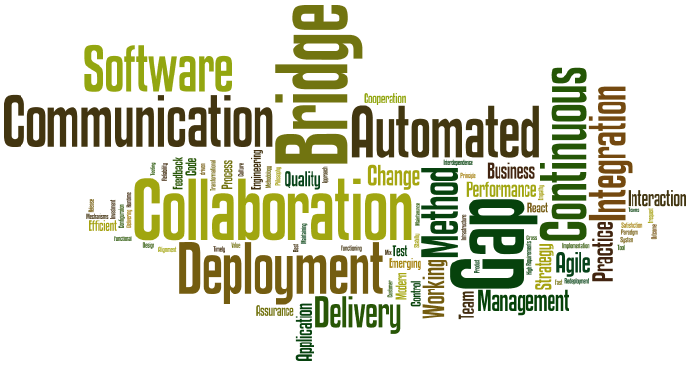
Word-cloud with the common terms
used for definitions of DevOps
in the studies analyzed,
excluding ‘Development’ and ‘Operations’
—taken from Jabbari et al. (2016).
Components of DevOps definition
As a first component (C1),
Jabbari and colleagues
show us the already mentioned combination of terms
‘Development’ (Dev) and ‘Operations’ (Ops).
The second component (C2) comprehends communication,
collaboration and teamwork
between developers and operators.
In the third component (C3),
we can see “the main goal of DevOps,”
which is to bridge the gap between Dev and Ops teams.
From the fourth component (C4),
it is assumed that
DevOps is a modern software development method
that unifies other methods and tools.
The fifth component (C5) is where DevOps is seen
as a paradigm of software delivery
with continuous feedback,
fast response to modifications
and automated delivery pipelines.
The sixth component (C6) shows the automatic “deployment process
from the source code in version control
to the production environment.”
The seventh component (C7) is related to ‘continuous integration.’
Finally,
the eight component (C8) is where DevOps is taken as a method
where quality assurance is essential
for improving performance.
With those components identified,
Jabbari et al.
give us the following definition of DevOps:
DevOps is a development methodology (C4)
aimed at bringing the gap (C3)
between Development and Operations (C1),
emphasizing communication and collaboration (C2),
continuous integration (C7),
quality assurance (C8) and delivery (C5)
with automated deployment (C6)
utilizing a set of development practices.
Now,
with this definition as a guide,
we can easily delve into different issues about DevOps
and always know
what component or part of this methodology
we are referring to.
Exploring a bit of DevOps
So,
for instance,
let’s expand what is said in C1, C2 and C3.
As our CTO,
Rafael Alvarez,
explains in one of his conferences,
there are typically two teams in companies
where software is created and sold
as a product or as a service.
A team of developers and a team of operators.
In short,
the first team,
with its programming knowledge,
creates the app.
The second team,
which manages the hardware and operating systems,
is in charge of deployment
(making the app available for customer use)
and service.
Rafael explains that
the development team is often asked
to change the software quickly.
In contrast,
the operations team is asked
to ensure that the infrastructure remains stable
and changes slowly.
Therefore,
the parties tend to struggle with “political noise,”
slowing down the overall process.
Here is where DevOps methodology comes into play,
bringing those two teams together.
As Rafael mentions,
people are no longer grouped by task or function
but by product (or service),
and we then have cross-functional teams.

Image taken from quickmeme.com.
Now,
focused on C4
(not the explosive),
we have that DevOps is related to some software development methods:
Waterfall,
Agile, and Lean.
Let’s extend the information about this,
mostly from what Freddy Yumba
shares.
Waterfall is a traditional linear plan-driven approach
to software development.
So,
it is assumed that
all requirements can be specified
before starting the development process.
Each phase must end before moving on to the next.
Results in detailed documents must be signed,
and these are measures of progress.
In this model,
the integration of later changes
may mean redesigning the entire system.
So,
it is said that
it doesn’t accommodate well to modifications requested by users
and that it doesn’t give rise to creativity.
Instead,
Agile focuses more on collaboration “between development teams,
business people and customer,”
and on creativity
and rapid response to user needs.
Through this methodology,
earlier and more frequent releases are sought.
Besides,
communication of the development plan is preferred
through face-to-face conversations,
rather than through documentation
as in Waterfall.
Finally,
Lean,
according to Yumba,
is more oriented towards improving production system operations,
project management
and the delivery of products and services.
Some people see Lean as a way
to bring agility from the project level
to the organization level.
In the Lean methodology,
there’s an essential aim:
the elimination of waste,
anything that doesn’t add value to the development process.
Therefore,
unnecessary meetings,
documentation and tasks are discarded
as much as possible.
DevOps arises by mixing Agile and Lean principles and practices,
but it’s more than that.
As the author
says:
DevOps is “a new culture,
corporate philosophy,
and way of working.”
It is a result of the experiences of many people
and the desire to create
and maintain organizations with high-speed,
high-performance processes
and exceptional IT products and services.
Well,
talking about more components,
continuous integration (C7) is one of the drivers
of the DevOps culture.
We know that
development practice can be made from different machines and locations.
With continuous integration,
we mean that
the resulting code is integrated into a shared repository
over and over again during the day,
even every day.
This is something different
from what we were used to,
years ago,
when integration was quite late.
Additionally,
as part of DevOps methodology,
an automated build verifies each check-in,
which serves to detect bugs and other problems quickly (C8),
without waiting for full code integration
and the deployment of the entire system.
Then we have continuous,
automated and fast delivery (C5),
with software always ready for the production environment,
to be released to users whenever required.
In DevOps,
there’s increased responsiveness
to customer requirements and needs.
With a continuous deployment (C6),
companies in the web domain,
as is commented by Lwakatare and colleagues,
have “the opportunity to quickly verify
whether their new software features are useful to customers
and [can adopt] practices such as A/B testing.”
In this,
“users are randomly assigned
to one of the two variants of the system
for experimentation.”
Quick feedback becomes quite useful
to evaluate the quality of the software
and continuously repair or improve
what is needed in the development process.
Today,
many companies offer software as a service (SaaS) on the web.
“Resource virtualization and cloud computing
have provided the required building blocks”
(Spinellis, 2016).
DevOps proves to be quite useful
for those companies with SaaS,
since from this methodology,
extensive control of the infrastructure is achieved,
and the software can be quickly restructured and re-released
if there are some problems.
What happens if we implement the term “security” in this context?
We get the much mentioned DevSecOps.
And what does that term mean?
We break down the concept
and mention some of its basics here.
*** This is a Security Bloggers Network syndicated blog from Fluid Attacks RSS Feed authored by Felipe Ruiz. Read the original post at: https://fluidattacks.com/blog/devops-concept/
