The Infinite Monkey Fuzzer

In our last entry, we argued that fuzzing is
both dumb and surprising.
In this article,
we’ll continue exploring the possibilities of fuzzing.
This time though, we’ll focus on
desktop application fuzzing,
specifically UNIX applications written in C.
When developing in C, you usually have to handle memory issues
yourself. This makes your program very fast compared to languages like
Java. But at the same time this can lead to numerous kinds of
memory-access errors v.g. heap and stack
overflows.[1]
The woes of fuzzing
Recall that in our last article we ran a very simple-minded kind of
fuzzing: give the fuzzer a list of inputs and it will invoke the program
with each of those inputs one at a time. Since the list was very
generic, only the most trivial inputs were successful; because it was
not random at all, there could be no surprises.
Another type of fuzzing could be by injecting random inputs: this could
lead nowhere, but it could show surprises, as we discussed in our last
entry. Some go as far as saying that Heartbleed could have been found
with
fuzzing.
But blind, random fuzzing is usually very shallow, as was our attempted
SQL injection fuzzing. Such methods are “very unlikely to reach
certain code paths in the tested code” Amongst the attempts at solving
this problem we can count:
-
corpus distillation
-
program flow analysis
-
symbolic execution, and
-
static analysis.
However, while these methods appear to be very promising, they tend to
be impractical in real use.[2]
Down the Rabbit-Hole
American Fuzzy Lop (AFL) is a
‘security-oriented brute-force fuzzer’ that tries to solve these issues
with ‘compile-time instrumentation’ and ‘genetic algorithms’. But what
the heck does all that mean?
A different approach would be to make your fuzzer aware of the file
format taken by the tested program as input, but this is rather
inconvenient. Instead, what AFL does is, in plain words:
-
take the source code of your app,
-
compile it in a “tricked” way,
-
run it with a good input and then
-
iteratively modifying that input until you get an error.
For example, you might start AFL on a program with an image of a
rabbit as input. Then the fuzzer modifies the image a little piece at a
time, feeding it back to the tested program until a hang or crash or
other unexpected behavior happens. Here you can see the sequence of
images fed into the tested program:
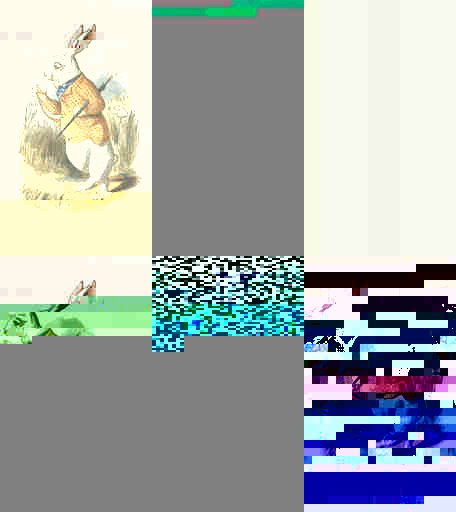
Figure 1. Fuzzed AFL logo.
Via Wikimedia
Running AFL
The American Fuzzy Lop is primarily a white-box testing tool, so you
must have the code for the app you want to test. This is because AFL
needs to trick the app during compilation in a process known as
‘instrumentation’ so that it will allow the fuzzing process. Thus you
must compile using the included afl-gcc, which is a modified version
of the GNU Compiler Collection.
Then you should run your program with a valid, simple input: program input. If that goes well, put that input file in a folder by itself.
I’ll call it in. Make another empty one for the results called
out. I’m assuming everything lives in the folder you are in right now.
Now you’re ready to run AFL:
Invoking the AFL fuzzer.
afl-fuzz -i in -o out program input @@
If everything went right, then you should see this:
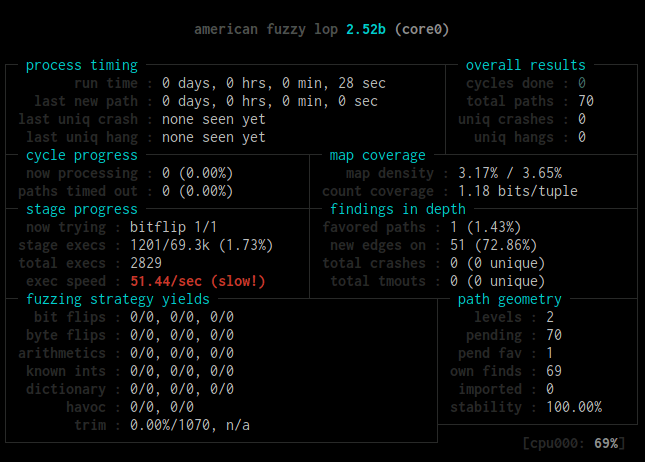
Figure 2. AFL main interface
Not very exciting, huh? But as long as the total paths indicator is
not stuck at 1, trust me, it’s doing its thing. AFL will continue
running until you tell it to stop by hitting <Ctrl-C>.
When last uniq crash or last uniq hang stops saying `none seen yet'', you have made your program crash. `AFL will save the inputs that provoked the crash in the output
folder we specified.
Fuzzing libpng – details
libpng is the official PNG reference library. If you’ve ever seen an
image in a web browser, you’ve been using it indirectly. It is used by
ghostscript, imagemagick, amongst many others.
As listed in its website, it
has had many bugs throughout its history. We’re interested in showing
here how to find
CVE-2015-8126
which is a potential pointer overflow/underflow, using American Fuzzy Lop (which is how they found it in the first place).
As it turns out, it’s not just a matter of following the generic
instructions above, because if you do:
-
the fuzzer will tell you that the execution speed is slow
-
a single instance of
afl-fuzzon a single core will take a long
time -
it won’t find anything anyway, because you need to patch
libpng -
you need the right executable using
libpng, namelyoptipng
So, let’s fix all these issues in the right order. Here the credit is
due to Jakub
Wilk who
originally reported the bug.
-
Apply this
patch
topngrutil.ctolibpng-1.5.1 -
You need to instrument
libpngandoptipng-0.7.5using
afl-clanginstead of the defaultafl-gcc. Also installlibpng
withmake clean allso it doesn’t conflict with your local
installation (which you most certainly have):CC="afl-clang" CXX="afl-clang``" ./configure --disable-shared make clean all CC="afl-clang" CXX="afl-clang``" ./configure -without-system-libpng make install -
To use all
ncores available to you, creatensubdirectories in
your output folder. Runafl-fuzzas before with the option-M folder1for the first core, and-S folderxfor the rest. Example
with two cores:$ afl-fuzz -i in -o out -M core0 program input @@ $ afl-fuzz -i in -o out -S core1 program input @@ -
Use a small
PNGfile as input, such asnot_kitty.pngincluded in
AFL. -
You can further speed up the process by
`cheating'' using a previously produced set of fuzzed images available here. Put these images in your `outfolder.
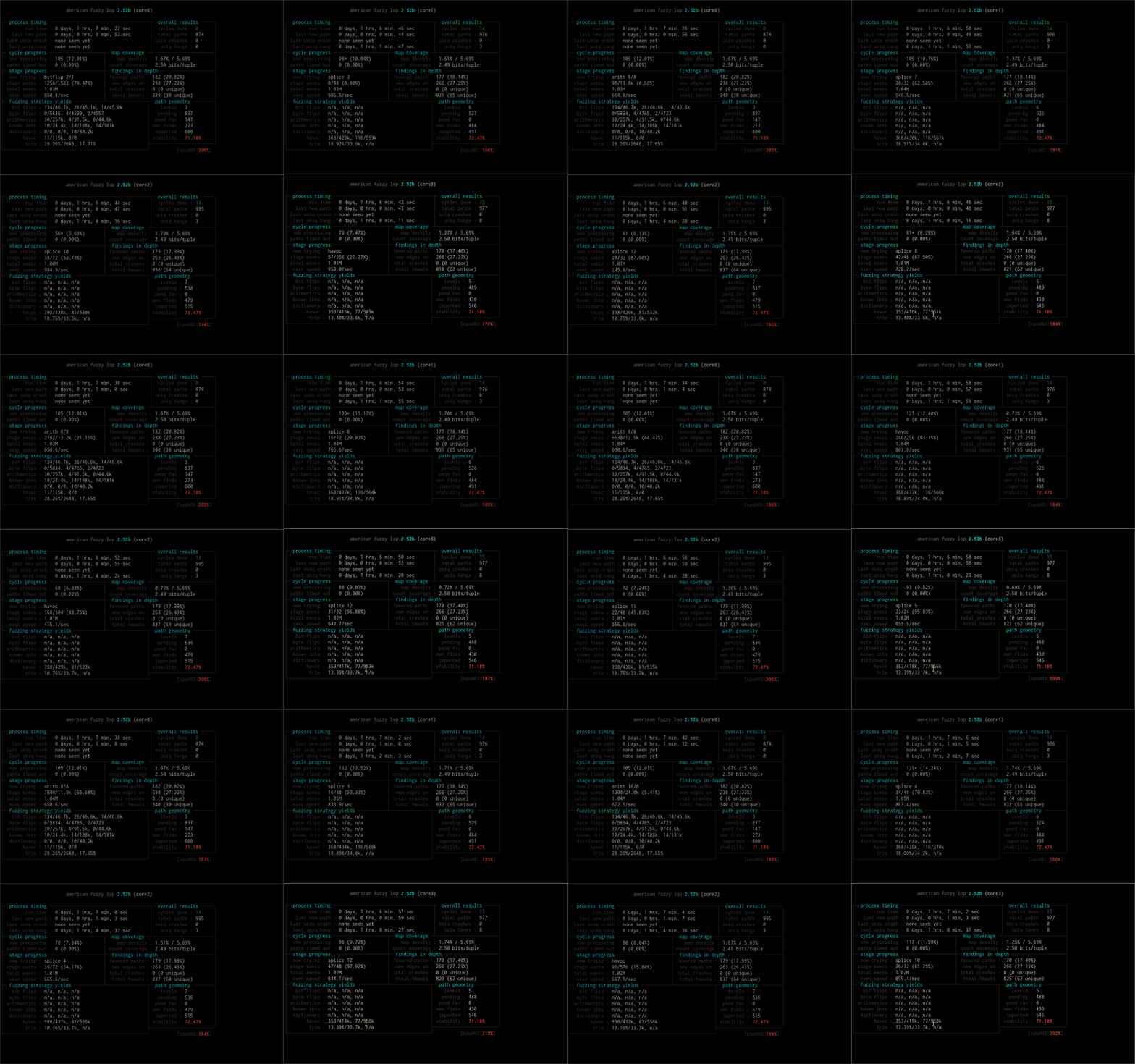
Following the steps above, here is the optimised afl-fuzz running on
libpng and optipng with 4 cores:

Figure 3. AFL succesful run
(click
to view larger)
We see that, within a few minutes, the slave processes have made the app
hang, but not the master. The reason falls out of the scope of the
article, though; see AFL performance
tips.
So what’s the bug?
OK, we made the application hang. So what? It’s not up to me to explain
it, but I will quote the essentials from the pros for the sake of
completeness.
Back then, if you called optipng with this
file
you’d crash it:
    $ optipng crash.png
    ** Processing: crash.png
    Warning: Can't read the input file or unexpected end of file
    24x32 pixels, 1 bit/pixel, 4 colors in palette, interlaced
    optipng: opngreduc.c:697: opng_reduce_palette_bits:
    Assertion `src_bit_depth == dest_bit_depth' failed.
    Aborted
The problem happens when an application uses low-bit-depth palette
mapped PNG data because when returning the palette it has to be copied
back to the OS-specific format in a potentially vulnerable way:
    for (i=0; i<num_palette; ++i) {
        bmh.palette[i][0] = tmp_palette[i].red;
        bmh.palette[i][1] = tmp_palette[i].green;
        bmh.palette[i][2] = tmp_palette[i].blue;
    }
And here’s the problem with that code:
`This is valid code according to the `PNG spec because
num_palette cannot be more than 16 in a valid PNG. Unfortunately in
libpng before the fix num_palette can be up to 256 with an
appropriately modified PNG. The overwrite above is at the high address
end of bmh, so it overwrites up the stack (on a typical machine) into
the call frame and pretty much gives an attacker complete control over
the application program.” [3]
This bug was actually found using AFL at the time on Debian Sid, as has
been the case for many other real-world C applications, even
high-profile ones like bash, the X server, curl, and the Linux kernel. See `AFL’s “bug-o-rama trophy
case”.
So there you have it: as promised, a more in-depth follow-up to our
initial invitation to fuzzing. According to
`AFL’s father, this technique is both very powerful and
underappreciated:
Fuzzing is one of the most powerful and proven strategies for
identifying security issues in real-world software; it is responsible
for the vast majority of remote code execution and privilege
escalation bugs found to date in security-critical
software.[2]— Michal Zalewski
Hopefully this article has helped to spark some curiosity and convince
you a little of that.
References
*** This is a Security Bloggers Network syndicated blog from Fluid Attacks RSS Feed authored by Rafael Ballestas. Read the original post at: https://fluidattacks.com/blog/infinite-monkey-fuzzer/