

Getting Started With Quantum Computing

“More often than not, the only reason we need experiments is that we’re not smart enough.” ― Scott Aaronson
IBM is currently offering free time on one of their quantum computers for interested researchers. Yup, you can program a real life quantum computer right now! In fact, I highly recommend signing up which you can do here. Go ahead and check it out. It took me about 24 hours to get my account approved so you can come back here afterwards to finish reading this post.
What got me interested in this opportunity was that while I have tried to keep up on the field of quantum computing, it basically is magic to me. I’ve been building up some general rules in my head about quantum systems, but any sort of question about them that did more than scratch the surface left me shrugging my shoulders. Also it was hard to separate fact from fiction.
Quantum Laws (in Matt’s head):
- Quantum is a system like everything else.
- A quantum state is a configuration of the system.
- A quantum state changes; it naturally wants to evolve, but it can always be undone.
- Evolution of a closed system is a unitary transformation on its Hilbert space.
- Only the Keeper can block quaffle shots thrown by the opposing team
- Do not feed your qubits after midnight
That’s why IBM’s offer interested me so much. Let’s be honest, there’s always going to be some magic when it comes to quantum systems, but the opportunity to actually get hands on time programming one would at least turn the whole experience into alchemy if not science for me.
Participating in IBM’s Quantum Experience:
After your account is approved you immediately have access to a research portal which IBM calls the “Quantum Experience”. It’s currently in Beta, but beyond a few bugs in the composer, (which I’ll talk about in a bit), it’s a very well polished site.
 |
| Are you ready to experience some quantums!? |
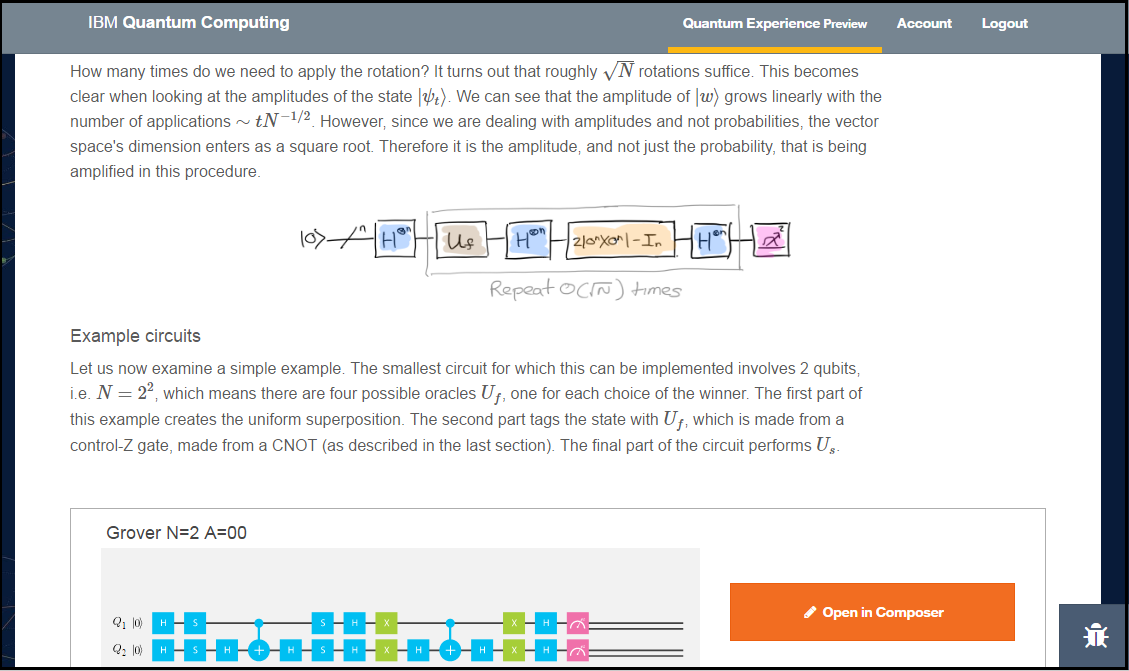
The portal is divided into three tabs, “User Guide”, “Composer”, and “My Scores”. The User Guide is fairly self explanatory but actually impressed me more than the quantum computer itself. I’m still making my way through it but the authors deserve a pat on the back since it’s some of the best technical writing I’ve seen in a while. What’s more, there are multiple links to the quantum simulator with examples for each section so you can read about a particular operation or theory and then run a simulation of it and check the results. You can then modify the example, re-run it, and in general play around with the concept before going back to where you were in the user’s guide.
 |
| Don’t worry, it starts out with simpler concepts. |
The Composer is the programming interface for the quantum computer. It is attached to a quantum simulator as well. In it, you write “Scores” which are basically circuits to run on the quantum computer. IBM calls them scores since with five qubits to work with it looks like sheet music. That’s also how the composer got its name.
 |
| An example score in the composer. Yes, this is the default example for Grover’s algorithm, but I renamed it since it’s all about how you frame the problem. |
You can simulate a given quantum score as much as you’d like. When doing so, (or creating a new score), you have the option of choosing an ideal or real layout. The difference is that there are physical limitations of the real quantum computer which directly impact how you design your score.
 |
| Red pill or blue pill? |
 |
| Qubit 2 is the gatekeeper |
That’s one of the neat things about using this service vs a standard quantum simulator. You can see some of the limitations that current implementations have to deal with. For example, Qubit 2 is the only qubit that can talk to other qubits, so if you want to perform operations like conditional NOTs, (CNOT), that has a huge impact.
Running it For Real:
 |
| I feel a bit guilty about not just running this once, but it’s the same price! |
 |
| Well I guess I wasn’t that original… |
 |
| Someone else is quantuming ahead of me |
 |
| Looks like the plain-text is ’00’. As I said, it’s all about framing the problem. |
Issues With the Composer:
Summary:
*** This is a Security Bloggers Network syndicated blog from Reusable Security authored by Matt Weir. Read the original post at: https://reusablesec.blogspot.com/2016/05/getting-started-with-quantum-computing.html
