

How to Implement Passwordless Authentication to Boost User Conversion

The post How to Implement Passwordless Authentication to Boost User Conversion appeared first on MojoAuth Blog – Passwordless Authentication & Identity Solutions.
Passwordless authentication is already widely deployed across modern applications. It’s the single most effective tool you have to kill the friction that’s currently choking your user journey.Passwords create friction in signup and login experiences.Passwordless authentication removes shared secrets from the authentication process.
Think about the last time you signed up for a service. You’re ready to buy, you’re excited to use the product, and then—bam. You’re hit with a password requirement. Needs 12 characters, a special symbol, a blood sacrifice, and a partridge in a pear tree. You forget it five minutes later, hit the "forgot password" loop, and suddenly, you’re done. You’re gone.
By replacing that archaic, memory-heavy chore with cryptographic proof, you stop bleeding customers at the exact moment they’re ready to engage. Don’t take my word for it, the Passwordless Conversion Impact Report 2026 makes it clear: the faster the entry, the higher the lifetime value. Speed isn't just a luxury; it’s a conversion multiplier.
The Business Case: Is Passwordless Just About Security?
If you think this is purely an IT security play, you’re missing the point. Sure, ditching shared secrets helps you avoid the nightmares documented in the IBM Cost of Data Breach Report, but the real win happens on your P&L.
Let’s talk about your help desk. How much time and money does your team waste on "I forgot my password" tickets? It’s a massive, soul-crushing tax on your support operations. Switching to biometric or device-bound authentication effectively nukes that ticket category. Your team can finally focus on actual problems instead of playing the role of digital locksmiths.
Then there’s the conversion math. Every single field you force a user to fill out is a potential exit ramp. When you stop demanding they create, verify, and store yet another password, the cognitive load plummets. Users aren’t balancing the value of your app against the headache of managing another account. You turn the login process from a barrier into a feature.
Password-Based vs Passwordless Authentication
|
Feature |
Password Authentication |
Passwordless Authentication |
|---|---|---|
|
Credential Type |
Shared secret |
Cryptographic key |
|
Phishing Risk |
High |
Very low |
|
Password Resets |
Frequent |
Rare |
|
User Experience |
Friction-heavy |
Fast and seamless |
|
Credential Theft Risk |
High |
Minimal |
Demystifying the Tech: What Are Passkeys and FIDO2?
Passkeys are passwordless authentication credentials based on public-key cryptography.
Passkeys replace passwords with a cryptographic key pair:
a private key stored on the user’s device
a public key stored on the server
During login, the device signs a cryptographic challenge to prove identity.
Passkeys are resistant to phishing because the private key never leaves the user’s device. We’re moving away from "shared secrets"—the old model where both you and the user hold a copy of a password. In the old world, if your database gets hacked, the keys to the kingdom are gone. In a passwordless world, the secret never actually leaves the user’s device.
It sounds like magic, but it’s just math. It uses FIDO2 and WebAuthn standards—basically a high-tech digital handshake.
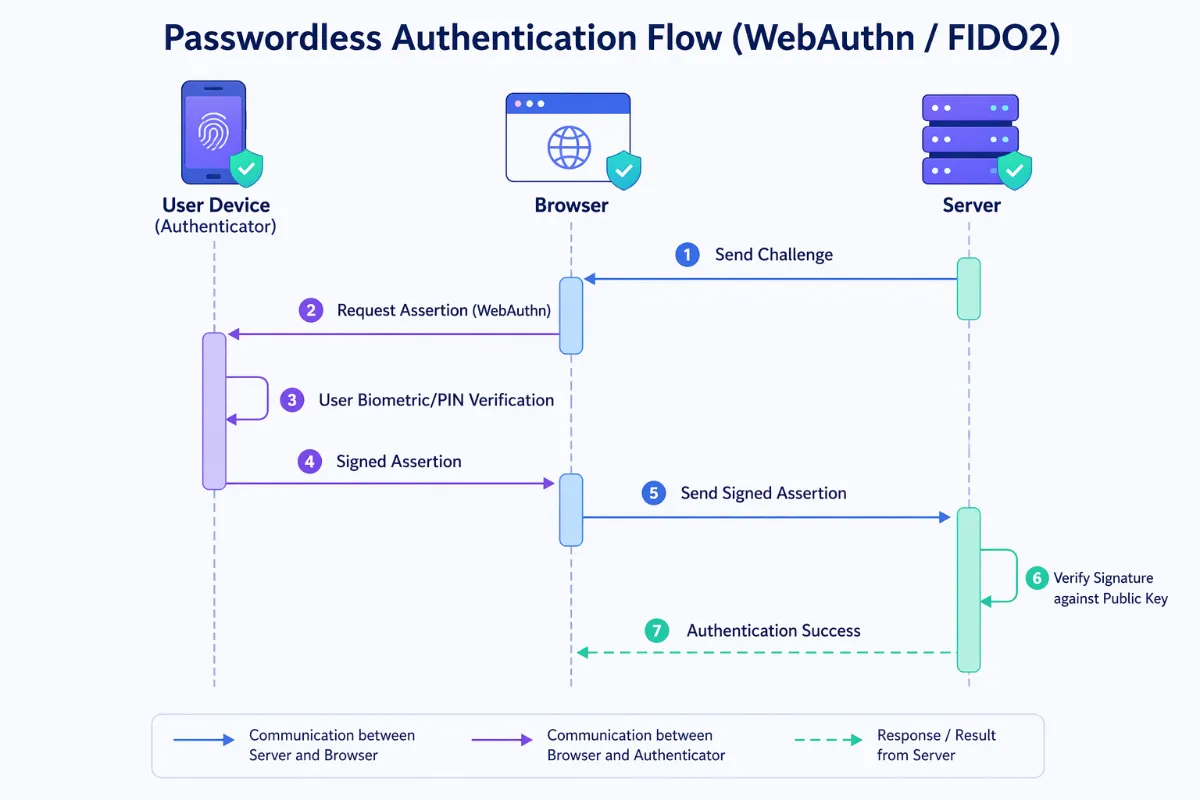
When a user signs up, their device creates a pair of keys: one public, one private. The private key stays locked in the device’s secure enclave, accessible only by a fingerprint or face scan. The public key goes to your server. When they come back, your server sends a "challenge," the device signs it, and your server checks the signature. No passwords. No phishing. No nonsense.
Learn more in our guide:
What are passkeys and how They Work
Benefits of Passwordless Authentication
Passwordless authentication improves both security and user experience.
Key benefits include:
-
Eliminating Password Reuse
-
Preventing Credential Phishing Attacks
-
Reducing Password Reset Support Tickets
-
Improving Login Conversion Rates
-
Simplifying Authentication Flows
Organizations adopting passwordless authentication often see measurable improvements in both security posture and customer experience.
How to Design a Frictionless Authentication Flow
Here is where most companies screw it up: they turn their login page into a science project.
If you want people to actually use this, keep it simple. It should feel like a native extension of the phone or laptop they already trust. Follow the best practices from the FIDO Alliance to keep your UI clean.
Avoid "the cliff." Don’t make the user choose between a password they know and some mysterious, scary biometric prompt. Use progressive disclosure. If they’re on a modern device, offer the passkey as the obvious, "recommended" path. Use human language: "Use FaceID to sign in" beats "Authenticate via WebAuthn assertion" every single time.
And for heaven’s sake, give them feedback. If a biometric scan fails, don’t just throw a cryptic error code. Offer a secondary way in—like a magic link—without making them refresh the page or restart the whole process.
The Migration Roadmap: Moving Millions Without Breaking Trust
Don't panic—you don't have to delete your password database overnight. You need a hybrid approach. This is a standard practice in modern CIAM architecture because it keeps the lights on for your legacy users while you transition.
Keep both methods running for a while. When a user logs in the old way, show a small, non-intrusive overlay: "Want to enable one-tap sign-in for next time?"
Once they click yes, you register their device. Over a few months, your password-reliant user base will shrink as your passkey base grows. This phased approach lets you catch bugs, refine your fallback protocols, and harden your security without ever locking a loyal user out of their account.
Is Passwordless Authentication NIST Compliant?
Yes. Passkey-based authentication satisfies phishing-resistant authentication requirements under NIST SP 800-63 guidelines.
Passkeys meet AAL2 authentication requirements because they:
-
resist phishing attacks
-
use cryptographic authentication
-
bind credentials to devices
This makes passkeys suitable for high-security authentication environments.
Staying Compliant: Meeting NIST SP 800-63-4 Standards
If you’re working with enterprise clients, compliance isn't optional. The NIST SP 800-63-4 guidelines are the gold standard now.
Passkeys hit the AAL2 (Authenticator Assurance Level 2) requirements for phishing resistance perfectly. Think about SMS-based MFA—it’s easy to intercept. FIDO2 passkeys are locked to your website’s origin. Even if a user visits a fake, malicious version of your site, the browser won’t provide the cryptographic signature because the domain doesn’t match. That level of security is exactly what enterprise procurement teams are looking for.
Passwordless Readiness Checklist: Is Your Stack Prepared?
Before you dive in, run a quick audit of your setup:
-
Browser Compatibility: Are you using the latest WebAuthn APIs? Most modern browsers are great, but make sure your frontend handles legacy browsers gracefully.
-
Database Compatibility: Can your schema store public keys? You’re moving away from salted hashes to storing public key associations. Make sure your backend team is ready for that shift.
-
Account Recovery: This is the big one. If someone loses their phone, how do they get back in? You need a rock-solid, identity-verified recovery flow—like a backup email or a secondary device—that doesn't just fall back to a weak, phishable password.
Overcoming the "Cold Start" Problem
The biggest hurdle is getting users to set up that first passkey. People are creatures of habit. They’ll keep typing that password until you give them a damn good reason to stop.
Stop talking about "cryptographic tokens" in your UI. Nobody cares. Sell the benefit. Frame the switch as a massive time-saver. Prompt them during high-intent moments, like right after they log in or finish a checkout. "Speed up your next checkout by 5 seconds with TouchID" is a value proposition that hits home.
When you frame the transition as a premium feature that makes their life easier, you stop being a tech company forcing an update and start being a product company providing a better experience.
Frequently Asked Questions
Will users find passwordless logins confusing?
Not at all. Users are already conditioned by the ubiquity of FaceID and TouchID on their mobile devices. The muscle memory for "glance to unlock" is already there. When you align your web authentication with the native biometric prompts users see every day, the conversion rate typically outperforms traditional password entry.
What happens if a user loses their device?
Device loss is a reality, which is why multi-device support is essential. Modern passkey providers allow users to sync their credentials across their ecosystem (e.g., iCloud or Google Password Manager). For edge cases, your recovery protocol should rely on verified secondary channels, such as hardware security keys or a pre-verified recovery email, ensuring that the user never loses access to their account.
Is passwordless authentication compatible with older browsers?
While FIDO2/WebAuthn is supported by all major modern browsers, you should implement a fallback strategy for edge cases. A "magic link" sent to the user's registered email address serves as a perfect, secure bridge for users on legacy systems who cannot utilize biometric passkeys.
How do I migrate my existing user database to passwordless?
The most effective strategy is the "Hybrid Login" transition. You keep your existing password database active but implement a prompt that triggers during a successful login. Once the user authenticates via their old password, you ask them to register their device as a passkey. Over time, your reliance on the password database wanes until you can eventually deprecate it entirely.
Does passwordless authentication increase or decrease security?
It significantly increases security. By shifting from shared secrets—which can be stolen, phished, or guessed—to cryptographic proof of possession, you effectively neutralize the primary attack vectors of the modern web: credential stuffing and phishing. When the key never leaves the user’s device, the server has nothing for an attacker to steal.
Final Thoughts
Passwords were designed for an earlier internet.
Modern applications require authentication systems that prioritize both security and usability.
Passwordless authentication replaces shared secrets with cryptographic identity verification.
By adopting passkeys and passwordless login flows, organizations can improve conversion rates while reducing credential-based attacks.
Passwordless authentication is not just a security upgrade.
It is a fundamental improvement to the user authentication experience.
*** This is a Security Bloggers Network syndicated blog from MojoAuth Blog - Passwordless Authentication & Identity Solutions authored by MojoAuth Blog - Passwordless Authentication & Identity Solutions. Read the original post at: https://mojoauth.com/blog/how-to-implement-passwordless-authentication-to-boost-user-conversion
