

Why “Platform Consolidation” Often Increases Risk Instead of Reducing It

One vendor. Many engines. The same security problems.
In boardrooms across the globe, a compelling narrative dominates enterprise security strategy: consolidate the security stack to reduce complexity, lower costs, and improve operational efficiency. Fewer vendors promise simpler management, cleaner procurement, and a stronger security posture through tighter integration.
On paper, the logic is difficult to challenge.
In practice, however, platform consolidation frequently increases risk rather than reducing it. The disconnect between marketing claims and architectural reality creates a dangerous blind spot-one that becomes most visible during real-world security incidents, when speed, context, and coordination matter most.This is not an argument against consolidation itself. Rather, it is an examination of how consolidation is commonly implemented, why vendor reduction alone fails to improve security, and what true architectural unification actually requires
The Acquisition-Driven Platform Economy
Over the last decade, the cybersecurity industry has undergone aggressive consolidation. Most major security platforms did not emerge from unified architectural design. They were assembled through serial acquisitions of point solutions across endpoint, network, cloud, identity, and analytics domains.
The acquisition model typically follows a familiar pattern:
- Identify a fast-growing or technically strong point solution
- Acquire the company and preserve its core engineering
- Rebrand the product as a “native platform module”
- Bundle it commercially under a single contract
- Promise deeper technical integration on future roadmaps
This strategy enables rapid portfolio expansion and competitive positioning. What it does not guarantee is architectural consistency.
The result is often a commercially unified platform built on technically fragmented foundations.
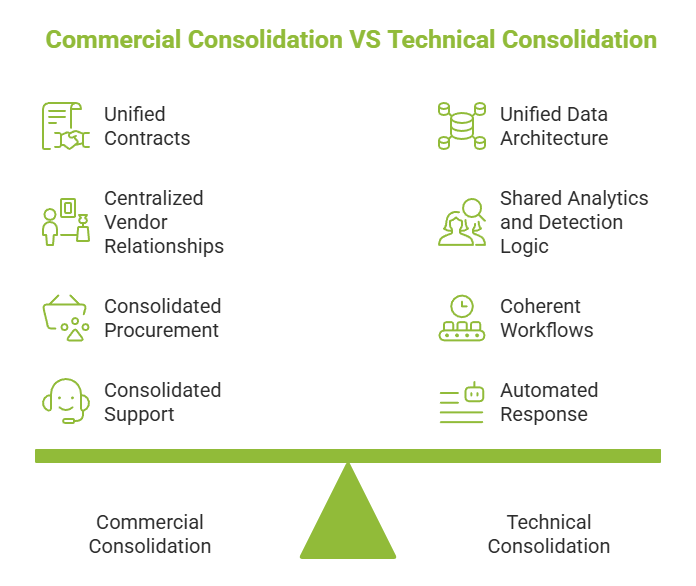
Commercial Consolidation vs. Technical Consolidation
This distinction is where many security strategies break down.
A commercial platform delivers:
- Unified contracts and pricing
- Centralized vendor relationships
- Consolidated procurement and support
A technical platform delivers:
- Unified data architecture
- Shared analytics and detection logic
- Coherent workflows across security domains
- Automated, coordinated response
Organizations need both. Too often, they receive only the former while assuming the latter.
In real deployments, “single-platform” customers frequently operate:
- Multiple management consoles with inconsistent user experiences
- Independent agents and collectors competing for system resources
- Separate data stores with incompatible schemas
- Multiple analytics engines requiring manual correlation
- Disconnected update, patching, and maintenance cycles
Vendor count decreases. Operational and investigative complexity does not.
The Hidden Complexity Beneath Consolidation
Fragmented Data Architectures
Data is the foundation of security operations. In a genuinely unified platform, telemetry from all sources flows into a single, normalized data plane.
In acquisition-driven platforms, the reality is different:
- Endpoint, network, cloud, and identity data are stored separately
- Schemas differ across products, even for identical fields
- Retention policies vary by component
- Cross-domain queries require APIs, exports, or manual correlation
This fragmentation makes holistic analysis difficult. Analysts cannot easily trace attacker behavior across domains, and automation lacks the full context needed for confident decisions.
Disparate Analytics and Detection Logic
Beyond data storage, analytics remain siloed:
- Different detection philosophies coexist without alignment
- Alerts use inconsistent severity and confidence models
- Threat intelligence is not uniformly shared
- Machine learning models are trained in isolation
The result is a platform that appears integrated, but behaves like multiple independent security products during detection and investigation.
Agent Proliferation and Infrastructure Overhead
Consolidation is often expected to reduce infrastructure footprint. In practice, organizations still deploy:
- Multiple endpoint agents for different functions
- Overlapping telemetry collection
- Complex compatibility testing across “native” components
Endpoints become more complex, not less-introducing performance risks and operational overhead that consolidation was meant to eliminate.
When Incidents Reveal Architectural Gaps
The true test of any security platform occurs during an incident.
In multi-stage attacks-such as ransomware or identity-based compromise-organizations expect consolidated platforms to provide:
- Early detection
- Cross-domain visibility
- Automated containment
Instead, they often encounter:
- Delayed correlation between endpoint, identity, and network signals
- Manual investigation across multiple interfaces
- Disconnected response actions
- Incomplete attack narratives
The systems may exchange data through APIs, but lack the deep architectural coupling required for real-time, coordinated defense.
Attackers exploit these seams precisely because they persist beneath consolidated branding.
The Lock-In Paradox
Consolidation is frequently positioned as a way to gain leverage. In reality, it often creates new dependencies.
Organizations face:
- Technical lock-in through proprietary data models and workflows
- Operational lock-in as teams build automation around vendor-specific logic
- Strategic lock-in as innovation becomes tied to vendor roadmaps
Ironically, integration flexibility often declines after consolidation. Open APIs and third-party interoperability receive less emphasis, reducing an organization’s ability to adopt new capabilities as threats evolve.
Security effectiveness begins to move at vendor speed, not attacker speed.
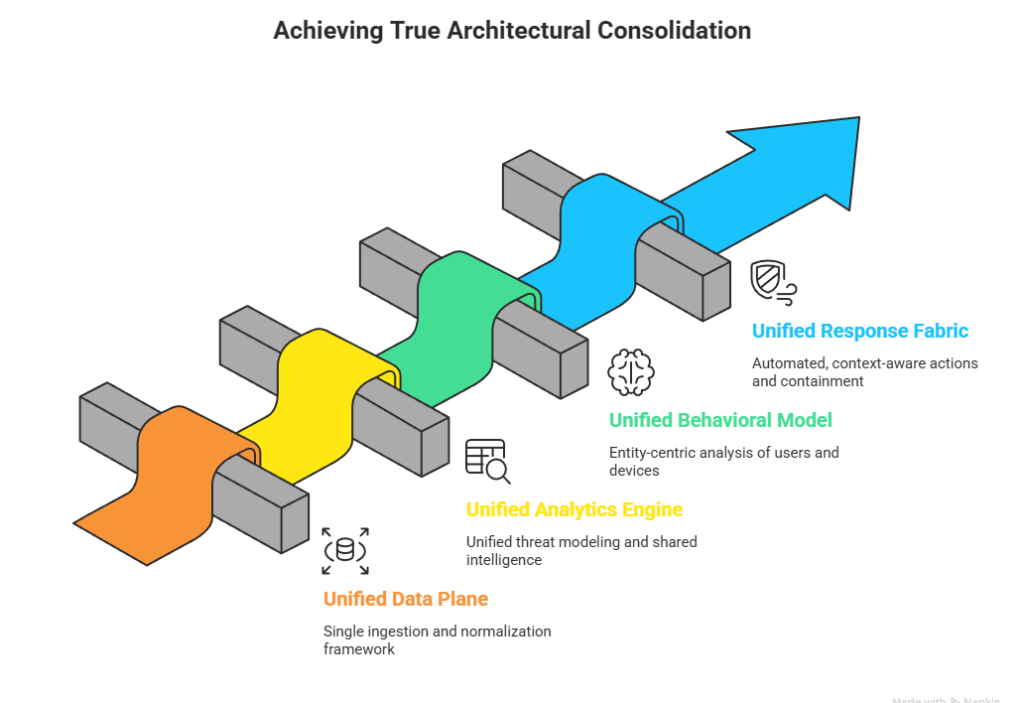
What True Architectural Consolidation Actually Requires
Real consolidation is not about reducing tool count. It is about unifying intelligence and action.
One Unified Data Plane
- Single ingestion and normalization framework
- Centralized storage across all domains
- Consistent query, access, and retention policies
One Analytics Engine
- Unified threat modeling
- Shared intelligence and scoring
- Cross-domain machine learning
One Behavioral Model
- Entity-centric analysis of users, devices, and resources
- Consistent baselines across environments
- Continuous learning across all controls
One Response Fabric
- Automated, context-aware actions
- Coordinated containment across domains
- Central intelligence with distributed enforcement
Anything less preserves fragmentation under a unified brand.
How Seceon Delivers True Platform Consolidation
Seceon was built to solve the architectural problems created by acquisition-driven security platforms. Instead of stitching together multiple tools under one brand, Seceon is designed from the ground up as a single, unified security platform.
At its core, Seceon does not treat endpoint, network, cloud, identity, and application security as separate products. It treats them as different signal sources feeding one shared intelligence fabric.
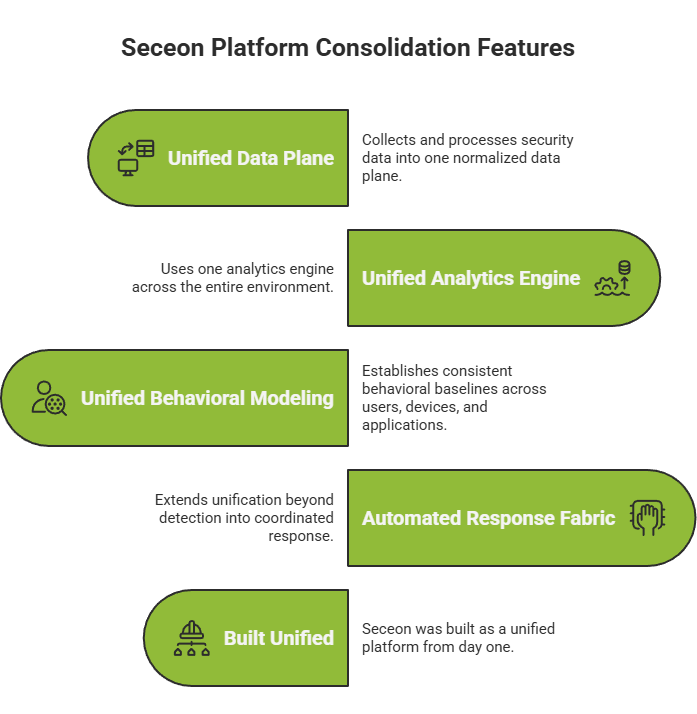
A Single, Unified Data Plane
Seceon collects and processes security data from across the enterprise into one normalized data plane. This provides:
- Consistent data schemas and enrichment from the moment data is ingested
- Real-time correlation without relying on slow API-based integrations
- Uniform access, querying, and data retention policies
- Complete elimination of data silos across security domains
As a result, analysts can investigate complex threats using a single query, instead of manually stitching data together from multiple tools.
One Analytics Engine Built on Behavior
Many platforms use separate analytics engines for each module. Seceon uses one analytics engine across the entire environment.
This engine:
- Correlates signals across endpoint, network, identity, and cloud activity
- Shares threat intelligence and risk scoring across all security domains
- Detects attacks as connected behavioral patterns rather than isolated alerts
- Continuously learns from the full security context
This enables earlier detection of multi-stage and identity-driven attacks that siloed tools often miss.
Unified Behavioral Modeling Across the Enterprise
Seceon takes an entity-centric approach, continuously tracking behavior across:
- Users
- Devices
- Applications
- Cloud resources
This allows Seceon to:
- Establish consistent behavioral baselines
- Detect subtle anomalies that traditional tools overlook
- Reduce false positives
- Identify attacker movement early in the attack lifecycle
Security teams shift from reactive alert handling to behavior-driven threat detection.
A Cohesive, Automated Response Fabric
Seceon extends unification beyond detection into coordinated response.
The platform enables:
- Context-aware containment actions based on full attack visibility
- Automated response workflows across endpoint, network, identity, and cloud
- Centralized orchestration with enforcement at the point of control
- Continuous improvement based on response outcomes
Instead of isolated reactions, Seceon delivers synchronized, intelligence-driven response, reducing dwell time and limiting attack impact.
Built Unified-Not Assembled Later
Most importantly, Seceon was built as a unified platform from day one, not assembled later through acquisitions. This removes:
- Redundant analytics engines
- Conflicting data models
- Integration delays during incidents
- Operational complexity hidden behind branding
The result is true platform consolidation-not just fewer vendors, but fewer failure points and better security outcomes.
Conclusion: Beyond the Logo Count
Platform consolidation will continue to shape enterprise security strategies, driven by legitimate economic and operational pressures. However, many acquisition-driven platforms replace tool sprawl with hidden architectural complexity, failing to deliver meaningful security gains.
Reducing vendor logos does not reduce attack surfaces or operational risk.
Only architectural coherence does.True consolidation means one data plane, one analytics engine, one behavioral model, and one response fabric. Security leaders who understand this distinction will build platforms that deliver simpler operations, lower costs, and genuinely stronger security outcomes-not just the appearance of consolidation.

The post Why “Platform Consolidation” Often Increases Risk Instead of Reducing It appeared first on Seceon Inc.
*** This is a Security Bloggers Network syndicated blog from Seceon Inc authored by Anamika Pandey. Read the original post at: https://seceon.com/why-platform-consolidation-often-increases-risk-instead-of-reducing-it/
