

Tech Debt: Why Fixing the Foundation Comes Before Building the Castle

I learned this lesson the hard way during my early ventures. When you're building what you think is the next big thing. Your team is excited, features are shipping fast, and everyone's talking about the "game-changing" innovation you're about to launch. Then reality hits.
Your system starts crashing during peak hours. Users can't log in. Payment processing breaks at the worst possible moment. Sound familiar? That's tech debt collecting its interest, and trust me – it never forgets to send the bill.
What exactly is Tech Debt?
Think of technical debt like a credit card for your codebase. Taking shortcuts in your software today means paying the price eventually with interest. Every quick fix, every "we'll come back to this later" decision, every piece of undocumented code adds to your debt balance.
The cost of poor software quality in the US has risen to at least $2.41 trillion annually, while the accumulated technical debt has grown to approximately $1.52 trillion. That's not a typo – trillion with a T.
Here's what really shocked me: 42% of every developer's working week is spent dealing with technical debt and bad code, which equates to nearly $85 billion worldwide in opportunity cost lost annually. Your best engineers – the ones you're paying top dollar for – are spending almost half their time cleaning up messes instead of building new value.
The Hidden Costs That Keep Growing
Tech debt isn't just about slower development (though that's painful enough). It's about everything that stems from unstable foundations.
I had to learn this during our scaling journey. Early on, we made quick decisions to ship features fast. But as we grew, those shortcuts started choking our growth. Companies pay an additional 10 to 20 percent to address tech debt on top of the costs of any project, and we felt every percentage point.
The real killer isn't just the extra time – it's the opportunity cost. While your team is fixing yesterday's shortcuts, your competitors are building tomorrow's features. Developers working on the right things can accelerate a company's move into new markets or product areas and help companies differentiate themselves at disproportionate rates.
But there's a human cost too. Nobody likes working with a significant handicap and being unproductive day after day. I've seen talented developers leave companies because they were tired of spending their days fighting technical debt instead of building meaningful solutions.
P0 and P1: The Priority System That Actually Works
This brings me to something crucial – not all problems are created equal. Understanding P0 and P1 issues can save your company from the kind of disasters that make headlines.
P0 Issues: These are your "drop everything" emergencies. P0 is a critical error that requires immediate attention no matter the time of day. Think system outages, security breaches, or anything that makes your product completely unusable. P0s represent the highest priority items – something so critical to the product that you would hold the release to include or fix it.
P1 Issues: P1 is a major issue that requires immediate attention during a regular working day. These significantly impact functionality but don't cause complete system failure. They're like warning lights on your dashboard – ignore them and you're heading for trouble, but you don't need to pull over immediately.
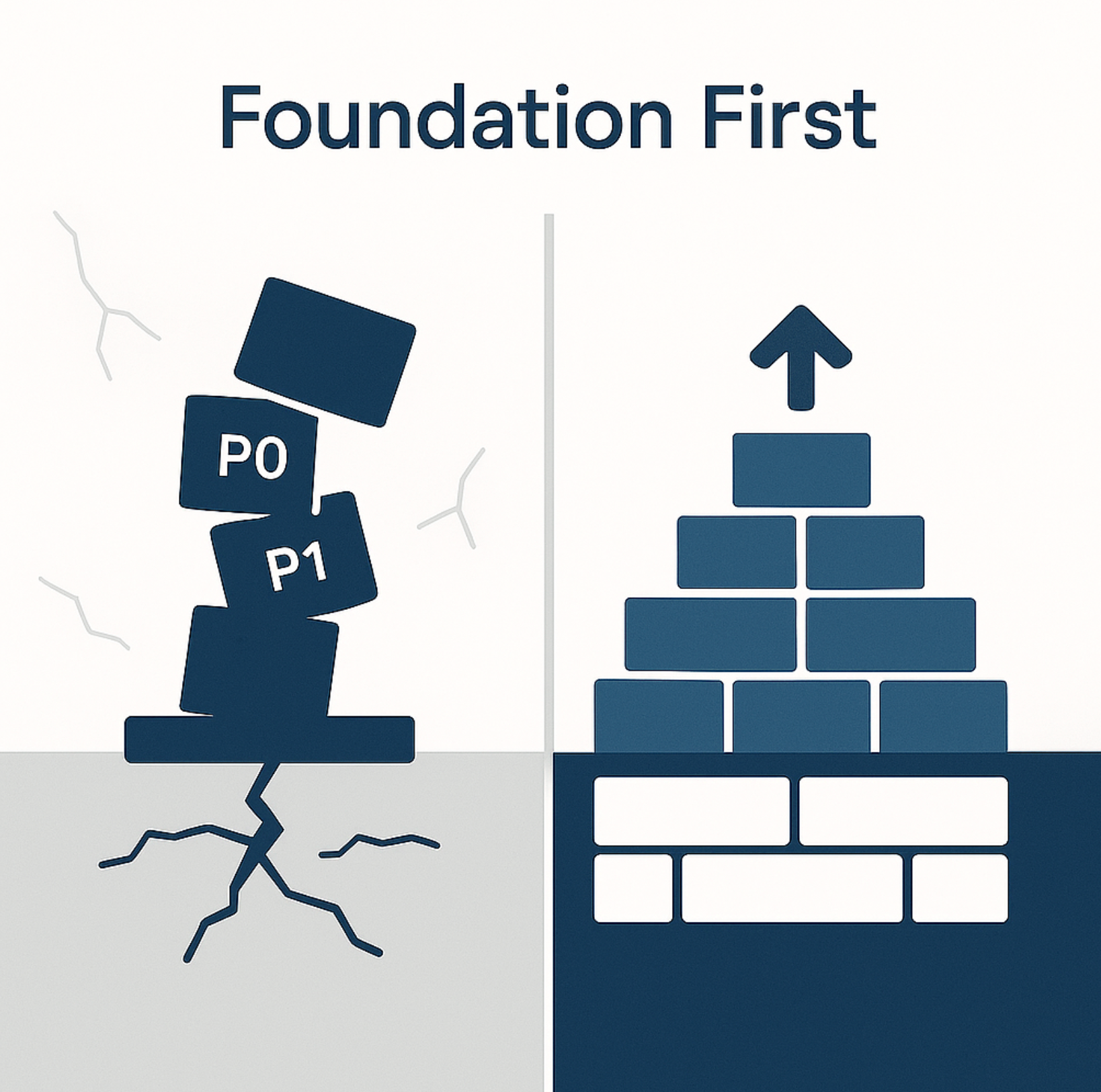
Here's the key insight: you cannot innovate effectively while sitting on P0 and P1 issues. It's like trying to build a second story while your foundation is cracking.
Why "It Won't Happen Again" Usually Does
I can't count how many times I've heard this phrase in engineering meetings. A critical bug gets fixed with a band-aid solution, everyone promises it was a one-time thing, and then… surprise! It happens again, usually at the worst possible moment.
The Knight Capital story still gives me chills. In 2012, Knight Capital suffered a $460 million loss due to technical debt in their trading platform – outdated and poorly maintained code caused a series of unintended trades, resulting in one of the largest financial losses in history. The next day, their stock dropped 75%.
That wasn't just a technical failure – it was a systematic failure to address known issues before they became catastrophic.
The Innovation Trap
Here's where most companies get it wrong. They think innovation means constantly adding new features, launching new products, exploring new markets. But true innovation requires a stable foundation.
30 percent of CIOs surveyed believe that more than 20 percent of their technical budget ostensibly dedicated to new products is diverted to resolving issues related to tech debt. You're essentially pouring money into a bucket with holes in it.
I've learned that the most innovative companies aren't necessarily the ones building the flashiest features – they're the ones who've mastered the discipline of maintaining clean, stable systems that can support rapid innovation.
A Framework That Actually Works
Based on my experience building and scaling multiple companies, here's a framework that works:
1. Audit Your Current State Start by understanding exactly what you're dealing with. Over a five-year period, costs due to technical debt for one million lines of code can reach $1.5 million, equivalent to 27,500 developer hours. You need to know your debt load before you can pay it down.
2. Classify Everything Use the P0/P1 system religiously. P0s get fixed immediately, no exceptions. P1s get scheduled in the current development cycle. Everything else waits until the critical issues are resolved.
3. Stop the Bleeding Before you tackle existing debt, stop creating new debt. Employing a Clean as You Code methodology allows organizations to avoid the expensive cost associated with technical debt by preventing bad code from reaching production in the first place.
4. Allocate Resources Systematically Leading companies allocate, on average, 15% of the IT budget toward tech debt remediation. This isn't optional maintenance – it's strategic investment in your ability to innovate.
The Payoff Is Real
The benefits of addressing technical debt aren't just theoretical. They include freeing up engineers to spend as much as 50 percent more of their time working on value-generating products and services, reducing costs by cutting back on time needed to manage complexities, and improving uptime and resiliency.
When I implemented this discipline, the change was dramatic. Development velocity increased, our team's morale improved, and we could actually predict release timelines. Most importantly, we could focus on building features that customers wanted instead of constantly firefighting.
Clean Code Isn't Optional – It's Strategic
I know what you're thinking: "But Deepak, we're moving fast and breaking things! Isn't this how startups work?"
Here's the truth – moving fast and breaking things only works if you're also fixing things methodically. Organizations actively managing technical debt will release at least 50% faster. Clean code isn't the opposite of speed – it's what enables sustainable speed.
When I look at successful companies today, they all share one characteristic: they treat code quality as a competitive advantage, not a nice-to-have. They understand that every shortcut today becomes a roadblock tomorrow.
The Bottom Line
Technical debt isn't going away. In fact, with AI increasingly involved in code generation, the growing adoption of generative-AI for code creation has the potential to proliferate a sub-standard codebase, making attention on code quality a business imperative.
But here's what I've learned after building multiple companies: you get to choose how you pay this debt. You can pay it proactively, on your terms, when you have time and resources. Or you can pay it reactively, at 3 AM, when everything is on fire and customers are angry.
The companies that will thrive in the next decade aren't the ones with the most features – they're the ones with the cleanest foundations. They're the ones who've learned that innovation isn't about building faster; it's about building smarter.
Fix your P0 and P1 issues completely. Build clean systems. Then innovate from a position of strength.
Because the next time you say "it won't happen again," make sure you mean it.
*** This is a Security Bloggers Network syndicated blog from Deepak Gupta | AI & Cybersecurity Innovation Leader | Founder's Journey from Code to Scale authored by Deepak Gupta - Tech Entrepreneur, Cybersecurity Author. Read the original post at: https://guptadeepak.com/tech-debt-why-fixing-the-foundation-comes-before-building-the-castle/
