
Home » Security Bloggers Network » From NIST 800-53 to FedRAMP: What it really takes to bridge the gap

From NIST 800-53 to FedRAMP: What it really takes to bridge the gap

While FedRAMP is built on NIST 800-53, the two are not interchangeable. FedRAMP adds a layer of rigor, documentation, and oversight specifically tailored to the requirements of the federal government. Many organizations underestimate the distance between implementing NIST controls and actually obtaining a FedRAMP Authority to Operate (ATO). That underestimation can cost them time, credibility, and revenue.
This article breaks down what it really takes to move from NIST 800-53 compliance to FedRAMP authorization and why being “close” doesn’t mean you’re ready.
Why FedRAMP matters, even if you already follow NIST
NIST SP 800-53 is the foundation of many federal and commercial security programs. It provides a catalog of controls covering access control, system integrity, audit logging, incident response, and much more. Many cloud service providers adopt these controls voluntarily or as part of state or commercial contracts.
But FedRAMP is more than just a list of controls. It is a standardized, government-wide program designed to ensure secure adoption of cloud services across federal agencies. It introduces governance, documentation templates, third-party audits, and a formal approval path either through an agency sponsor or the Joint Authorization Board (JAB).
So while NIST compliance demonstrates technical alignment, FedRAMP is about proving it in a federal context and maintaining that proof continuously.

Looking for automated, always-on IT control assurance?
TrustCloud keeps your compliance audit-ready so you never miss a beat.
What NIST 800-53 compliance does (and doesn’t) cover
If you’re NIST 800-53 compliant, here’s what you likely already have:
- A control framework aligned with federal standards
- Documented policies and procedures for key security areas
- A security team familiar with risk assessments, incident response, and user access management
- Technical controls like MFA, encryption, logging, and backup strategies
These elements are foundational. But FedRAMP raises the bar in several ways:
- Requires specific parameter values for many controls (e.g., timeout settings, encryption key lengths)
- Adds mandatory Control Implementation Summaries (CIS) and detailed narratives
- Imposes continuous monitoring requirements, not just point-in-time reviews
- Requires an independent 3PAO assessment, not just internal audits
- Enforces U.S. person-only access and U.S.-based data storage for Moderate and High impact levels
- Demands full System Security Plan (SSP) documentation, often over 300 pages
Read the “NIST CSF Overview and Guides” to learn more!
Having NIST 800-53 in place puts you on the starting block, not the finish line. FedRAMP demands a level of operational maturity, documentation quality, and third-party validation that goes far beyond control implementation.
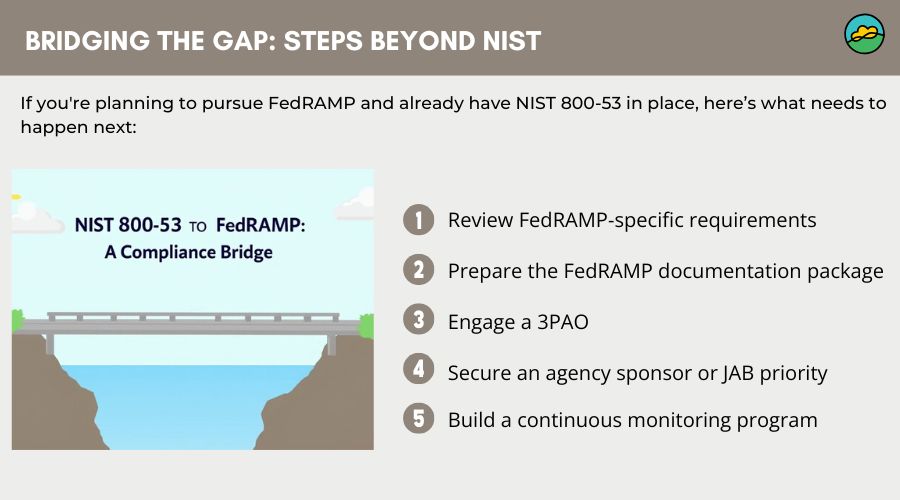
Bridging the gap: Steps beyond NIST
If you’re planning to pursue FedRAMP and already have NIST 800-53 in place, here’s what needs to happen next:
1. Review FedRAMP-specific requirements
Each FedRAMP baseline (Low, Moderate, High) contains a control set derived from NIST 800-53, but with customized parameters. Review the FedRAMP Security Controls Baseline and ensure your existing implementations meet those expectations, not just the generic NIST guidance.
2. Prepare the FedRAMP documentation package
The documentation burden is substantial. You’ll need:
- System Security Plan (SSP)
- Policies and procedures mapped to every control
- Control Implementation Summary (CIS)
- POA&M (Plan of Action & Milestones)
- Privacy Threshold Analysis (PTA) and Privacy Impact Assessment (PIA), if applicable
- Information System Contingency Plan (ISCP)
- Configuration Management Plan
3. Engage a 3PAO
You can’t self-attest in FedRAMP. An accredited Third Party Assessment Organization (3PAO) must conduct the full security assessment, including penetration testing, vulnerability scans, and documentation review. Select a 3PAO early, as availability and costs vary.
4. Secure an agency sponsor or JAB priority
You’ll need a federal agency to sponsor your ATO, or you can attempt to go through the Joint Authorization Board (JAB) if your solution is intended for government-wide use. Each path has its own timeline and complexity.
5. Build a continuous monitoring program
FedRAMP authorization is not a one-time certification. You must provide monthly vulnerability scans, incident reporting, and annual reassessments to stay listed on the FedRAMP Marketplace.
Read the “NIST password guidelines 2025: what you need to know to stay secure” article to learn more!
How TrustCloud accelerates your FedRAMP compliance journey
Achieving FedRAMP authorization is a complex and resource-intensive process, but TrustCloud helps make it faster, more organized, and less manual. The platform is purpose-built to align with the NIST SP 800-53 control framework and FedRAMP-specific requirements, helping organizations map, implement, and document controls efficiently.
TrustCloud automates the generation of key artifacts like the System Security Plan (SSP), Control Implementation Summary (CIS), and POA&M, using data collected directly from your infrastructure. It integrates with commonly used cloud services and security tools (like AWS, Azure, Splunk, and ServiceNow) to provide real-time telemetry, reducing the need for screenshots or spreadsheet-driven evidence gathering.
With centralized dashboards, automated control testing, and built-in workflows for coordinating with 3PAOs, TrustCloud supports customers from initial gap analysis through authorization and continuous monitoring. Whether you’re working with an agency sponsor or pursuing a JAB P-ATO, TrustCloud provides the tools and guidance needed to accelerate your path to FedRAMP compliance while maintaining the rigor federal agencies expect.
“Continuous auditing and third-party risk management gave us the agility of a startup with the rigor of an enterprise. That’s the competitive edge we didn’t have before TrustCloud.”
– Dave Brown, Head of Security & Compliance, Andesite
NIST 800-53 vs FedRAMP: Detailed comparison
|
Feature |
NIST 800-53 |
FedRAMP |
|
Purpose |
Framework for federal systems |
Mandatory program for federal cloud services |
|
Authority |
National Institute of Standards and Technology (NIST) |
U.S. General Services Administration (GSA) via FedRAMP PMO |
|
Control Catalog |
300+ controls |
Subset of NIST 800-53 + FedRAMP overlays |
|
Customization |
Organizations define parameters |
Strict, predefined parameters (e.g., timeout, encryption, logging) |
|
Assessment |
Can be internal or external |
Must be performed by an accredited 3PAO |
|
Documentation |
Flexible, self-documented |
Specific templates (SSP, CIS, POA&M, etc.) |
|
Monitoring |
Organization-defined |
Mandatory continuous monitoring and monthly reporting |
|
Reusability |
Informal; used as reference |
Formal reuse via FedRAMP Marketplace for all agencies |
|
Legal Requirement |
Not a compliance program |
Federally mandated for all agency cloud use |
|
Data Residency |
Not always enforced |
Data must reside in U.S., with U.S. personnel for Moderate and High |
Summing it up
Adopting NIST 800-53 is a meaningful step toward securing your cloud service, but FedRAMP is a compliance regime, not just a set of best practices. It demands proof, oversight, and continuous diligence.
For cloud providers seeking to enter the federal market, planning for FedRAMP early can prevent costly delays. The gap between “aligned with NIST” and “FedRAMP authorized” is not trivial, but it’s bridgeable with the right preparation, resources, and partnerships.
And once you’re authorized, the door opens to a multi-billion-dollar market, with reuse across agencies, formal recognition, and a federal stamp of trust.
FAQs
If we’re already NIST 800-53 compliant, how close are we to FedRAMP authorization?
You’re directionally aligned, but not yet FedRAMP-ready. FedRAMP uses NIST 800-53 as its foundation but adds specific control parameters, documentation formats, a formal third-party assessment (3PAO), and continuous monitoring requirements.
Do we need to reimplement all our controls for FedRAMP?
Not necessarily. If your current controls meet FedRAMP’s specific parameters (e.g., session timeout, encryption standards), you can reuse them. But many organizations need to tighten or better document their existing implementations.
What are the key documents required for FedRAMP that we don’t need for standard NIST compliance?
FedRAMP requires a standardized System Security Plan (SSP), Control Implementation Summary (CIS), POA&M, Continuous Monitoring Plan, and several others. These are formal templates reviewed by both the 3PAO and the FedRAMP PMO.
The post From NIST 800-53 to FedRAMP: What it really takes to bridge the gap first appeared on TrustCloud.
*** This is a Security Bloggers Network syndicated blog from TrustCloud authored by Shweta Dhole. Read the original post at: https://www.trustcloud.ai/fedramp/from-nist-800-53-to-fedramp-what-it-really-takes-to-bridge-the-gap/
