
Home » Security Bloggers Network » Achieving AML compliance: preventing illicit financial activities

Achieving AML compliance: preventing illicit financial activities

Money laundering isn’t just a headline; it’s a growing risk that shadows every transaction and shakes stakeholder trust. With estimates showing that trillions of dollars move through illicit channels every year, regulatory bodies worldwide are tightening expectations and increasing enforcement.
To stay compliant and avoid harsh penalties, businesses must move beyond check-the-box AML (Anti-Money Laundering) policies. Effective AML compliance demands clear customer due diligence (CDD), real-time transaction monitoring, and transparency around beneficial ownership.
This article dives into what modern AML compliance looks like in 2025, key obligations, emerging challenges, and how you can build systems that not only meet legal demands but also protect your reputation and reinforce trust with customers.
What is AML compliance?
Anti-money laundering (AML) compliance involves a set of rules and regulations designed to prevent criminals from disguising illegally obtained funds as legitimate income. The process requires comprehensive due diligence, regular monitoring, and reporting each suspicious transaction to appropriate authorities. Understanding AML compliance starts with recognizing that the impact of money laundering extends beyond illegal financial gains; it can weaken economic structures, destabilize governments, and erode public trust in institutions.
AML regulations are enforced by national governments and international bodies, including the Financial Action Task Force (fatf), which sets global standards and promotes effective implementation of legal, regulatory, and operational measures to combat money laundering. Companies across multiple sectors must adapt their internal policies to ensure that they not only meet current regulatory requirements but also remain agile for future changes.
The evolution of AML regulations
The regulatory landscape for aml compliance has evolved significantly over the past few decades. Initially, aml regulations were narrowly focused on specific sectors such as banking. However, with technological advancements and globalization, regulators have expanded their scope to include various industries like real estate, cryptocurrency, and even art markets. This evolution reflects the growing complexity of financial crime, which has adapted to exploit loopholes in traditional safeguards.
Modern AML regulations emphasize transparency and accountability. Financial institutions now need to submit comprehensive reports detailing their compliance efforts, risk assessments, and the measures taken to mitigate potential risks. Regulatory bodies have also started to collaborate more closely across borders, ensuring that money laundering networks cannot exploit jurisdictional differences. This collective approach not only strengthens global efforts to combat money laundering but also underscores the importance of a unified response to a common threat.
The risks of illicit financial activities
Illicit financial activities such as money laundering, fraud, and terror financing remain among the most pressing threats to global economies. They erode trust, weaken financial systems, and enable criminal networks to thrive. When left unchecked, these activities destabilize regulatory frameworks, compromise institutional credibility, and even trigger systemic risks that extend beyond borders. The impact is not limited to fines and penalties; it can damage an organization’s reputation, investor confidence, and long-term stability. That’s why a proactive approach to Anti-Money Laundering (AML) compliance is crucial, not only to protect institutions but also to preserve the integrity of the broader financial ecosystem.
Key risks to consider
- Economic destabilization
Illicit financial activities funnel money into underground economies, disrupting legitimate financial flows and weakening economic growth. When resources are diverted to support criminal activities, governments lose revenue, tax systems become compromised, and fair competition is undermined. Over time, unchecked financial crime can destabilize national economies and limit opportunities for sustainable development. - Reputational damage
Institutions caught in money laundering or fraud scandals face more than regulatory penalties—they suffer lasting reputational harm. Customers, partners, and investors quickly lose trust, making it difficult to rebuild credibility. This loss of confidence can result in declining market share, reduced investments, and in some cases, the collapse of the organization itself. - Legal and regulatory penalties
Failure to comply with AML requirements invites severe consequences, including hefty fines, sanctions, and even criminal liability for executives. Global regulators are increasingly aggressive in their enforcement, meaning even small oversights can lead to costly outcomes. Beyond financial penalties, institutions may face restrictions on operations or be barred from certain markets altogether. - Enabling criminal networks
Weak AML compliance allows illicit actors to exploit financial systems to fund terrorism, human trafficking, and drug trade. By providing criminals with a pathway to launder money, institutions inadvertently support activities that endanger lives and security worldwide. Effective risk management is essential to cut off these financial lifelines and disrupt broader criminal networks. - Systemic and global risks
Illicit financial activities don’t remain confined to one institution or sector. They create ripple effects that weaken the stability of entire financial systems, impacting trade, investment, and international relations. For instance, cross-border laundering schemes can strain diplomatic ties and invite stricter global regulations, raising compliance costs for all institutions involved.

Looking for automated, always-on IT control assurance?
TrustCloud keeps your compliance audit-ready so you never miss a beat.
Foundations of AML compliance programs
Building an effective Anti-Money Laundering (AML) compliance program requires a strong foundation rooted in proactive processes, technology, and accountability. These programs are not just regulatory requirements but essential safeguards against illicit financial activities. A robust AML framework weaves due diligence, monitoring, reporting, training, and risk management into daily operations, ensuring financial institutions remain secure, resilient, and compliant while fostering trust across clients, regulators, and stakeholders. Each core element plays a critical role in reducing vulnerabilities and strengthening the institution’s defense against financial crime.
Core elements of AML compliance
- Customer Due Diligence (CDD)
Customer due diligence is the first line of defense in AML compliance. By verifying client identities, understanding their business activities, and assessing associated risks, institutions can flag high-risk accounts early. Ongoing CDD also allows organizations to monitor clients’ transactions and behavior continuously, making it easier to spot anomalies that could indicate potential money laundering. - Risk Assessments
Effective AML programs rely on detailed risk assessments to identify which clients, services, or geographies pose the greatest threat. Institutions often adopt a risk-based approach, channeling resources to high-risk areas while maintaining efficiency. These assessments evolve as new threats emerge, helping organizations adapt their AML strategies and stay aligned with regulatory expectations. - Transaction Monitoring
Advanced transaction monitoring systems detect unusual financial patterns and raise alerts for further review. Using artificial intelligence and machine learning, these systems analyze massive volumes of data in real time, identifying suspicious activity that human oversight might miss. Automated monitoring not only enhances detection but also ensures faster responses to potential risks, strengthening compliance effectiveness. - Reporting Mechanisms
Timely and accurate reporting is vital for regulatory compliance. Institutions must establish clear channels for staff to escalate suspicious activities internally, ensuring nothing is overlooked. Once flagged, these cases must be reported to the appropriate financial intelligence units. Strong reporting frameworks demonstrate transparency, regulatory cooperation, and commitment to combating financial crime on all fronts. - Employee Training
Employees are the backbone of AML compliance, making training essential. Regular workshops, certifications, and simulated exercises equip staff with the knowledge and skills to detect red flags. Continuous updates on regulatory changes and evolving threats ensure employees remain vigilant. Training embeds a compliance-first mindset, turning every staff member into a crucial defense mechanism. - Integration with Corporate Governance
AML programs are most effective when embedded into broader corporate governance. Treating compliance as a strategic priority ensures leadership accountability and cross-departmental collaboration. This integration reduces silos, promotes consistency, and builds a culture where financial crime prevention is everyone’s responsibility. By aligning AML with governance, institutions strengthen resilience and maintain regulator and client trust.
Read the “Change management policy best practices: Tips for ensuring seamless adaptation” article to learn more!
AML compliance framework
To achieve full compliance with AML regulations, businesses need to establish a robust framework that encompasses various aspects of money laundering prevention.
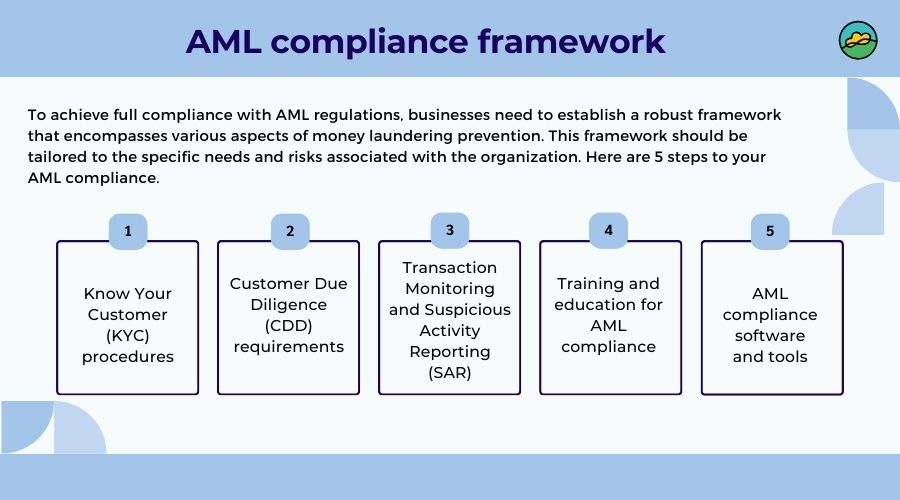
This framework should be tailored to the specific needs and risks associated with the organization. Here are 5 steps to your AML compliance.
- Know Your Customer (KYC) procedures
The first step in any AML compliance program is the implementation of robust Know Your Customer (KYC) procedures. KYC involves verifying the identity of customers, assessing their risk profiles, and understanding the nature of their business activities. By conducting thorough due diligence on customers, businesses can identify potential red flags and mitigate the risk of being involved in money laundering activities.
KYC procedures typically include collecting customer identification documents, conducting background checks, and monitoring customer transactions. These measures help businesses establish a comprehensive customer profile and ensure that they are not unknowingly facilitating money laundering activities. - Customer Due Diligence (CDD) requirements
Customer Due Diligence (CDD) is an integral part of AML compliance. It involves conducting a risk assessment of customers to determine their level of risk for money laundering or terrorist financing. CDD requirements may vary depending on the nature of the business relationship and the risk profile of the customer.
Its measures typically include ongoing monitoring of customer transactions, conducting regular risk assessments, and updating customer information as necessary. By implementing CDD requirements, businesses can identify and mitigate the risk of being involved in illegal financial activities.
It involves verifying the identity of clients, understanding the nature of their activities, and assessing their risk profile. By implementing robust CDD procedures, financial institutions can detect and mitigate potential risks posed by high-risk customers. This comprehensive approach to CDD not only supports AML compliance but also enhances the overall security and integrity of financial transactions. - Transaction Monitoring and Suspicious Activity Reporting (SAR)
Transaction monitoring is a critical component of AML compliance. It involves the continuous monitoring of customer transactions for suspicious activities that may indicate money laundering or terrorist financing. Businesses need to implement robust systems and tools that can analyze large volumes of data in real time and identify potential red flags.
When suspicious activities are detected, businesses are required to file Suspicious Activity Reports (SARs) with the appropriate regulatory authorities. SARs provide a mechanism for reporting potentially illicit transactions and initiating investigations. Filing SARs in a timely and accurate manner is crucial for maintaining compliance with AML regulations.
Vigilant monitoring and timely reporting of suspicious transactions are vital for maintaining AML compliance. Financial institutions must have systems in place to detect unusual or suspicious activity that may indicate money laundering or terrorist financing. This section explores the mechanisms for monitoring transactions and the processes for reporting suspicious activities to the relevant authorities.
By understanding these requirements and implementing effective monitoring and reporting systems, financial institutions can play a crucial role in combating financial crimes. - Training and education for AML compliance
Ensuring that employees are well-trained and educated about AML regulations is essential for maintaining a strong compliance culture within an organization. Effective training programs should cover the basics of AML regulations, the company’s policies and procedures, and specific roles and responsibilities of employees in preventing money laundering.
Training should be tailored to the specific needs of different departments and job roles within the organization. It should be ongoing and regularly updated to reflect changes in AML regulations and emerging trends in money laundering. - AML compliance software and tools
To streamline AML compliance processes and enhance efficiency, businesses can leverage AML compliance software and tools. These tools automate various aspects of compliance, such as customer due diligence, transaction monitoring, and suspicious activity reporting.
AML compliance software can help businesses analyze large volumes of data, identify potential risks, and generate accurate reports for regulatory authorities. By implementing such tools, organizations can improve their compliance processes, reduce manual errors, and ensure consistent adherence to AML regulations.
In the digital age, technology and automation play a pivotal role in enhancing AML compliance processes. From advanced analytics to machine learning algorithms, technological solutions can significantly improve the efficiency and effectiveness of compliance efforts.
There are various technological tools available to financial institutions and how they can be leveraged to streamline AML compliance. By embracing technology, financial institutions can stay ahead of the curve in detecting and preventing money laundering activities.
Read the “Vital data privacy & AI ethics: Essential practices every organization must follow” article to learn more!
The role of AML compliance officers
The AML compliance officer is a key figure in any financial institution’s compliance program. They are responsible for overseeing the institution’s AML strategy, ensuring compliance with regulations, and acting as a liaison with regulatory bodies. This section highlights the critical responsibilities of AML compliance officers and the skills they need to succeed. Understanding the role of these professionals is crucial for ensuring the effectiveness of an institution’s AML compliance efforts.
Adhere to 18+ out-of-the-box standards and unlimited custom frameworks
TrustCloud helps you achieve regulatory compliance with confidence. Auto-generated controls and policies help you easily adopt frameworks like SOC 2, ISO 27001, GDPR, HIPAA, PCI-DSS, and more. With our common control framework and complimentary gap analysis, you can track progress toward the certifications you want now and as you grow.
Strategies for effective AML compliance
An effective Anti-Money Laundering (AML) compliance strategy is not a one-time setup but a dynamic process that adapts to evolving threats, regulatory changes, and technological advancements. Institutions must go beyond basic compliance checklists to create proactive, flexible, and resilient programs.
By combining customized risk assessments, strong internal controls, advanced technology, staff training, and regulator collaboration, organizations can build a framework that strengthens their defenses while promoting trust and transparency. These strategies ensure financial institutions stay ahead of criminal tactics while maintaining compliance with global regulatory standards.
Key strategies for AML compliance
- Tailored Risk Assessments
Every financial institution has unique vulnerabilities, depending on its operations, geography, and clientele. Tailored risk assessments help identify these specific risks, allowing resources to be allocated where they matter most. By customizing assessments, organizations can monitor high-risk transactions effectively, minimize blind spots, and maintain compliance while ensuring operational efficiency in detecting suspicious activities. - Robust Internal Controls
Strong internal controls form the backbone of AML compliance. Clearly defined roles and responsibilities, supported by regular audits, create accountability across all levels. These controls ensure that AML policies are not only documented but also consistently practiced. Internal reviews and independent audits further validate adherence, strengthening trust with regulators and reducing risks of compliance lapses. - Advanced Data Analytics
Modern AML compliance requires leveraging data-driven technologies. Advanced analytics and artificial intelligence can process large volumes of transactions in real time, spotting anomalies and suspicious behaviors faster than manual checks. These insights allow financial institutions to proactively respond to risks, minimize false positives, and adapt monitoring systems as criminal methods evolve, boosting overall efficiency. - Continuous Employee Training
Employees are the first line of defense against money laundering. Ongoing training ensures they remain alert to new threats, regulatory updates, and evolving criminal strategies. Simulations, refresher programs, and certifications build confidence in recognizing suspicious activities. By fostering a culture of compliance, institutions empower staff to act decisively and responsibly when identifying potential risks. - Engagement with Regulators
Maintaining strong relationships with regulators is critical for compliance success. Proactive engagement allows institutions to anticipate regulatory shifts and adapt policies before they are enforced. Open communication also fosters transparency and demonstrates a genuine commitment to fighting financial crime. Collaboration with regulators strengthens credibility, builds trust, and reduces the risk of costly penalties. - Building a Resilient Framework
Beyond meeting baseline requirements, AML compliance strategies should aim to build resilience. By integrating tailored assessments, advanced technologies, and continuous learning into everyday operations, organizations create a system that evolves alongside emerging threats. This holistic framework not only safeguards against money laundering but also enhances institutional integrity, ensuring long-term compliance and stakeholder confidence.
Read the “Master regulatory compliance: Dominate change before it dominates you” article to learn more!
The role of internal and external audits
Regular audits, both internal and external, are critical for verifying that aml compliance frameworks are effective and up-to-date. Internal audits help assess whether the in-house controls, risk management protocols, and employee training programs are functioning effectively.
In addition, external audits provide a fresh perspective and verify compliance from an independent standpoint.
External audits, often carried out by regulatory bodies or independent third parties, serve as a safeguard ensuring that institutions abide by current laws and standards. The findings from these audits can highlight areas for improvement and suggest best practices that can be implemented across the institution.
The integration of audit feedback into compliance strategies is crucial for continuously refining and improving aml policies, ensuring that the institution is better prepared to confront new challenges.
The impact of international cooperation
International cooperation is integral to advancing aml compliance. Financial crimes rarely conform to national borders, and a collaborative approach is crucial in tracking and intercepting illicit funds. Organizations such as the fatf and inter-governmental bodies play an important role in fostering a coordinated response among different jurisdictions.
Their guidelines help harmonize regulatory efforts, ensuring that financial institutions globally are equipped with similar knowledge and standards in combating money laundering.
This international collaboration has led to several joint operations, information-sharing initiatives, and cross-border investigations. Moreover, global sanctions and regulatory frameworks have made it riskier for criminals to seek refuge in jurisdictions with lenient aml regulations. The continuous evolution of these cooperative efforts signifies that the fight against money laundering is a dynamic process that adapts to the changing modus operandi of criminal networks.
Challenges in achieving AML compliance
While the advantages of strong Anti-Money Laundering (AML) compliance are undeniable, organizations face numerous hurdles in implementation. Regulatory expectations continue to evolve, financial technologies advance rapidly, and operational pressures create friction between compliance and efficiency. At the same time, data privacy concerns, cross-border regulations, and cybersecurity risks complicate enforcement.
For many institutions, balancing business performance with compliance demands requires significant investment, adaptability, and foresight. Overcoming these challenges is essential not only for legal adherence but also for building long-term trust with stakeholders and protecting the financial system from illicit activities that can undermine global stability.
Key challenges
- Balancing Compliance and Efficiency
Meeting rigorous AML requirements often slows down customer onboarding and transaction processing. Lengthy procedures can frustrate clients and hinder business agility, particularly in industries with high transaction volumes. Striking the right balance between robust compliance and operational efficiency remains an ongoing challenge for institutions that must remain competitive while ensuring regulatory obligations are consistently met. - Evolving Financial Technologies
With innovations like digital wallets, blockchain, and cryptocurrencies, financial crime risks are becoming more sophisticated. Traditional AML systems may not detect these novel methods effectively. Institutions must continually update compliance frameworks, adopt advanced monitoring tools, and retrain staff, requiring substantial investment in time and resources to keep pace with rapidly changing financial technologies. - Cross-Border Regulatory Complexity
Financial institutions operating globally must navigate diverse, and often conflicting, AML regulations across jurisdictions. What is acceptable in one country may be non-compliant in another. This lack of uniformity creates confusion and increases the administrative burden. Constantly adapting to varying regulatory frameworks requires robust governance structures and legal expertise, adding complexity to day-to-day operations. - Data Privacy Concerns
AML compliance depends on extensive data collection and monitoring. However, this can sometimes clash with strict data protection laws such as GDPR. Institutions must ensure they are not overstepping privacy boundaries while still collecting enough information to detect suspicious activities. Balancing compliance with respect for customer privacy creates significant operational and legal challenges. - Cybersecurity Risks
As institutions gather and store massive volumes of sensitive data, they become prime targets for cybercriminals. Any breach can expose confidential customer information, leading to regulatory penalties and reputational harm. Building robust cybersecurity defenses alongside AML systems is resource-intensive but necessary, as cyber threats continue to evolve in parallel with compliance requirements. - Resource Constraints
Smaller financial institutions often lack the manpower, budget, and expertise required to implement advanced AML systems. While larger firms may absorb the costs of continuous updates, smaller entities struggle to keep up. Limited resources make it difficult to balance innovation, compliance, and risk management, leaving these institutions more vulnerable to regulatory scrutiny.
Read the “One unexpected challenge organizations face while implementing SOC 2” article to learn more!
Revenue-Generating Compliance for startups and SMBs
Unlock enterprise deals and build a foundation of trust!
Compliance automation, risk management, trust portal, AI to complete questionnaires, third-party risk assessments, all in one platform, at an affordable price. Get everything you need to achieve compliance that is required for revenue.
Building a culture of compliance
Achieving effective aml compliance goes beyond having written policies and procedures; it requires cultivating a culture of integrity and vigilance throughout the organization. Such a culture starts at the top, with leadership demonstrating a strong commitment to ethical practices and regulatory adherence.
When employees see that compliance is a core value of the company, they are more likely to take their responsibilities seriously and engage proactively in detecting and reporting suspicious activities.
To build this culture, organizations can adopt several practices:
- Leadership involvement
Senior management should take an active role in compliance initiatives, reinforcing the importance of aml policies at all levels. - Employee empowerment
Create an environment where staff feel comfortable reporting suspicious activities without fear of reprisal. Whistleblower programs and clear reporting protocols can facilitate this. - Ongoing training
Regular workshops, seminars, and simulated scenario-based training sessions ensure that employees stay informed about emerging threats and regulatory changes. - Transparent communication
Foster open channels of communication between compliance officers and other staff members. This transparency helps in early identification of potential issues and promotes collective responsibility.
Ultimately, a strong culture of compliance becomes a self-reinforcing mechanism. When employees are committed to upholding high standards, the institution is better equipped to fend off illicit financial activities and maintain a reputation for integrity in the marketplace.
Integrating AML compliance into the business model
Integrating AML compliance into a company’s overall business model is a strategic investment that yields long-term returns. This integration ensures that compliance is not viewed as a peripheral cost center but as an essential component of operational excellence and risk management. Financial institutions that embed aml strategies into their core business operations tend to be more resilient in the face of evolving risks. They also experience enhanced trust among customers, investors, and regulators alike.
To integrate this effectively, businesses can adopt a cross-departmental approach that aligns risk management practices with marketing, customer service, and even product development. For instance, incorporating compliance considerations during new product launches or when entering new markets can prevent compliance issues down the line. This holistic approach not only minimizes risk but also ensures that compliance enriches rather than hinders business growth.
Read the “Fortify cyber resilience: Unstoppable defense strategies for 2025” article to learn more!
Benefits
The advantages of a strong Anti-Money Laundering (AML) compliance program reach far beyond regulatory adherence. While avoiding fines is a crucial incentive, the real value lies in the long-term resilience it builds for financial institutions. Robust AML measures strengthen credibility, create operational efficiencies, reduce fraud, and lower exposure to risks. Customers, investors, and stakeholders feel more secure when they see institutions prioritize transparency and ethics.
Advanced tools and analytics streamline monitoring, freeing up resources for strategic initiatives. Ultimately, AML compliance safeguards business integrity while boosting overall performance and growth, making it a strategic necessity rather than just a legal requirement.
Key benefits
- Protecting Institutional Reputation
Reputation is one of the most valuable assets for any financial institution. A robust AML framework signals a strong stance against illicit activities, reassuring stakeholders that the organization operates with integrity. This credibility helps attract customers and investors while insulating the business from reputational damage that often accompanies financial scandals or compliance failures. - Building Customer and Investor Trust
Customers and investors want assurance that their money is safe and not tied to illicit practices. AML compliance fosters transparency, which builds trust and strengthens long-term relationships. When clients see institutions proactively tackling financial crime risks, they are more likely to remain loyal, creating a solid foundation for sustained growth and market confidence. - Enhancing Operational Efficiency
Modern AML programs leverage automation, artificial intelligence, and advanced analytics to monitor and detect anomalies in real time. This reduces reliance on manual processes, allowing compliance teams to focus on higher-risk areas. Streamlining operations not only improves efficiency but also helps allocate resources more effectively, reducing costs and improving overall business performance. - Reducing Fraud and Financial Crime
Robust AML systems create an effective defense against fraudulent transactions and money laundering attempts. By continuously monitoring and analyzing financial activities, institutions can quickly detect suspicious behavior and mitigate risks. This proactive stance helps reduce financial losses, strengthens system resilience, and minimizes disruptions, ultimately lowering the organization’s exposure to criminal networks and operational risks. - Promoting Long-Term Business Sustainability
Beyond immediate compliance needs, AML programs contribute to organizational sustainability. By embedding ethical practices into core operations, institutions align with regulatory expectations while building resilience against future threats. This long-term approach not only supports growth but also ensures the business remains agile, competitive, and capable of withstanding evolving financial and regulatory challenges in a dynamic environment.
The future of AML compliance
The future of this compliance is likely to be shaped by further technological advancements and evolving international standards. As criminal networks become more sophisticated in their methods, regulators and financial institutions must evolve in tandem. Emerging technologies such as artificial intelligence, machine learning, and blockchain will continue to revolutionize data analysis and transaction monitoring.
Looking ahead, we can expect AML regulations to become more harmonized across borders, paving the way for global standards that enhance transparency and cooperation. Institutions that embrace these changes early on and invest in adaptive technologies will find themselves well-positioned to mitigate risks and maintain compliance in an ever-changing regulatory landscape.
Moreover, the rise of decentralized finance (defi) and new forms of digital currencies raises important questions about how traditional aml frameworks will apply to these emerging domains. Regulators are already exploring ways to extend compliance measures into the world of digital assets, ensuring that this revolution in financial technology does not become a safe haven for illicit activities.
In this rapidly evolving environment, continuous innovation and flexibility are the keys to long-term success. Institutions must be ready to adjust their aml strategies in response to new threats and take advantage of cutting-edge technologies that enhance their ability to detect and prevent financial crimes.
Summing it up
Achieving strong AML compliance is more than checking regulatory boxes; it’s about building trust and a resilient institution. When you implement robust due diligence, stay vigilant with risk assessments, monitor transactions in real-time, and cultivate a culture of awareness, you’re not just protecting your organization; you’re contributing to the integrity of the entire financial system.
But compliance is not static. Laws change, criminal schemes evolve, and technological tools improve. The institutions that stay ahead are those that adapt: continuously revising policies, investing in staff training, and using intelligent tools to detect threats before they escalate. Do more than merely respond; proactively anticipate.
In doing so, financial institutions don’t just avoid penalties; they preserve reputation, enhance operational efficiency, and foster confidence among customers and partners. Let AML compliance be the foundation on which you build not only security but also competitive strength.
Frequently asked questions
Why is AML compliance more than just a regulatory requirement?
AML compliance goes well beyond ticking boxes; it’s foundational for preserving institutional integrity and trust. Financial criminals undermine economies, distort markets, and damage reputations, organizations that fail to act risk heavy fines, legal penalties, and loss of stakeholder confidence. Effective AML programs protect customers, investors, and partners by demonstrating that your institution takes illicit financial risks seriously.
In doing so, compliance supports more stable markets, helps prevent fraud or terror financing, and builds a competitive edge: customers prefer institutions that are transparent, responsible, and resilient. TrustCloud’s article argues that strong AML isn’t only about avoiding legal consequences but about embedding ethical standards into corporate DNA.
What are the key components of an effective AML compliance program?
An effective AML compliance program includes several core components: first, customer due diligence (CDD) ensures every client’s identity is verified, business purpose understood, and risk level assessed. Second, transaction monitoring, ideally in real time, to spot unusual financial behavior. Third, reporting mechanisms for suspicious activities to internal units and regulatory authorities.
Fourth, ongoing risk assessments that adapt to changing threat landscapes. Finally, continuous training that keeps employees up to date on AML regulations and evolving illicit financial tactics. These pieces must work together so institutions can both detect issues early and respond appropriately. TrustCloud stresses that alignment between policy, process, and culture is essential.
What challenges do organizations face in implementing AML compliance, and how can they overcome them?
Implementing AML compliance comes with obstacles: balancing regulatory demands with business efficiency is tough, especially when procedures slow down customer onboarding or impose heavy operational burdens. Emerging financial technologies, digital payments, and cryptocurrencies often move faster than regulators, creating gaps.
Cross-border transactions introduce uncertainty with conflicting rules across jurisdictions. Data privacy and cybersecurity concerns also complicate compliance efforts. The article suggests overcoming these by adopting a risk-based approach (which focuses resources where risk is highest), investing in technology (such as analytics and automation), maintaining close dialogue with regulators, and building a strong compliance culture through training and leadership commitment.
The post Achieving AML compliance: preventing illicit financial activities first appeared on TrustCloud.
*** This is a Security Bloggers Network syndicated blog from TrustCloud authored by Shweta Dhole. Read the original post at: https://www.trustcloud.ai/grc/achieving-aml-compliance-preventing-illicit-financial-activities/
