
Home » Security Bloggers Network » Aligning compliance with business goals: A strategic approach

Aligning compliance with business goals: A strategic approach

Compliance management has emerged as a cornerstone of sustainable growth and risk mitigation. Companies today face increasing regulatory demands while striving to achieve ambitious business objectives. Strategic compliance management, therefore, is not just about adhering to rules but about seamlessly aligning compliance efforts with business goals.
This article delves into the essence of strategic compliance management, offering insights into its importance, practical steps, and the role of technology in streamlining processes. We will also highlight industry data and trends to underscore why forward-thinking businesses prioritize compliance as a strategic asset.
The growing importance of compliance management
In 2024, regulatory requirements across industries have surged, driven by factors such as global economic interdependence, data privacy concerns, and emerging technologies. According to Deloitte’s Global Compliance Survey, 72% of organizations reported increased regulatory scrutiny over the past year. Non-compliance is no longer a minor oversight; it can result in hefty fines, reputational damage, and operational disruptions.
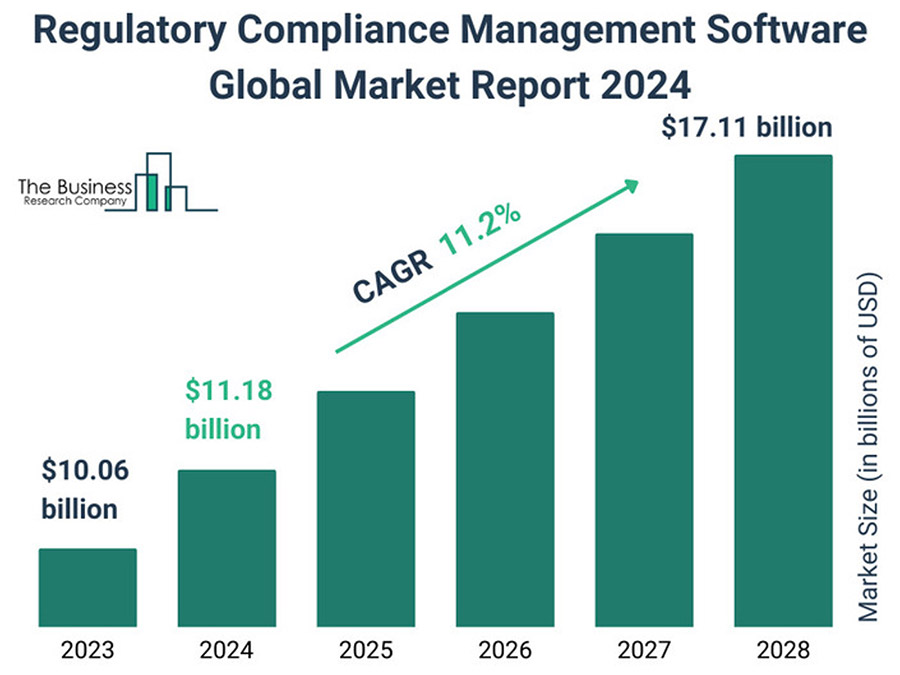
Source: The Business Research Company
The regulatory compliance management software market size has grown rapidly in recent years. It will grow from $10.06 billion in 2023 to $17.11 billion in 2028 at a compound annual growth rate (CAGR) of 11.1%.
Compliance is no longer a function isolated to legal and audit teams. It now intersects with every facet of an organization, from human resources and IT to marketing and customer service. Aligning compliance with broader business objectives ensures that companies not only avoid penalties but also build trust, enhance efficiency, and gain a competitive edge.
Steps to achieving strategic compliance management
- Understand the regulatory landscape
Every organization operates under a unique set of regulations based on its geography, industry, and operational scope. A thorough understanding of these requirements is essential. This involves:- Identifying relevant laws and standards (e.g., GDPR, HIPAA, ISO standards).
- Monitoring regulatory changes to adapt swiftly.
- Engaging with legal advisors and compliance experts.
- Integrate compliance into business strategy
Strategic compliance goes beyond checkbox exercises. It should be embedded into the organizational strategy. This integration involves:- Mapping compliance objectives to business goals.
- Involving leadership in compliance discussions.
- Defining metrics to measure both compliance effectiveness and its contribution to business success.
- Adopt a risk-based approach
A risk-based compliance strategy focuses on areas with the highest potential impact. This approach prioritizes resources and efforts where they are needed most. Key steps include:- Conducting regular risk assessments.
- Classifying risks based on severity and likelihood.
- Implementing controls to mitigate high-priority risks.
- Leverage technology for automation
Modern compliance management relies heavily on technology to reduce manual workload and improve accuracy. Automated tools help organizations:- Monitor compliance in real-time.
- Generate comprehensive audit trails.
- Ensure consistent application of policies.
Industry insights: Compliance as a competitive advantage
A 2023 report by PwC revealed that 62% of executives view compliance as a driver of competitive advantage. Companies that proactively manage compliance tend to:
- Foster trust with customers and partners.
- Enhance operational resilience.
- Improve decision-making through better data governance.
Consider the case of data privacy compliance. Organizations that demonstrate strong data protection practices attract more customers in today’s privacy-conscious world. A well-managed compliance program also enables companies to enter new markets with confidence, knowing they meet global standards.
Role of technology in compliance management
Automating compliance processes
Compliance tools powered by AI and machine learning can simplify complex tasks. For instance, regulatory monitoring platforms can scan global updates and alert organizations to changes affecting their operations.
Real-time data analytics
Advanced analytics provide actionable insights into compliance performance. Dashboards allow stakeholders to track key metrics such as:
- Policy adherence rates.
- Incident response times.
- Risk exposure levels.
- Cloud-based compliance solutions
Cloud platforms enable secure, centralized storage of compliance documents and audit records. These solutions facilitate collaboration among dispersed teams and ensure data integrity.
Challenges in strategic compliance management
Despite its benefits, strategic compliance management presents challenges, including:
- Evolving regulations: Keeping pace with regulatory changes across jurisdictions can be daunting.
- Resource constraints: Smaller organizations may lack the resources to invest in sophisticated compliance programs.
- Cultural resistance: Employees may view compliance as a hindrance rather than an enabler, leading to poor adherence.
Overcoming these challenges requires strong leadership, ongoing training, and a culture that values compliance as integral to business success.
Building a compliance-first culture
A compliance-first culture ensures that every employee understands their role in maintaining regulatory standards. Practical steps to foster this culture include:
- Conducting regular training sessions.
- Recognizing and rewarding compliance adherence.
- Encouraging open communication about compliance concerns.
Transforming compliance into a strategic asset
In an era of heightened scrutiny and complex regulations, strategic compliance management is a necessity, not a luxury. By aligning compliance efforts with business objectives, organizations can minimize risks, enhance efficiency, and create value for stakeholders.
As technology continues to transform the compliance landscape, businesses must embrace innovation and proactive strategies to stay ahead. By doing so, they will not only meet regulatory demands but also position themselves as leaders in their industries, earning trust and securing long-term growth.
The post Aligning compliance with business goals: A strategic approach first appeared on TrustCloud.
*** This is a Security Bloggers Network syndicated blog from TrustCloud authored by Tejas Ranade. Read the original post at: https://www.trustcloud.ai/compliance/aligning-compliance-with-business-goals-a-strategic-approach/
