

Home » Security Bloggers Network » The ultimate security questionnaire guide for vendors: Simplify compliance & build trust
The ultimate security questionnaire guide for vendors: Simplify compliance & build trust
If you’re like 98% of organizations, you have at least one vendor that’s had a breach in the last two years. Although this doesn’t necessarily mean affiliated organizations were affected by the breaches, it does emphasize the extensive range and proximity of potential exposure to indirect risks.
Vendors must develop a deep understanding of security questionnaires and implement best practices. By doing so, vendors can continue to do business, demonstrate their commitment to security, and safeguard the data of all parties involved.
Below is a complete breakdown of vendor security assessments, their role, topics they cover, common issues, and best practices. By the end of this article, you’ll be able to minimize risk, have an efficient vendor questionnaire answering process, and build trust like never before.
What is a security questionnaire?
A security questionnaire is a structured assessment tool used by organizations to evaluate the cybersecurity and data protection practices of third-party vendors, partners, or service providers. These questionnaires are typically issued during procurement, vendor onboarding, or compliance reviews. They help companies ensure that any third party handling their data meets required security standards and industry best practices. The questions are designed to identify how a vendor manages data privacy, system access, encryption, incident response, regulatory compliance, and other critical elements of cybersecurity.
The content of a security questionnaire can vary depending on the industry, risk tolerance, and regulatory requirements of the evaluating organization. Common categories include access control, network security, data protection, disaster recovery, and governance frameworks like ISO 27001, SOC 2, HIPAA, or GDPR. Some questionnaires are highly detailed, with hundreds of questions covering technical, operational, and policy-based controls. Others are shorter and more high-level, intended to screen vendors with low-risk exposure. In many cases, security questionnaires are based on standard frameworks such as CAIQ (Consensus Assessments Initiative Questionnaire) or SIG (Standardized Information Gathering).
Completing security questionnaires can be resource-intensive for vendors, especially if they receive multiple versions from different clients. However, organizations increasingly automate and centralize their responses using trust centers or security portals that allow real-time sharing of audit reports, certifications, and standardized answers. By doing so, vendors improve transparency, reduce delays in sales cycles, and increase trust with prospective clients. For the companies issuing these questionnaires, the process plays a vital role in third-party risk management, regulatory compliance, and overall cybersecurity resilience.
Tired of manual risk assessments that leave your board exposed?
Automate IT risk quantification with TrustCloud and confidently minimize CISO and Board liability.
What’s covered in a security questionnaire?
A security questionnaire is designed to give organizations a clear view of a vendor’s security posture by evaluating how well they protect sensitive data and systems. It typically begins by assessing core cybersecurity practices, such as network security measures, data protection strategies, access controls, and how incidents are detected and managed. These areas ensure that the vendor can safeguard critical information and respond effectively to potential breaches. Questionnaires also evaluate regulatory alignment, asking vendors to demonstrate compliance with industry standards and legal frameworks to ensure that data handling practices meet required security benchmarks.
Beyond these foundational elements, a security questionnaire dives into more specialized areas to provide a holistic assessment. Topics such as application and interface security, encryption and key management, and infrastructure security ensure technical controls are robust. It also examines governance and risk management practices, business continuity and operational resilience, and the security of data centers. Human factors are equally important, so hiring policies, personnel management, and vendor supply chain transparency are included to gauge organizational accountability. Finally, the questionnaire assesses the vendor’s ability to manage threats and vulnerabilities, ensuring a proactive approach to reducing risk across all levels of operations.
These questionnaires typically cover various aspects of cybersecurity, such as network security, data protection, access controls, incident response, and compliance with industry regulations.
Other areas covered include:
- Application & Interface Security
- Audit Assurance and Compliance
- Business Continuity Management & Operational Resilience
- Data Center Security
- Encryption and Key Management
- Governance and Risk Management
- Identity and Access Management
- Infrastructure Security
- Hiring and personnel policies
- Security Incident Management
- Supply Chain Management, Transparency, and Accountability
- Threat and Vulnerability Management
Read the “10 things to keep in mind when completing security questionnaires” article to learn more!
Why you would receive a security questionnaire
If you are being asked to respond to a security questionnaire, it’s because your company is being considered as a potential vendor or partner. That potential client wants to ensure you comply with certain compliance and cybersecurity frameworks, proactively work to lower your cyber risk, and are taking the right measures to protect data. Completing the questionnaire with thorough, accurate data is one of the first steps in building a positive, long-lasting vendor relationship. Consider these security questionnaires to be vendor due diligence questionnaires.
To facilitate this, organizations may request that you provide information through security questionnaires, which will enable them to centralize and comprehend their entire vendor landscape. Being prepared to respond to these questionnaires accurately and timely is crucial as a vendor in today’s data-driven environment.
- Proof of compliance and security maturity
Receiving a security questionnaire means the potential client is evaluating your organization’s ability to meet regulatory and cybersecurity standards. They want assurance that your company aligns with industry frameworks such as ISO 27001, SOC 2, HIPAA, or GDPR and has the right controls in place to safeguard sensitive data. - Demonstrating proactive risk management
A questionnaire helps clients understand how you identify, assess, and mitigate risks within your environment. They are looking for signs that your company is not just reacting to threats but actively managing vulnerabilities, monitoring systems, and strengthening security measures over time. - Establishing trust in vendor relationships
Completing a security questionnaire thoroughly and accurately builds trust with the potential client. It shows your willingness to be transparent, communicate openly, and maintain strong data protection practices, critical factors in creating long-term partnerships. - Centralizing vendor risk information
Clients often use these questionnaires to maintain a single view of all third-party risks across their vendor ecosystem. Your responses help them compare security postures, prioritize high-risk areas, and make informed decisions about which vendors meet their risk tolerance. - Competitive advantage and readiness
Vendors that respond quickly and confidently to questionnaires stand out. Being prepared with updated policies, evidence, and documentation not only speeds up the onboarding process but also signals professionalism, which can give your company an edge over competitors.
Read the “Best Practices for Responding to a GRC Vendor Assessment” article to learn more!
Stop wasting time on repetitive questionnaires; TrustCloud pulls the right data automatically and delivers confidence every time.
What is the difference between an RFP and an SQ?
The Request for Proposal (RFP) process provides a structured and effective way to gather information, evaluate options, and make informed decisions about which vendor to choose. The RFP business document goes into detail about what product or service the buyer wants to purchase. Once this is sent out, vendors can review it and submit their bids.
Security questionnaires (SQs) are technical questions created by IT teams and are typically used to determine a vendor’s security and compliance posture. If a company is interested in hiring a vendor, the buyer will ask them to fill out a security questionnaire. The buyer wants to make sure that the vendor meets their security requirements before potentially advancing to the next stage in the sales process with said vendor.
To figure out which kind of tool can best answer an RFP or Security Questionnaire for your org, check out our breakdown on RFP software vs. Security Questionnaire Automation.
Common security questionnaire challenges
Completing security questionnaires may seem straightforward, but for many organizations, they quickly become time-consuming and complex. Each questionnaire can differ in format, scope, and level of detail, requiring teams to track down information across departments, update documentation, and provide evidence for security controls. Vendors often face repetitive requests from multiple clients, each with unique requirements, which can strain resources and delay responses. These challenges not only impact operational efficiency but can also affect a company’s ability to build trust and win new business if not handled effectively.
Whether your company still relies on spreadsheets or you’ve (thankfully) made the transition to digital practices.
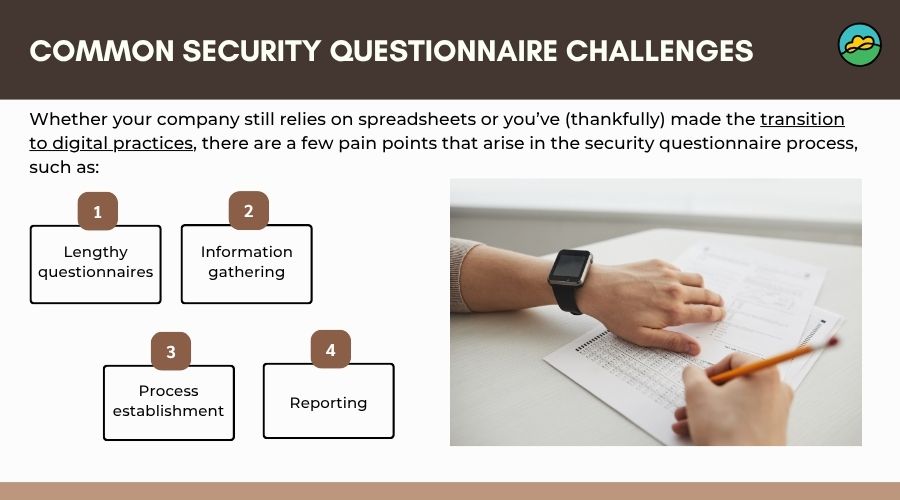
There are a few pain points that arise in the security questionnaire process, such as:
- Lengthy questionnaires: Security questionnaires are detailed and time-consuming due to their comprehensive nature. Establish a consistent data-gathering process to handle the length of questionnaires efficiently.
- Information gathering: Determine who should be involved in gathering the required information and consult subject matter experts (SMEs) for each relevant area.
- Process establishment: Establish a standardized process for answering questionnaires and ensure its consistent implementation throughout your organization.
- Reporting: Move away from ad hoc reporting and strive for uniform, consistent processes to minimize errors in security questionnaire responses.
Read the “Vendor Risk Assessments: 3 Common Mistakes to Avoid” article to learn more!
Security questionnaire best practices
Security questionnaires are a critical part of building trust with clients and partners, but they can quickly become overwhelming if not approached strategically. Following best practices ensures your responses are accurate, consistent, and delivered on time while reducing the strain on internal teams.
From organizing documentation and standardizing answers to using technology that streamlines the process, these practices help vendors demonstrate security maturity and stand out as reliable partners.
Fortunately, you can minimize and even eliminate some of the challenges that security questionnaires may pose. Below are some of our recommendations:
- Remove irrelevancies: Remove any questions from the security questionnaire that do not apply to your specific circumstances. Compile evidence and reasoning to support why those questions are not applicable. Seek clarification on any unclear questions to ensure a thorough understanding and provide comprehensive answers. Failing to address all parts of a question may put your customer and business relationship at risk.
- Have a remediation plan on deck: Have a solid remediation plan ready to address security vulnerabilities identified in the questionnaire. Demonstrate ongoing efforts to align security posture with customer expectations. Discuss the potential for another assessment questionnaire after implementing new controls. Taking responsibility for control gaps and providing a remediation plan shows honesty, accountability, and a proactive approach to earning customer trust.
- Keep it short and sweet: Make sure answers are concise and honestly assess strengths and weaknesses. Involve subject matter experts, communicate openly with partners, and ask for clarification when needed to provide accurate information to assessors.
Additionally, the advent of AI in the security space has played a significant role in streamlining security questionnaires, providing several benefits for businesses, such as:
- Having a live, self-sustaining security portal: TrustCloud’s security portal creates bespoke portals that publicly showcase an organization’s security and compliance status. These portals highlight security credentials such as certifications, attestations, and compliance reports.
Apart from the public-facing information, users can share additional details by invitation utilizing enhanced security features like NDA click-wrapping. Proactively sharing this information helps organizations decrease the volume of security questionnaires they receive from potential clients and customers. The cherry on top? You don’t have to manage a knowledge base, because these portals maintain themselves by connecting and pulling information from your security program. It’s accurate, up-to-date, and much less work. - Faster and more accurate responses with SQ automation: These smart solutions help you save time by pre-populating answers and make collaboration among teammates easier by allowing you to assign and tag the right people for the right answers.
TrustCloud is the world’s first product to combine AI-powered security questionnaire responses with a trust portal! To read more about our smart solution, check out our page about TrustShare and our own trust portal.
How TrustCloud supercharges your security questionnaire workflow
The TrustCloud platform transforms the process from tedious to efficient, allowing teams to respond faster, more confidently, and with unmatched accuracy.
- Design or import assessments easily
TrustLens offers a user-friendly assessment builder. You can create questionnaires from scratch using your control framework or upload your existing questionnaire and let the system adapt it seamlessly. - Automated intake and tracking
Once a questionnaire lands, TrustLens organizes it into a structured form, capturing vendor details, risk metrics, policy info, and more, all programmatically. - Speedy auto-completion with TrustShare
TrustShare uses AI to draft answers for your security questionnaires, pulling from your compliance data. It accelerates the response process and cuts turnaround time dramatically. - Centralized visibility and control
Through TrustCloud’s portal, you gain oversight into your response process monitoring progress, edits, and outstanding tasks in real time for complete control and transparency. - Reduce errors and lighten team workload
Automation reduces manual mistakes and repetitive tasks. Your team can focus on refining answers and engaging with stakeholders not copying, pasting, or hunting for documents.
Creating a security questionnaire response library
Establishing a Security Questionnaire Response Library is one of the most effective ways to reduce repetitive work and improve your response accuracy over time. By housing standardized, vetted answers and supporting documentation in one easily accessible repository, your team can quickly pull responses that align with each new questionnaire’s requirements. This central library also helps ensure consistency across submissions and builds institutional knowledge that can support onboarding, audits, and cross-departmental collaboration.
5 Best Practices for Building Your Response Library
- Keep Answers Concise and Focused
Ensure every entry in your library directly addresses the question. Avoid unnecessary elaboration and back each answer with clear, relevant evidence, whether that’s a policy reference, audit report, or screenshot. This clarity builds trust and reduces back-and-forth clarification. - Centralize Documentation
Collect all supporting documents, security papers, certifications, and audit reports in a centralized repository. This makes it easy to attach the right evidence quickly and helps ensure that it stays up-to-date and accessible. - Use Version Control for Accuracy
Regularly review and update stored responses and attached documents. Version control ensures that outdated answers don’t get reused, and your library remains a reliable, up-to-date resource. - Tag Entries for Easy Searching
Assign meaningful tags, like “ISO 27001,” “incident response,” or “data encryption,” to each answer or document. Tagged entries allow you to quickly retrieve relevant information based on questionnaire topics or frameworks. - Leverage Collaboration and Automation Tools
Use platforms that support shared access, editing, feedback, and automation. Many modern tools offer AI-assisted matching and auto-population, which lets your team generate responses fast, then review and finalize them.
Summing it up
Security questionnaires no longer need to feel like roadblocks; they can become powerful proof points. Mastering them boosts confidence, streamlines vendor reviews, and brings teams together around compliance goals. By applying smart preparation, reusing pre-vetted answers, and leveraging automated tools like TrustCloud, you transform a time-consuming chore into a strategic advantage.
The companies that win today are the ones that respond fast, clearly, and consistently. Make security questionnaires a seamless part of your process and let them help you stand out with clarity, speed, and trust.
FAQs
What is a security questionnaire, and why do companies use them?
A security questionnaire is a structured set of questions issued by companies to prospective vendors. Its purpose is to assess how well a vendor manages security and privacy, including data protection controls, compliance with standards, access management, incident response, and operational resilience. Organizations typically issue these questionnaires during the vendor assessment phase to mitigate third-party risk.
They often draw from well-known frameworks like SOC 2, ISO 27001, NIST, or SIG to align with compliance expectations. Vendors who respond comprehensively demonstrate transparency and build trust early. For the requesting company, responses highlight strengths, gaps, or risks before any formal agreement is signed. This helps ensure that selected vendors meet security expectations and support robust supply chain governance.
What steps should vendors take to streamline the questionnaire process effectively?
Vendors can significantly reduce response time and improve accuracy by adopting a structured approach. First, an intake process should collect incoming questionnaires through a centralized portal, whether via CRM integration, web form, or designated email address, to track requests efficiently.
Next, vendors should build an answer library: reusable, consistent responses to common questions, ideally tagged and version-controlled for quick retrieval. A trust profile provides pre-populated proof points like certifications and policies, reducing the need for repeated attachments. Metrics tracking helps monitor volume, response time, and effort spent per questionnaire.
Finally, vendors should maintain an audit trail of submissions and approvals, assigning responsibilities to subject matter experts across departments (IT, security, and compliance) and enforcing quality control before submission.
What best practices help vendors deliver effective and consistent questionnaire responses?
Effective questionnaire responses hinge on clarity, consistency, and relevance. Vendors should respond only to what is asked and avoid submitting unnecessary details that confuse reviewers. Keeping documentation like SOC 2 reports, policies, and evidence libraries accessible ensures responses are backed by credible proof. Customize language to align with the style of each questionnaire, while mapping repetitive questions to standardized answer formats.
Internal collaboration with relevant departments ensures correctness and helps avoid misstatements. Finally, preemptive outreach with the requesting company clarifies ambiguous questions upfront, improving alignment and reducing the need for follow-up. This proactive, organized approach not only accelerates sales cycles but also positions vendors as reliable, professional, and security-conscious partners.
The post The ultimate security questionnaire guide for vendors: Simplify compliance & build trust first appeared on TrustCloud.
*** This is a Security Bloggers Network syndicated blog from TrustCloud authored by Mimi Pham. Read the original post at: https://www.trustcloud.ai/security-questionnaires/ultimate-security-questionnaire-guide-for-vendors/

