

The Top SOC Analyst Challenges

If you’re a SOC analyst, you know that security alerts never end. No matter how large or small the organization you work for, there always seems to be more work to do. From new vulnerabilities to critical alerts and ongoing patches that need to be applied, the struggle goes on.
Analysts in today’s SOCs are tasked with ensuring that their organization is protected from cyber threats. This can be a difficult job to balance, with so many different types of threats and so many incoming alerts – it’s easy to become overwhelmed.
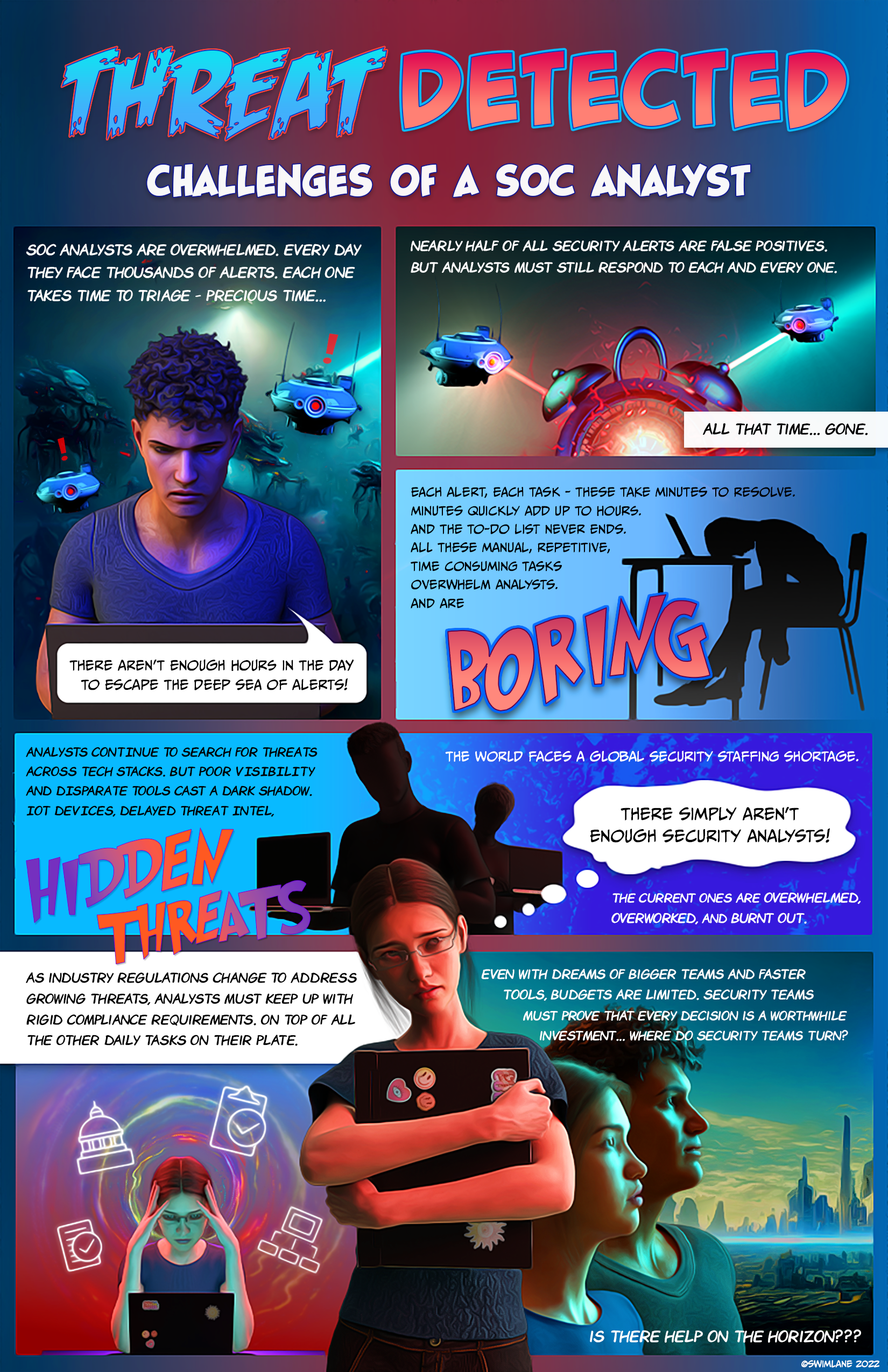
Jump to the graphic novel, below.
Now, let’s dive into the top challenges for analysts in the security operations center (SOC).
Too Many Alerts
56% of large organizations deal with 1,000+ security alerts daily. That puts SOC analysts in a tough position. They’re the first in line to stop active threats and they have to know what’s going on in their networks at all times. The problem is that the SOC analyst deals with too many alerts to triage them all effectively.
55% of security teams say critical alerts are being missed, which fuels work frustrations for analysts. It’s no wonder then that 62% of security professionals say that alert fatigue has led to staff turnover.
Too Many False Positives
43% of security pros find that 40% of their alerts are false positives.
SOC analysts deal with too many false positive security alerts. It’s tedious to sift through all the noise and find the real threats, which means SOCs are missing out on critical opportunities to stop threats early. This results in increased analyst burnout and makes it harder for them to do their job effectively.
Understaffed Security Teams
57% of the industry describes the global security skills shortage as either ‘very bad ‘or ‘serious’.
Analysts are feeling the effects of understaffed security teams. They are often stretched thin, with little time for training or other responsibilities. It also means that it takes longer for them to respond when incidents occur since there’s typically a backlog of work. Analysts must then take more time to investigate whether it’s a legitimate threat or false alarm — leading to wasted time and money spent investigating non-events.
Poor Visibility in Environments
54% of security teams describe visibility as a key challenge in SecOps.
Analysts are tasked with addressing threats and vulnerabilities, but they don’t always have access to the data they need. Siloed tools and delayed data ingestion make it nearly impossible to get real-time data. Delays or incomplete analysis can lead to undetected threats.
It takes an average of 280 days to contain a data breach, which puts even more stress on analysts.
Spending Too Much Time on Manual Tasks
78% of analysts say that it takes them an average of 10+ minutes to investigate each alert.
The amount of data that is collected in an enterprise environment is enormous, so it’s no surprise that SOC analysts spend most of their time collecting, analyzing and reporting on data. This leaves little time to triage critical alerts, proactively hunt threats, or invest in training. No wonder then that 92% of security professionals agree that automation is necessary to deal with these large alert volumes.
Compliance Challenges
69% of security teams note that regulatory compliance is a major part of their security spending.
Compliance is a big deal for SOCs. It’s not just about keeping your organization out of hot water; it’s also about demonstrating to customers that you’re taking security seriously. But one of the biggest challenges faced by SOC analysts is maintaining compliance while working within constrained systems and budgets.
Limited Security Budgets
Even amid expensive, damaging cyber-attacks, security teams still struggle with limited budgets. Analysts understand that there are solutions available to improve security performance, like dwell time, MTTD and MTTR. But if the budget isn’t there, analysts are stuck manually triaging threats.
Security teams need to be able to track metrics and pull reports to demonstrate value. However, there usually isn’t enough time or enough existing capabilities to do this effectively.
Security analysts are up again a deep sea of alerts. Considering the size and scope of any SOC, security analysts often have their hands full with large volumes of data and alerts to sift through. However, with the right tools and processes in place, SecOps could tackle these challenges head-on, in turn enabling them to protect their organizations.
Dive into the short graphic novel, Threat Detected: Challenges of a SOC Analyst.
*** This is a Security Bloggers Network syndicated blog from Swimlane (en-US) authored by Ashlyn Eperjesi. Read the original post at: https://www.swimlane.com/blog/top-soc-analyst-challenges/
