

Friday, June 12, 2026

Security Boulevard Logo

Security Boulevard

The Home of the Security Bloggers Network

Community Chats Webinars Library
  • Home
    • Cybersecurity News
    • Features
    • Industry Spotlight
    • News Releases
  • Security Creators Network
    • Latest Posts
    • Syndicate Your Blog
    • Write for Security Boulevard
  • Webinars
    • Upcoming Webinars
    • Calendar View
    • On-Demand Webinars
  • Events
    • Upcoming Events
    • On-Demand Events
  • Sponsored Content
  • Chat
    • Security Boulevard Chat
    • Marketing InSecurity Podcast
    • Techstrong.tv Podcast
    • TechstrongTV - Twitch
  • Library
  • Related Sites
    • Techstrong Group
    • Cloud Native Now
    • DevOps.com
    • Security Boulevard
    • Techstrong Research
    • Techstrong TV
    • Techstrong.tv Podcast
    • Techstrong.tv - Twitch
    • Devops Chat
    • DevOps Dozen
    • DevOps TV
  • Media Kit
  • About
    • Sponsor

  • Analytics
  • AppSec
  • CISO
  • Cloud
  • DevOps
  • GRC
  • Identity
  • Incident Response
  • IoT / ICS
  • Threats / Breaches
  • More
    • Blockchain / Digital Currencies
    • Careers
    • Cyberlaw
    • Mobile
    • Social Engineering
  • Humor
Security Bloggers Network 

Home » Security Bloggers Network » Responding to the Twilio SMS Incident with Obsidian

SBN

Responding to the Twilio SMS Incident with Obsidian

by Emile Antone on August 25, 2022

Earlier this month, Twilio shared publicly that they had been targeted with an ongoing social-engineering phishing scam via SMS. This is the latest in a string of recent sophisticated breaches gaining access to internal systems such as the Okta LAPSUS$ hack and adversary-in-the-middle (AiTM) attacks. 

While the Obsidian organization and our platform are not directly impacted by this incident, several of our own customers were understandably concerned that they might have been affected. In this blog, we recount how Obsidian customers leveraged our platform to promptly respond to the Twilio incident, provide some guidance on potentially malicious activities to watch out for, and share our team’s thoughts on trends manifesting across recent account compromises at several organizations.

Twilio hackers compromise over 130 organizations with ‘oktapus’ phishing kit

Twilio, a leading customer engagement platform, notified approximately 125 customers that their data had been accessed by malicious actors in a recent phishing attack on August 7th, 2022. The attackers gained access to Twilio’s customer support console by stealing employee login credentials through SMS messages. These texts impersonated their IT department and included malicious URLs prompting former and current employees to falsely update their SSO credentials, using words like Okta, SSO, or Twilio. 

The hackers responsible have been very successful, hitting over 130 other organizations such as MailChimp, and Klaviyo. Customers using these services were consequently targeted with supply-chain attacks including Signal and DigitalOcean. The most recent update from Twilio on August 10th asserts that attackers have continued their social engineering efforts, as such, Twilio will not be providing further information at this time.

How to tell if you’re being targeted and respond with swift accuracy 

Around the time that the Twilio incident was announced, some Obsidian customers began to suspect that they had fallen victim to a similar breach scenario. Several of their employees began receiving suspicious text messages containing a malicious URL that appeared to point to a credential harvesting website aiming to gain access to their Okta environment.

Acting on this suspicion, their team began to review their Okta logs to identify any questionable activity. Upon doing so, they observed numerous requests from user accounts to enroll new devices for multi-factor authentication (MFA) and deactivate existing trusted devices.

While not inherently malicious behavior on its own, the registration of a new device for MFA allowed our customer to begin investigating potentially compromised user accounts. Within minutes, Obsidian’s custom detection capabilities were leveraged to trigger anytime new MFA devices were successfully enrolled in Okta which signaled the successful enrollment of a new device for MFA. This enabled the swift identification of employees who may have fallen victim to the SMS phishing attack. With a cohort of potentially compromised users easily identified, they focused their time on investigating each individual from within the Obsidian portal.
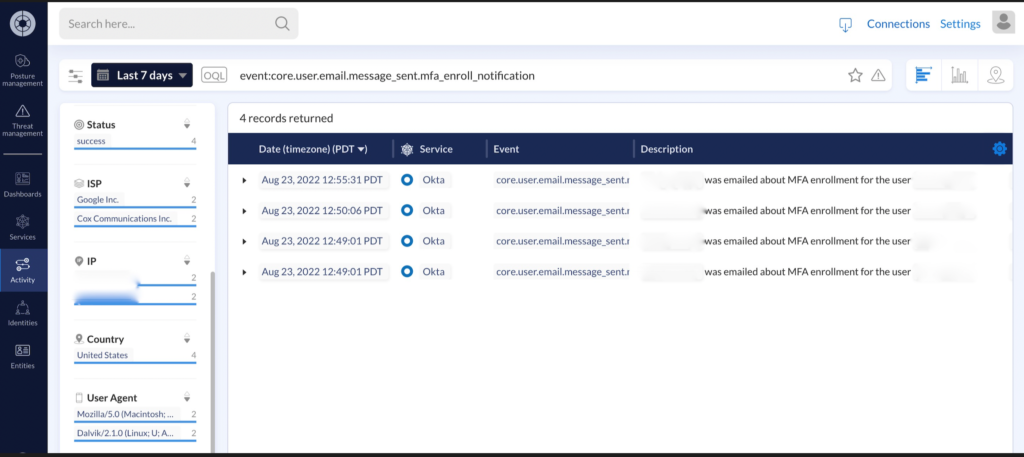
Our customers leveraged Obsidian user dashboards and custom detections to stay ahead of potentially malicious activity from accounts with unusual client details. The platform’s built-in threat detection models like impossible travel were also critical for providing further evidence of compromised accounts. The ability to easily pivot and investigate all relevant contexts for a compromised user—their accounts, events, and activities—throughout the SaaS environment significantly reduced the time and effort required for thorough incident response. Compromises were quickly identified, and security teams were able to effectively respond.

A Changing Face of Compromise

Businesses have collectively moved into a “SaaS forward space,” entrusting an unprecedented amount of sensitive data to a proliferation of cloud applications. With adoption continuing to expand, protecting these services and the IDPs that validate access to them has never been more business-critical. SaaS complexities and resulting visibility gaps introduce significant risks to your business that cybercriminals are actively exploiting. A wealth of sensitive data combined with immature control and detection frameworks make SaaS a prime target. To respond quickly and confidently, security teams need a way to make sense of their noisy SaaS environments and identify threats across applications.

That’s why Obsidian sees threat mitigation as an absolutely critical component of SaaS security posture management (SSPM). Our team is committed to the continuous development of cutting-edge machine learning models that drive our world-class SaaS threat detections. With security teams already stretched thin by a monumental workload, it’s important to us that Obsidian offers immediate and clear investigation and remediation of SaaS threats without requiring the significant effort of deploying agents, building custom rulesets, or tuning detections.

The post Responding to the Twilio SMS Incident with Obsidian appeared first on Obsidian Security.

*** This is a Security Bloggers Network syndicated blog from Obsidian Security authored by Emile Antone. Read the original post at: https://www.obsidiansecurity.com/blog/responding-to-twilio-sms-incident-with-obsidian/

August 25, 2022August 25, 2022 Emile Antone Account Compromise, Phishing, SaaS Security, Security Advisories, SSPM, Twilio
  • ← Avoiding the Cyber Tools Integration Headache
  • Our DevSecOps Tools →

Techstrong TV

Click full-screen to enable volume control
Watch latest episodes and shows

Tech Field Day Events

Upcoming Webinars

Building a Resilient Security Culture in the AI Era with AWS & Datadog
Toxic Flows: When Your Agent Skill Becomes a Supply Chain Attack
The Future of Agentic Software Delivery: Unifying Source & Binaries
35 Million Lines, Zero Build-Breakers: How Adyen Scaled DevSecOps
How to Conduct AI-Native Bug Discovery & Triage

Podcast

Listen to all of our podcasts

Secure by Design

1 week ago | Jack Poller

Senator Sanders Wants to Own AI Companies — and Hand America’s Adversaries the Keys

2 weeks ago | Jack Poller

NIST’s Nine: The PQC Signature Race Moves to Round Three

2 weeks ago | Jack Poller

The Quantum Arms Race: Why Washington Just Wrote a $2 Billion Check to Nine Companies

4 weeks ago | Jack Poller

Beyond Moore’s Law: The Hyper-Acceleration of Autonomous AI Cyber Capabilities

1 month ago | Jack Poller

The Exception Economy: When Security Teams Stop Protecting and Start Negotiating

Press Releases

GoPlus's Latest Report Highlights How Blockchain Communities Are Leveraging Critical API Security Data To Mitigate Web3 Threats

GoPlus’s Latest Report Highlights How Blockchain Communities Are Leveraging Critical API Security Data To Mitigate Web3 Threats

C2A Security’s EVSec Risk Management and Automation Platform Gains Traction in Automotive Industry as Companies Seek to Efficiently Meet Regulatory Requirements

C2A Security’s EVSec Risk Management and Automation Platform Gains Traction in Automotive Industry as Companies Seek to Efficiently Meet Regulatory Requirements

Zama Raises $73M in Series A Lead by Multicoin Capital and Protocol Labs to Commercialize Fully Homomorphic Encryption

Zama Raises $73M in Series A Lead by Multicoin Capital and Protocol Labs to Commercialize Fully Homomorphic Encryption

RSM US Deploys Stellar Cyber Open XDR Platform to Secure Clients

RSM US Deploys Stellar Cyber Open XDR Platform to Secure Clients

ThreatHunter.ai Halts Hundreds of Attacks in the past 48 hours: Combating Ransomware and Nation-State Cyber Threats Head-On

ThreatHunter.ai Halts Hundreds of Attacks in the past 48 hours: Combating Ransomware and Nation-State Cyber Threats Head-On

Subscribe to our Newsletters

Most Read on the Boulevard

Ex-IBM Exec Accuses Big Blue and AT&T of Covering Up Foreign Data Breaches
Google Patches 429 Chrome Vulnerabilities in Major Browser Update
Anthropic’s Mythos Can Serve Up N-Day Exploits in Minutes or Hours
Zscaler Launches Industry-First Zero Trust Security for Agentic AI
ShinyHunters Secret to Success: Breaking the Trust Barrier
7 Best Local LLMs You Can Run for Coding
8 Self-Evolving Skills Hermes Agent Writes on Its Own
10 Best AI Models for Coding in 2026
10 Security & QA Skills for AI Coding Agents
12 AI Coding Agents Compared in 2026: Claude Code vs Antigravity vs Codex vs Cursor vs OpenCode vs Hermes

Industry Spotlight

Anthropic Mythos AI Model Strikes Fear in Trump Administration, U.S. Banks
Cloud Security Cybersecurity Data Privacy Data Security Featured Incident Response Industry Spotlight Malware Mobile Security Network Security News Security Awareness Security Boulevard (Original) Social - Facebook Social - LinkedIn Social - X Spotlight Threats & Breaches Vulnerabilities 

Anthropic Mythos AI Model Strikes Fear in Trump Administration, U.S. Banks

April 12, 2026 Jeffrey Burt | Apr 12 Comments Off on Anthropic Mythos AI Model Strikes Fear in Trump Administration, U.S. Banks
The Day the Security Music Died
AI and Machine Learning in Security Cybersecurity Featured Industry Spotlight Security Boulevard (Original) Social - Facebook Social - LinkedIn Social - X Spotlight 

The Day the Security Music Died

April 8, 2026 Alan Shimel | Apr 08 Comments Off on The Day the Security Music Died
The Lock, Not the Alarm: How Palo Alto’s Koi Acquisition Rewrites Endpoint Security
Featured Industry Spotlight Security Boulevard (Original) Social - Facebook Social - LinkedIn Social - X Spotlight Uncategorized 

The Lock, Not the Alarm: How Palo Alto’s Koi Acquisition Rewrites Endpoint Security

February 18, 2026 Jack Poller | Feb 18 Comments Off on The Lock, Not the Alarm: How Palo Alto’s Koi Acquisition Rewrites Endpoint Security

Top Stories

ServiceNow Fixes Flaw That Could Lead to Unauthorized Access to Instances
Cloud Security Cybersecurity Data Privacy Data Security Featured Identity & Access Incident Response Mobile Security Network Security News Security Awareness Security Boulevard (Original) Social - Facebook Social - LinkedIn Social - X Spotlight Vulnerabilities 

ServiceNow Fixes Flaw That Could Lead to Unauthorized Access to Instances

June 11, 2026 Jeffrey Burt | Yesterday 0
Zscaler Launches Industry-First Zero Trust Security for Agentic AI
AI and ML in Security Cybersecurity Featured News Security Boulevard (Original) Social - Facebook Social - LinkedIn Social - X Spotlight Zero-Trust 

Zscaler Launches Industry-First Zero Trust Security for Agentic AI

June 10, 2026 Jon Swartz | 1 day ago 0
Anthropic’s Mythos Can Serve Up N-Day Exploits in Minutes or Hours
Cloud Security Cybersecurity Data Privacy Data Security Featured Incident Response Malware Mobile Security Network Security News Security Awareness Security Boulevard (Original) Social - Facebook Social - LinkedIn Social - X Spotlight Threat Intelligence Vulnerabilities 

Anthropic’s Mythos Can Serve Up N-Day Exploits in Minutes or Hours

June 9, 2026 Jeffrey Burt | 2 days ago 0

Security Humor

Randall Munroe’s XKCD 'Husband and Wife'

Randall Munroe’s XKCD ‘Husband and Wife’

Download Free eBook

[su_panel border="0px solid #ddd" radius="0" text_align="center" padding-top="0px" padding-bottom="0px"]
The Dangers of Open Source Software and Best Practices for Securing Code
[/su_panel]

Security Boulevard Logo White

DMCA

Join the Community

  • Add your blog to Security Creators Network
  • Write for Security Boulevard
  • Bloggers Meetup and Awards
  • Ask a Question
  • Email: [email protected]

Useful Links

  • About
  • Media Kit
  • Sponsor Info
  • Copyright
  • TOS
  • DMCA Compliance Statement
  • Privacy Policy

Related Sites

  • Techstrong Group
  • Cloud Native Now
  • DevOps.com
  • Digital CxO
  • Techstrong Research
  • Techstrong TV
  • Techstrong.tv Podcast
  • DevOps Chat
  • DevOps Dozen
  • DevOps TV
Powered by Techstrong Group
Copyright © 2026 Techstrong Group Inc. All rights reserved.
×

Insert/edit link

Enter the destination URL

Or link to existing content

    No search term specified. Showing recent items. Search or use up and down arrow keys to select an item.