

A Recent OSCE in Our Team

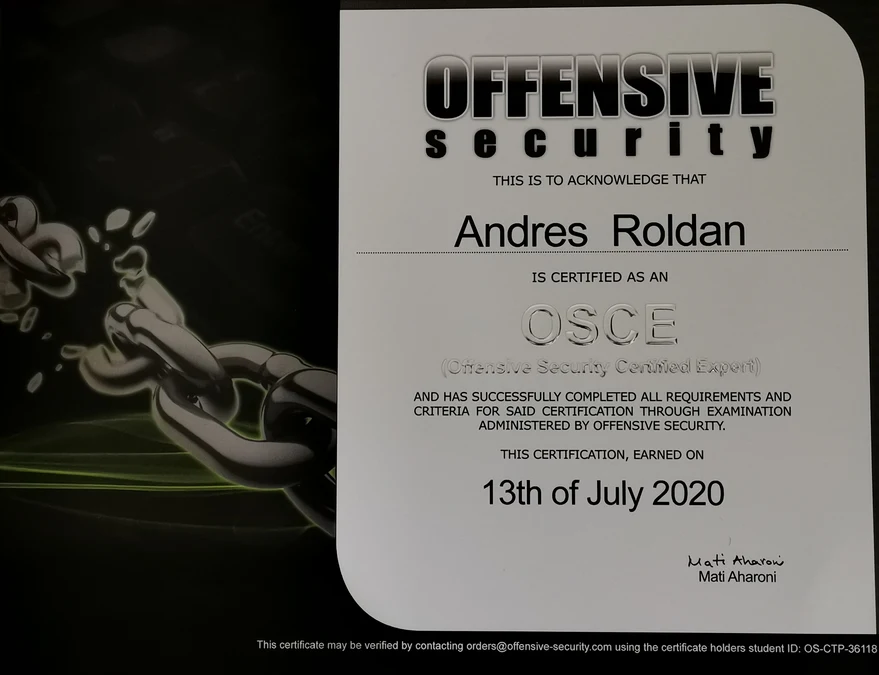
Figure 1. Certificate
A few days ago, Fluid Attacks' Offensive Team Leader Andres
Roldan, published a blog post about his
‘Journey to OSCE.’ After reading it and showing more
interest in his experience, we had some questions, which Andres was kind
enough to answer. Here we share with you some of his insights:
Why do you think you gravitated to the issues of hacking and
cybersecurity initially?
- I’ve always been curious about how things work. In college, while
studying Business Administration, some 20 years ago, I once read or
heard the word ‘Hacker’ and started reading about what it meant to
be a hacker and what skills were required. At that time, Windows 98
was in use, and terms like ‘hacker,’ ‘cracker,’ and ‘phreaker’ were
popular. Besides, Kevin Mitnick was an idol, and the movies Matrix
and Takedown were released. That atmosphere of deep knowledge was
what led me to change careers and start on the path of
cybersecurity.
Why did you read Aleph One’s article about exploitation if you didn’t
know anything about computers?
- If you searched in Altavista (the Google of 20 years ago) for terms
related to ‘hacking,’ that was one of the results. That article was
launched in Phrack magazine, which is still a reference point for
security issues.
How and when did you discover Fluid Attacks? What were the
requirements to fulfill at that time to become part of the company?
- Before
Fluid Attacks, I had a cybersecurity company, but it was
not successful.Fluid Attackswas created by some friends in 2001.
When they found out that my company was closed, they interviewed me
and asked me about my knowledge. By that time (ending 2002), the
experience I had acquired (in Linux, security, and hacking) by
studying on my own was enough to get me intoFluid Attacks.
What kind of skills and knowledge do you think a person should possess
to achieve this OSCE certification?
- The CTP course is designed to help you think in a creative way
when you are doing an intrusion. Knowledge is gained through study
and discipline, but the key is the ability to think outside the box
to resolve problems.
You told us that you did the CTP course modules several times. Why did
you do that?
- Because there are many variables to take into account when creating
an exploit. You have to understand every step, every instruction,
and why. Every application is different, and you can’t apply ‘by
heart’ attack patterns. You have to understand the reason for each
step, and that is accomplished by repetition.
What is it that changes so much between the laboratory in the course
and the exam?
- The techniques to solve the exam are taught in the course. However,
the exam exercises are not solved in the same way as the course
exercises. It is necessary to understand the problem, understand the
target’s environment, and reuse what has been learned creatively.
How does the ‘Hack The Box’ machines’ difficulty level compare to
these lab and test exercises?
- Hack The Box machines do a great job making you think
out-of-the-box. These machines use different techniques, commonly
employed on CTF challenges, but are uncommon in the real world. On
the other hand, the CTP course has exercises to exploit real
applications and real vulnerabilities using fuzzing and reverse
engineering techniques and focused on finding 0-days.
Which were the most complex challenges in the exam?
- Due to Offensive Security certification policies, students can’t
talk much about the exam details. However, all of the exam points
are not straightforward. You have to really understand what’s going
on before attempting to create a solution for the challenge. Reading
the objectives in detail for each exam point will give you a better
understanding of how to approach the solution.
What would you recommend to those who want to obtain this
certification?
- As I mentioned in the blog post, you should
perform extra self-training after the CTP course. I, for instance,
exploited several known vulnerabilities from scratch, using my
methods and exploits. Furthermore, although it’s not required to
have the OSCP certification to obtain the OSCE, I strongly
recommend it. Offensive Security certifications are meant to be
hard, and having experience with other certifications before OSCE
will be an advantage.
Regarding certificates, what is the next goal you have in mind?
- The current version of OSCE certification will disappear this
year. It will be replaced by 2 different certifications that, along
with OSWE, would be a new OSCE. However, those 2 new
certifications are not ready yet. For now, I already have a spot for
the Advanced Windows Exploitation course that will take place in
London in April 2021. That is the course required before attempting
to obtain the OSEE certification, which is regarded as the most
difficult exploitation certification in the world.
Thanks to Andres for sharing about his achievement.
Here you can read the previous post
about his experience with OSCE,
and if you want to know more about the certifications
that the members of our red team
have obtained,
you can follow this link.
*** This is a Security Bloggers Network syndicated blog from Fluid Attacks RSS Feed authored by Felipe Ruiz. Read the original post at: https://fluidattacks.com/blog/recent-osce/
