A Perspective in Cybersecurity

Daniel is a highly skilled security professional. His insights about the
current cybersecurity landscape complements previous perspectives on our
blog. Daniel has a bachelor’s degree in Computer Science and holds
qualifications such as OSCP, OSCE and OSWE. He recently finished
an MBA.
We started this conversation by discussing the main threats companies
face these days.
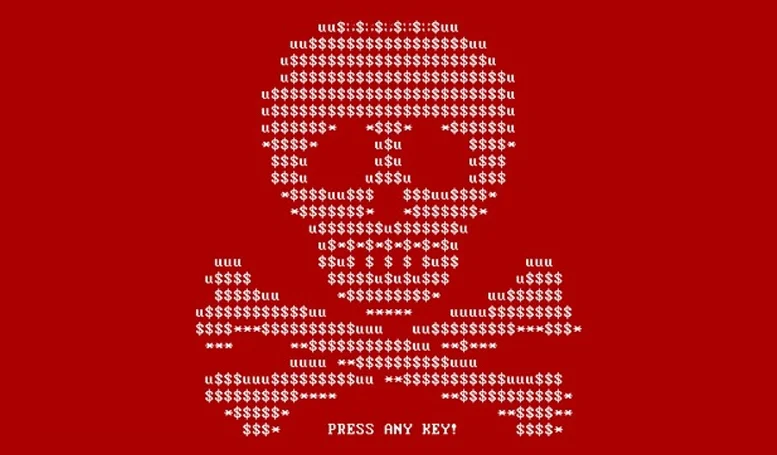
Figure 1. Splash screen of the
payload
of the original version of Petya
What are the leading cybersecurity threats organizations currently
face?
- You get to hear that newer threats are based on machine learning
(ML) and artificial intelligence (AI), but I disagree. I don’t
think this is feasible for now. Most of thoseML-based threats
seem just marketing to me. AMLapproach is viable for defense:
there is ‘big data’ on network (traffic) and user behavior, required
to train smart decision algorithms to prevent incidents.
- Current threats aren’t that different from those we have known for
years. Organizations are focusing on containing malware. Perhaps,
two newer variants are worth mentioning: malware that instantly
wipes data and criptojacking.
- Common ransomware looks to encrypt data, so that
crooks can ask for money. In the wiper malware, organizations face
data availability issues. With the wiper, attackers want to inflict
damage right away.
Is wiper worse than other types of malware?
- Not necessarily. It depends on the data and the backup policies in
place. As with ransomware, if data is fully backed-up elsewhere,
there’s no damage. If it’s not, there might be trouble. The
consequences are usually reputational, and sometimes those are worse
than financial. An example of the wiper is the NotPetya, which
caused significant trouble to
Maersk,
the Danish shipping company.
At Fluid Attacks,
we blend automation with the best talent in ethical hacking
to find weaknesses in our customer’s systems
by means of our Continuous Hacking
service.
As Daniel says,
hacking skills are still not replaceable by machines.
And the other variant?
- Cryptojacking. Capturing machines, so
third party resources are devoted to mine cryptocurrencies.
What is your opinion of cryptocurrencies?
- I believe all financial transactions will be made over blockchain or
similar technologies sometime in the future. Some big players and
central banks are doing research and testing with digital
currencies. They might find an innovative way to make it work with
current systems. Although I would say this is difficult without
undermining one of the premises by which bitcoin was proposed back
in 2008: decentralization.
What are other threats still out there causing troubles to
organizations and people?
- Phishing. It still makes it to the
ranks.
Even withML-based recognition on email providers, browser
extensions, and endpoint software protections against this threat,
nothing reduces to a great deal the odds of falling to well crafted
phishing communications. Human psychology at play.
- Other relevant threats are those coming from the supply-chain,
often overlooked. All the hardware, a significant proportion of
software, and many specific software developments aren’t
proprietary. So, what’s ‘inside’ is up to suppliers. Let’s say you
have a data center with hundreds of servers. Nobody has checked the
suppliers’ proprietary chips for malware because nobody does that.
What do these chips have? Who knows! In practice, it’s entirely
possible to program something to be activated in the future that
causes a harsh incident, or a spectacular hack. And it has happened.
See, for example, Meltdown and
Spectre. See how a telecom company
found backdoors in home
equipment.
Rate is high: a study found that59%of companies surveyed had a
Third-Party Data
Breach.
And you can keep going: a supplier has at the same time more
suppliers, and those other suppliers too. The supply-chain is
revealing itself very critical. Think ofIoTdevices in this same
line of thought: those deploying these devices face complex threats.

Figure 2. CVSS Severity Distribution Over Time. Source: NIST
- Application and infrastructure weaknesses will always be major
threats. As time passes, more and more vulnerabilities are found.
All that’s man-made is prone to error. We produce chips, create
software, deploy infrastructure, design security policies. Could
antivirus software have software weaknesses? Hell yeah, there are
plenty of
examples.
It even goes into making it possible for an attacker to gain
administrative control through the faulty antivirus by leveraging on
its privileges.
What do you think are the primarily blind spots when managing
cybersecurity?
- I like an analogy: cybersecurity works as a 4-piston engine —
people, processes, technology, and management. Pistons must be
synchronized, lubricated, going at the same speed, among others, for
the engine to work correctly. You can have the best technology,
systematic processes, and proper management. But, if people fail,
the whole cybersecurity endeavor fails. People are the piston that
fails the most. That’s why, I believe, we see so many incidents and
frauds. People keep clicking malicious links; people still give
information away they should not. Small actions are all attackers
need.
Do you think the problem is that people fall into those attacks?
- Not only on those, but people also fall for other untargeted
attacks. We invest in high technology; we streamline processes;
managers are conscious and attentive to cybersecurity. But it takes
only one person to open a breach. Perhaps, we should do more on
awareness.
Are awareness programs the solution?
- I’m in favor of awareness programs. Nonetheless, it’s not enough to
focus on employees only. I think we have to start educating at an
early age about risks in the information, digital, and technology
domains. As the idiom says, you can’t teach an old dog new tricks.
What about a more interactive approach where people could face a
threat more realistically?
- A must. In the NIST Cybersecurity
Framework, this is
recommended. Some day I gave a one-hour talk. I described risks and
how we can prevent them. I showed people
websites where they could check if
their emails have been compromised in well-known incidents. People
liked it and were engaged. Afterward, we ran a simulation where
people could fall for a real attack. They didn’t know. A
non-negligible proportion of attendees, many of them security
professionals just fell. Just telling people what to do or not, is
far from enough.
- But, when people face and feel the downsides of risks, they learn;
they increase their awareness; they really pay attention to their
behaviors and change accordingly. People react after their security
is broken, provided that the hole brings palpable consequences.

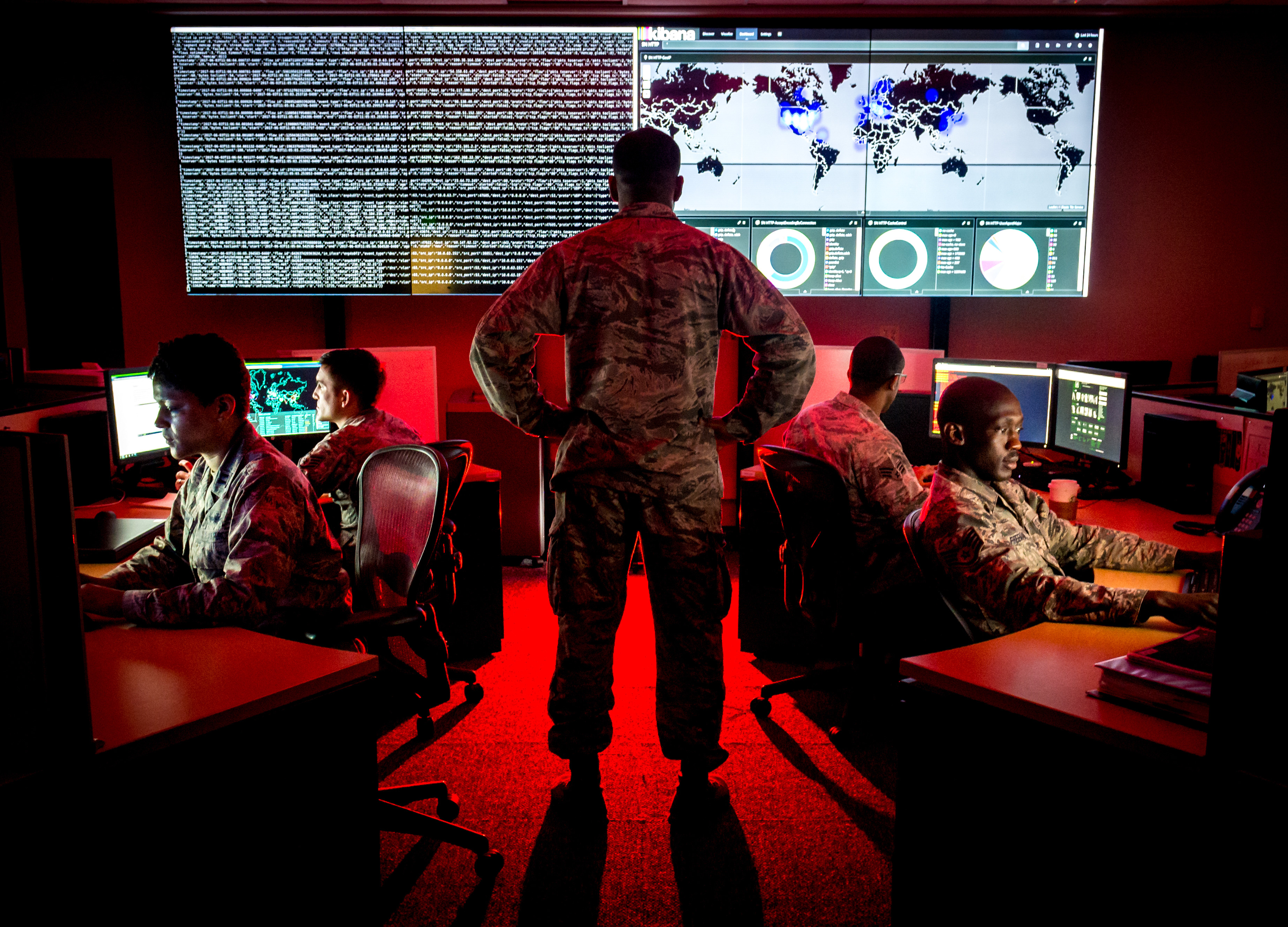
Figure 3. Cyber warfare specialists. June 3, 2017. Air Force photo by J.M.
Eddins Jr.
How can organizations do better in their pen-testing?
- I would recommend two things: focus on testing
ITassets where an
incident can endanger operations and the corporate mission. But
here’s where this suggestion makes real sense: identifying those
assets is no easy task. Not all organizations have this clear.
Companies should devote time and effort to clarify business
priorities and failure points inIT.
- Second, use a red teaming approach.
Diversity of perspective adds
value. One or two security analysts —a typical setting— could do a
good job, but a more diverse approach to attacking could mean
exceptional performance.
We’re grateful to Daniel for this conversation. We hope you have enjoyed
this post, and we look forward to hearing from you. Do get in touch
with us!
*** This is a Security Bloggers Network syndicated blog from Fluid Attacks RSS Feed authored by Julian Arango. Read the original post at: https://fluidattacks.com/blog/chat-with-correa/