

Understanding Program Semantics

Thus far, we have established the need to represent code as
vectors before feeding it into a machine learning
classifier that will help us sort through a messy
project. We have also discussed at length why neural
network based encoders are probably the best for this task. However, a
new problem arises from this. In the case of natural language, the
features and labels were clear: we try to predict neighboring words from
a central word, as is done in code2vec. But with code we have more
freedom, in a way: code has several special properties and structure. So
we need to decide how to represent pieces of code before even feeding
them to the network that will give us the vector representations, if you
recall, as a by-product in the middle layers.
One of these possible representations, is to represent snippets of code
as bags of words (tokens), i.e., a simple assignment of words to numbers
and then making up a vector around that saying which tokens occurr in a
snippet. And, by the way, we skip the neural network encoder. This is
what we did initially, but it is clear
even from the foundations that this leaves room for improvement.
Another possibility is to use the snippet’s Abstract Syntax Tree
(AST), which, incidentally, is what they use in tools such ascode2vec andcode2seq. However an issue that we could claim
to be present here is that code is not just about syntax, but it also
has rich semantics which could be exploited by us to obtain more useful
vector representations and thus, hopefully, better results at the
classifier level. Remember: garbage in, garbage out. The better the
input to the classifier, the better the triaging overall.
One interesesting approach I found which does take into account the
semantics of the code to be represented works by using intraprocedural
symbolic execution. Let’s see if this
improves accuracy and actually adds value to our toolchain.
As a refresher, recall that symbolic
execution. traverse all the paths a
program could take with all possible inputs, never defining them (unlike
fuzzing), but rather treating them symbolically like algebraic
indeterminates.
In the work we are reviewing, these paths are known as traces which are
left during the symbolic execution and are further abstracted or, if
you will, simplified, so that a simple snippet like the following
becomes two abstracted traces like this:
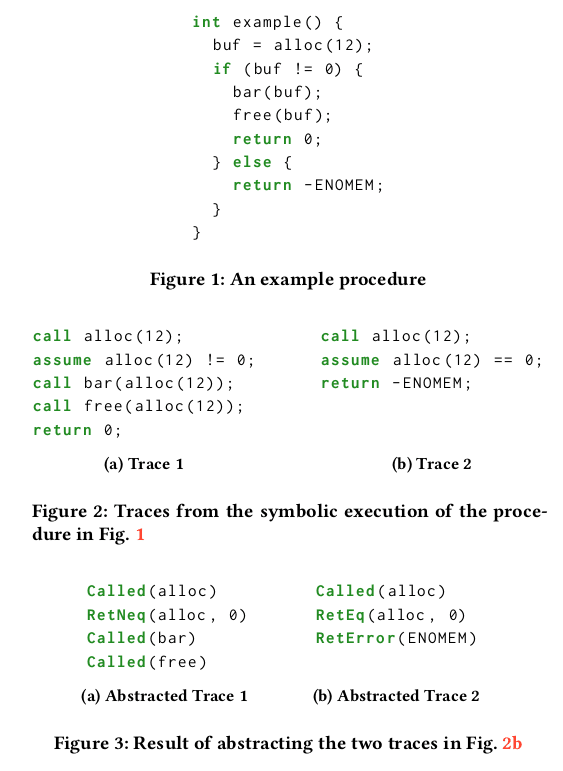
Figure 1. Abstracted traces from a snippet
Incidentally, these Call, Error, AccessPath, etc type of
abstractions subtly hint at an idea we’ve been considering, namely,
using an intermediate representation of code before performing the
actual encoding. This could be one such candidate, but pseudocode,
assembly or even some other ad hoc kind of intermediate representation
would solve or improve on two issues at hand:
Code from different clients will come in different programming
languages.Protecting the customer’s code from leakage by adding another
masking layer.
Back to abstracted symbolic traces, they then proceed to encode these as
words in order to use GloVe, a sort of big brother to Word2Vec. (I
warned you, most code encoders either work with or are heavily inspired
by W2V). GloVe exploits the intutition that when words appear
together frequently, they have some relation, which seems reasonable in
the regular usage of language. It remains to be seen how well such an
idea translates to code, though.
That describes the entire architecture of this system of embedding code
into vectors. They ran comprehensive experiments to determine the added
value vs the overhead of running symbolic execution regarding the
quality of the learned embeddings. One is the production of code
analogies: much like “king – man + woman = queen” for natural
language, similar relations arise here, such as “receive` is todownload as send is to `upload”, where each of those are tokens
naturally occurring in snippets of code. Of course, this is not yet
standardized, so the is no benchmark; the authors had to make their own
benchmark and corresponding dataset, a task we will certainly be
confronted with soon.
The most eye-opening result is the comparison between syntactic and
semantic based embeddings:
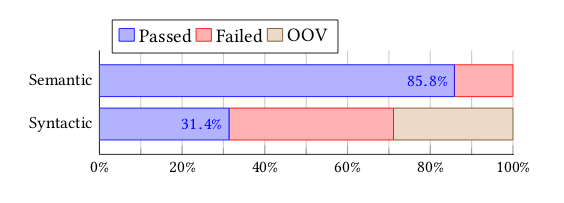
Figure 2. Syntactic vs semantic embeddings
Almost 300% better. This makes intuitive sense, since considering more
information, and especially the information which gives code its
meaning, should give better results. However only the experiment
proves it. And quite resoundingly at that. In the image above, OOV means
out-of-vocabulary tests, i.e., the ones that can’t be tested. Even
leaving these out, the semantic results are twice as good as the
syntax-based ones. This means, on the one hand, that is is certainly
worthwile to include semantic information in the code representation for
input to embedders, despite the overhead. On the other, to be fair, the
syntax-only approach they use might not be as sophisticated as, say,code2vec. It could be that we are comparing the weakest machine gun to
the weakest pistol, instead of to the strongest, which might win (sorry,
I’m short on metaphors today, but you get the idea).
The authors were nice enough to dedicate a section to the potential
usage of their tool in downstream tasks, such as error-code misuse
detection. That is, they don’t just give the tool, but also show you how
to integrate it into a complete machine learning toolchain, which is
nice for a research paper, where they usually don’t bother and leave it
up to the reader to figure that out. More interestingly for us, they
focused on bug-finding (although not strictly security-focused), and the
automatic repair of such code. The results gave an accuracy of 76.5%,
which as we haven seen throughout the series, is not bad in this
context.
This is, overall, a tool which we might actually use for our purposes
but, more importantly, shows us the importance of considering semantic
information before even attempting to design the network for embedding
code into vectors. More on that soon.
References
- J. Henkel, B. Liblit, S. Lahiri, T. Reps. Code Vectors:
Understanding Programs Through Embedded Abstracted Symbolic Traces.
ESEC/FSE ’18.
*** This is a Security Bloggers Network syndicated blog from Fluid Attacks RSS Feed authored by Rafael Ballestas. Read the original post at: https://fluidattacks.com/blog/understand-program-semantics/
