

We Need More Training in Basics

Ricardo is a DevOps engineer
in Australia.
Previously,
he worked for Fluid Attacks as a security analyst and instructor.
He also spent a couple of years developing
and maintaining an educational platform
focused on coding and security,
where students learned by solving programming challenges.
He also had his feet in academia for a while:
he holds an MSc in Engineering
and finished his dissertation in Germany.
As with previous interviewees,
we reached him out to discuss cybersecurity.
At first, he shared a bit of his experience in doing his MSc. To our
surprise, he wasn’t that enthusiastic.
Why did you get frustrated about research?
The main issue was the friction and the amount of time you have to
spend justifying ideas already validated by the industry. You end up
allocating too much energy looking for the right paper or the proper
journal to support the choice of your methods, which is probably
already outdated compared to alternative sources of information.
This is even more pronounced in cybersecurity.Another aspect was that the academic settings weren’t fun enough for
me. I enjoy learning about technology because I can apply my skills
to solve problems of increasing complexity. However, I found myself
researching and writing papers without having enough time to play
with the methods I have designed. Some people like to work on
improving state of the art in methods and tools by designing
rigorous experiments. Other people enjoy applying the best-known
techniques to solve new problems. I discovered that I am in the
latter group
What can you say about academia and cybersecurity?
- There is a vast gap between what industry needs and what is taught
in colleges. We need more training in security skills. It isn’t that
difficult to learn; nonetheless, you still get to know plenty of
developers with no notion of effective security practices. That’s
the reason I was attracted to work on an education platform some
time ago.
What you just mentioned is paradoxical. Why this paradox?
Some people get into college, waiting to be fed with everything
needed to succeed in a future job. That job probably doesn’t exist
yet; that’s the paradox. Therefore, no matter how much knowledge you
accumulate. At some point, you will need to learn more every day. +
+For example, when I was an undergrad, all we know today as cloud
computing wasn’t even mentioned, let alone how to protect those
environments. In contrast, the industry was promoting these new ways
of provisioning infrastructure, the tools were getting traction, and
some companies were spreading knowledge and training people. But,
this is the nature of our field. Computer science evolves so fast
that academia is incapable of catching up. Self-teaching and
self-learning are more widespread these days, and people are
becoming more aware that they should keep learning.
How do you study? How do you learn what you need to do in your
job?
What I’ve done is learning online through some of the many platforms
available. I have earned some certifications that are being demanded
by organizations, like AWS, GCP, or Kubernetes.Sometimes I pick a topic I don’t know, set a goal, and start
browsing web resources. I train myself around specific tasks that
interest me. Moreover, I also learn every day at work, solving new
problems.
Recently, I read somewhere that the most critical skill nowadays
for students is to know how to search in Google. You seem to nail
it…
It isn’t a joke! You find people these days getting stuck in their
jobs just because they don’t look for resources online. They might
say that they need to speak to an expert. Also, these experts many
times just google things out. It’s more of a mindset, rather than an
inability.I work building secure IT infrastructure using tools like
Terraform and GCP. I like applying software development
practices to the process of provisioning cloud resources, also known
as Infrastructure as Code (IaC). You could say I am working on the
defensive side of security; I have heard you’re doing cool stuff on
the offensive side as well, aren’t you?
Security,
as part of the development process,
is essential to Fluid Attacks.
We are proud to be working with this approach
for several years now.
Our Continuous Hacking service
relies on IaC
to support our customers consistently and faster.
We turned into cybersecurity specifics, and like with the other people
we have spoken with, we asked Ricardo about his opinion on machine
learning (ML) and artificial intelligence (AI).
What is your opinion on the contributions from ML and AI to
cybersecurity? Do you find hype here?
- We’re in the hype phase according to the famous Gartner curve. But,
indeed, there are several ML useful applications. I did some
research on the topic years ago, and I concluded the field was in
its early development. Around that time, some people even believed
ML/AI would replace developers in a few years, for example.
Something went wrong because I still got my paycheck last month
(laughing). ML is a marvelous tool, and its development should
continue. There are astonishing achievements, for instance, in
health diagnosis, computers beating humans playing games, etc., with
clear implications for society. However, those results are very
domain-specific, and most problems in real life aren’t that well
defined.
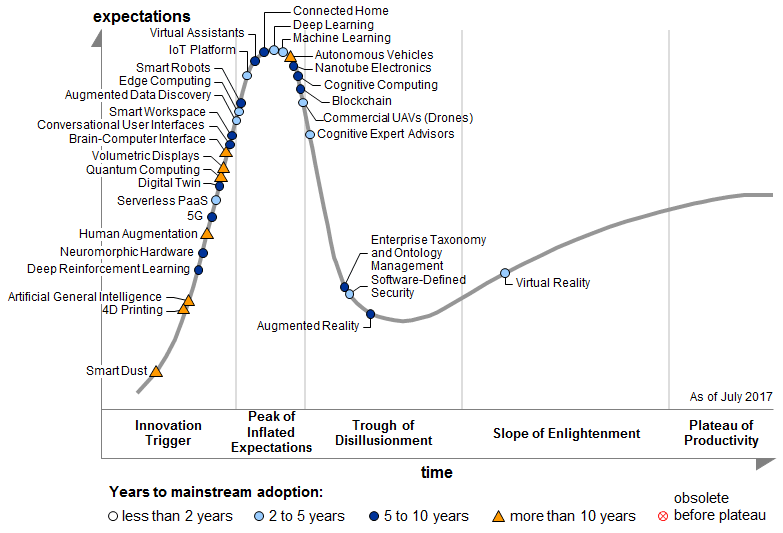
Figure 1. Hype Cycle for Emerging Technologies, 2017.
Do you think ML and AI would soon help in addressing digital threats
better?
To help yes, but not wholly address them. One of the most
significant sources of vulnerabilities is what happens at the
software design stage. Weaknesses created “by design”. For
example, in eliciting requirements, some design decisions lead to
developing functionalities in an insecure way. That is more frequent
than thought. And this is crazy: these “by-design” weaknesses are
so simple to avoid, that for a competent cybersecurity professional
is almost unthinkable to find them. The problems with these
weaknesses, if not identified in a development phase, is that they
might not be easily fixed when the software is already deployed.Perhaps, someday, a software solution could detect automatically
that kind of problems involving human judgment in the elicitation of
requirements. If so, we’re far from that.
Is this you just mentioned linked to the gap in teaching secure
software development in academia? Do you think this can be solved?
- Of course, but it isn’t a particular challenge for universities;
organizations, specifically development teams, should contribute
too. Programmers must know this. But, other people involved in
design processes, such as business analysts and software architects,
should also get to know more about security. In the initial stages
of development (requisites, domain analysis, design, etc.) it’s
enormously helpful to include a cybersecurity guy that supervises
and teaches people how to think about security and how to infuse it
from the very beginning —thus avoiding potential setbacks in the
future. Investing at that level is usually worth it.
The second part of this conversation will be published shortly. We hope
you have enjoyed this post and we look forward to hearing from
customers, partners, and friends. Do you want to share your thoughts?
Do get in touch with us!
Also,
read about our DevSecOps solution,
which helps teams implement security
from the beginning of software development.
*** This is a Security Bloggers Network syndicated blog from Fluid Attacks RSS Feed authored by Julian Arango. Read the original post at: https://fluidattacks.com/blog/training-basic/
