Sunday, December 6, 2020
  • Phishing Attacks on Your Brand are Unrelenting, AI is the Only Way to Fight Back
  • Germany’s Anti-Semitic Phonetic Alphabet
  • DEF CON 28 Safe Mode Aerospace Village – Allan Tart’s & Fabian Landis’ ‘Low Cost VHF Receiver’
  • XKCD ‘Contiguous 41 States’
  • DEF CON 28 Safe Mode Aerospace Village – Matt Gaffney’s ‘MITM: The Mystery In The Middle’

Security Boulevard

The Home of the Security Bloggers Network

Community Chats Webinars Library
  • Home
    • Cybersecurity News
    • Features
    • Industry Spotlight
    • News Releases
  • Security Bloggers Network
    • Latest Posts
    • Contributors
    • Syndicate Your Blog
    • Write for Security Boulevard
  • Webinars
    • Upcoming
    • On-Demand
  • Chat
    • Security Boulevard Chat
    • Marketing InSecurity Podcast
  • Library
  • Related Sites
    • MediaOps Inc.
    • DevOps.com
    • Container Journal
    • Digital Anarchist
    • SweetCode.io
  • Media Kit

  • Analytics
  • AppSec
  • CISO
  • Cloud
  • DevOps
  • GRC
  • Identity
  • Incident Response
  • IoT / ICS
  • Threats / Breaches
  • More
    • Blockchain / Digital Currencies
    • Careers
    • Cyberlaw
    • Mobile
    • Social Engineering
  • Humor
SBN News Security Bloggers Network 

Home » Cybersecurity » SBN News » Mapping Communication Between Facebook Accounts Using a Browser-Based Side Channel Attack

Mapping Communication Between Facebook Accounts Using a Browser-Based Side Channel Attack


by Ron Masas on March 7, 2019

A now-patched vulnerability in the web version of Facebook Messenger allowed any website to expose who you have been messaging with.

In a previous post, I showed how your Facebook likes, location history, and other metadata could have been extracted from your Facebook account using a side-channel attack I named “Cross-Site Frame Leakage,” or CSFL for short.

In this post, I’ll formalize the CSFL attack, cover the latest enhancements to it, and review the vulnerability I disclosed to Facebook.

What is a CSFL Attack?

Cross-Site Frame Leakage is a side-channel attack, performed on an end user’s web browser, that exploits the cross-origin properties of iframe elements to determine the state of a vulnerable application.

What’s a state?

Take a search results page as an example. In terms of state, the most useful information the attacker could uncover would be whether or not a given query returned results.

If an attacker could determine the state of the search results page, he could probably infer other information about the currently logged user. Click on the short proof of concept video demonstrating this.


https://www.imperva.com/blog/wp-content/uploads/sites/9/2019/03/fb-messenger-poc-smaller.mp4

Identifying the Threat

Like many people, I use Facebook Messenger to communicate with my friends, family, and businesses. As happens with applications I regularly use, I felt the need to understand how Facebook Messenger works.

I started poking around the Messenger web application and noticed that iframe elements were dominating the user-interface. The chat box, as well as the contact list, were rendered in iframes, opening the possibility for a CSFL attack.

Like in the previous bug, I relied on the ability to count the number of iframes on a cross-origin page located on a background page that could be controlled by an attacker. However, in Messenger, there was no way to create search requests without user interaction. Additionally, unlike the previous bug, the iframe count always reached three once the page was fully loaded, eliminating the possibility to detect a “state” using the number of iframe elements.

I started digging into those three iframes, in order to understand how, why and when they are loaded. I decided to record the iframe count data over time for as many endpoints I could find, with the goal of uncovering interesting and detectable states.

After a few tests, I started looking into the conversation endpoint. I recorded “full state” data, meaning pages that would load my conversation with a user I’ve been in touch with, and some “empty state” data, showing conversations with users I’ve never contacted.

After looking at five examples, it was clear I was on to something. The “empty state” charts consistently produce an interesting pattern as you can see in the visualization below, and in proof of concept video above.

The top blue line is the iframe count for the empty state, the bottom red line is the count for the full state.

When the current user has not been in contact with a specific user, the iframe count would reach three and then always drop suddenly for a few milliseconds. This lets an attacker reliably distinguish between the full and empty states. This could let him remotely check if the current user has chatted with a specific person or business, which would violate those users’ privacy.

To summarize, by recording the frame count data over time, I found two new ways to leak cross-origin information. By looking at patterns instead of a static number, I was able to leak the “state” of a cross-origin window, either by analyzing the raw pattern or by timing certain “milestones” of the pattern.

Attack Flow

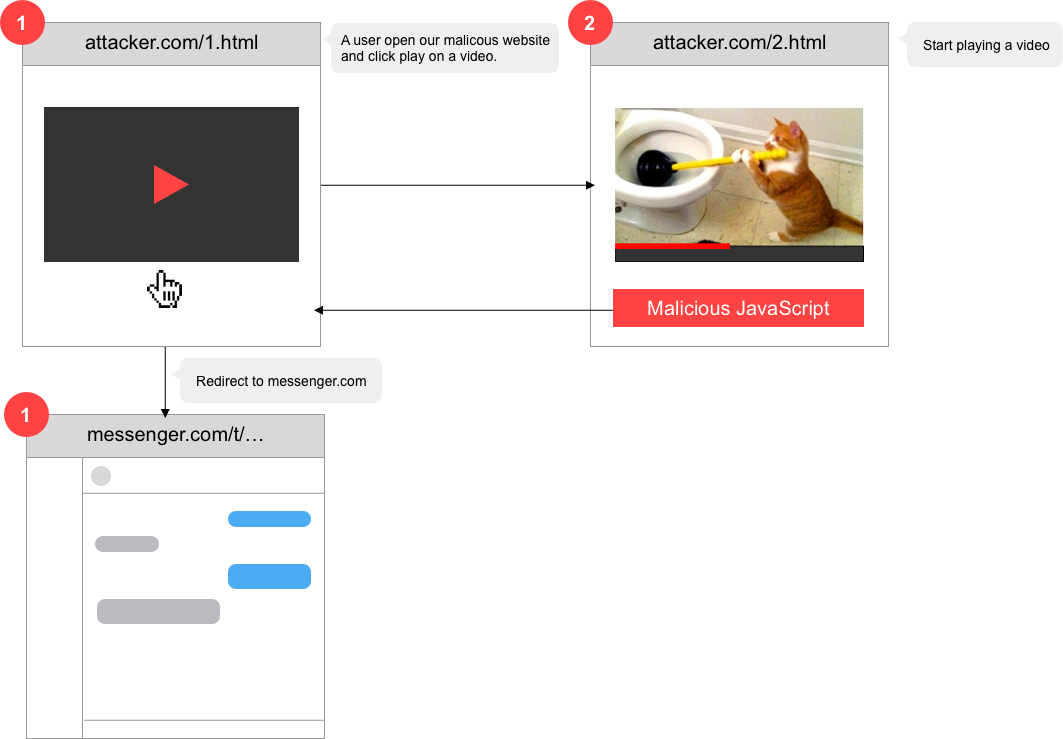
For this attack to work we need to trick a Messenger user into opening a link to our malicious site. Next, we need the user to click anywhere on the page. For example, this could be a video play button.

Once clicked, a new tab would open while keeping the previous one open in the background.

The new tab would start playing a video, keeping the user busy while we load the user messenger conversation endpoint in the background tab.
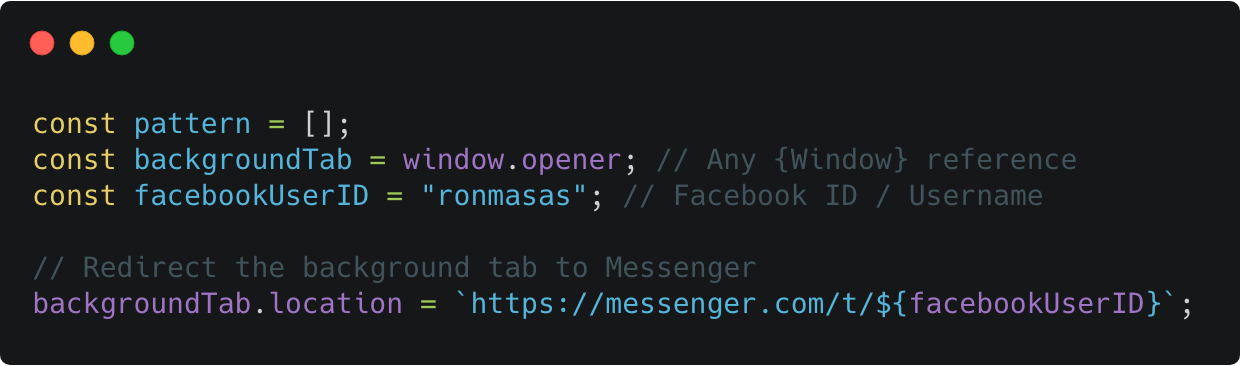
While Messenger loads in the background, we record the iframe count as I previously explained, allowing us to detect whether or not the current user has been in contact with specific users or Facebook Messenger bots.
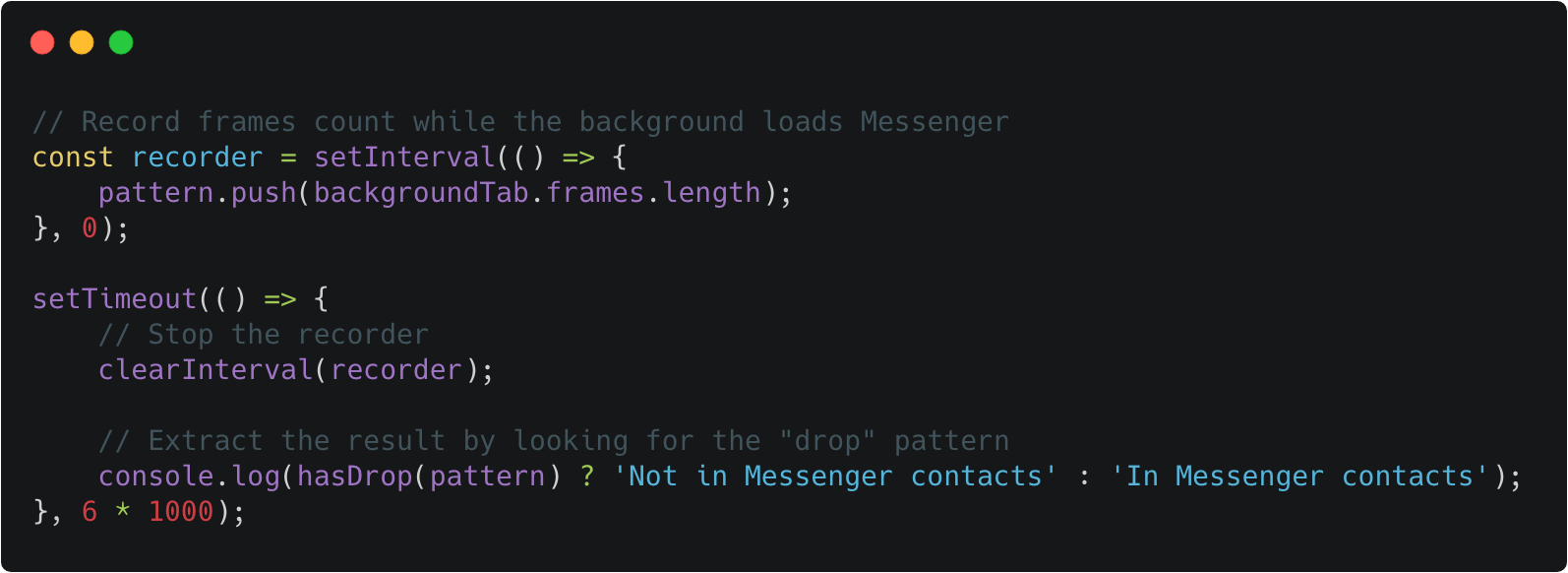
Full POC script: https://gist.github.com/masasron/1beca41f42599db1c6d48a89e135f653

Mitigation

Having reported the vulnerability to Facebook under their responsible disclosure program, Facebook mitigated the issue by randomly creating iframe elements, which initially broke my proof of concept. However, after some work, I managed to adapt my algorithm and distinguish between the two states. I shared my finding with Facebook, who decided to completely remove all iframes from the Messenger user interface.

Closing Thoughts

Browser-based side-channel attacks are still an overlooked subject, while big players like Facebook and Google are catching up, most of the industry is still unaware.

I recently joined an effort to document those attacks and vulnerable DOM APIs, you can find more information on the xsleaks repository (currently still under construction).

As a researcher, it was a privilege to have contributed to protecting the privacy of the Facebook user community, as we continuously do for our own Imperva community.

The post Mapping Communication Between Facebook Accounts Using a Browser-Based Side Channel Attack appeared first on Blog.


Recent Articles By Author
  • Now-Patched Google Photos Vulnerability Let Hackers Track Your Friends and Location History
  • Patched Facebook Vulnerability Could Have Exposed Private Information About You and Your Friends
  • WordPress Arbitrary File Deletion Vulnerability Plugged With Patch 4.9.7
More from Ron Masas

*** This is a Security Bloggers Network syndicated blog from Blog authored by Ron Masas. Read the original post at: https://www.imperva.com/blog/mapping-communication-between-facebook-accounts-using-a-browser-based-side-channel-attack/

March 7, 2019March 7, 2019 Ron Masas Application Delivery, application state, browser, CSFL, facebook, Facebook Messenger, iframe, metadata, Research & Reports, side-channel attack, vulnerability
  • ← SonicWall Extends SMB Cybersecurity Ambitions
  • PCI DSS Compliance for WordPress eCommerce & Business Sites →

TechStrong TV – Live

Watch latest episodes and shows
Featured Blog

Eric Kedrosky

The Future of Multi-Cloud Security: A Look Ahead at Intelligent Cloud Security Posture Management Solutions

Michael Clark

Prevent Catastrophic Data Loss in the Cloud

Rich Gardner

CISO Roundtable: What We’ve Heard, and What We’re Looking Forward To

Subscribe to our Newsletters

Get breaking news, free eBooks and upcoming events delivered to your inbox.
  • View Security Boulevard Privacy Policy

Most Read on the Boulevard

Brazil Govt’s Huge Leak: Health Data of 243M
Securing the Office of the Future
California Federal Court Weighs In (Again) on Social Media Scraping
Web App Security: Don’t Let the Code Injection Grinch Steal Holiday Joy
U.S. Election Security (and Insecurities)
Drupal Core: Behind the Vulnerability
VMware Horizon Architecture: Planning Your Deployment
There’s a RAT in my code: new npm malware with Bladabindi trojan spotted
A Modern Exploration of Windows Memory Corruption Exploits – Part I: Stack Overflows
“Free” Symchanger Malware Tricks Users Into Installing Backdoor

Upcoming Webinars

Mon 07

The Battle for Container Security

December 7 @ 1:00 pm - 2:00 pm
Tue 08

XDR (Extended Detection and Response): The Next Generation of Protection

December 8 @ 11:00 am - 12:00 pm
Thu 10

Data Security for Contact Centers Leveraging Cloud Technologies

December 10 @ 3:00 pm - 4:00 pm
Mon 14

Issues and Answers in Cloud Security

December 14 @ 1:00 pm - 2:00 pm
Tue 15

3 Things to Get Right for Successful DevSecOps

December 15 @ 3:00 pm - 4:00 pm
Wed 16

Unsolved Problems in Open Source Security

December 16 @ 11:00 am - 12:00 pm
Wed 16

Securing Medical Apps in the Age of COVID-19: How to Close Security Gaps and Meet Accelerated Demand

December 16 @ 1:00 pm - 2:00 pm
Wed 16

Deliver your App Anywhere … Publicly or Privately

December 16 @ 3:00 pm - 4:00 pm
Thu 17

Secure Your Peace of Mind and Your Mobile App While Giving Developers Back Their Happy Coding Time

December 17 @ 11:00 am - 12:00 pm
Thu 17

Solving Kubernetes Security Challenges Using Red Hat OpenShift and Sysdig

December 17 @ 1:00 pm - 2:00 pm

More Webinars

Download Free eBook

Managing the AppSec Toolstack

Recent Security Boulevard Chats

  • Cloud, DevSecOps and Network Security, All Together?
  • Security-as-Code with Tim Jefferson, Barracuda Networks
  • ASRTM with Rohit Sethi, Security Compass
  • Deception: Art or Science, Ofer Israeli, Illusive Networks
  • Tips to Secure IoT and Connected Systems w/ DigiCert

Industry Spotlight

Why Hackers Love the Pandemic
Cybersecurity Data Security Industry Spotlight Security Boulevard (Original) 

Why Hackers Love the Pandemic

December 4, 2020 Chris Hallenback | 2 days ago 0
Security and COVID-19: Securing the New Normal
Cybersecurity Data Security Industry Spotlight Network Security Security Boulevard (Original) 

Security and COVID-19: Securing the New Normal

December 3, 2020 DAVID CANELLOS | 3 days ago 0
Web App Security: Don’t Let the Code Injection Grinch Steal Holiday Joy
Cybersecurity Industry Spotlight Security Boulevard (Original) Threats & Breaches 

Web App Security: Don’t Let the Code Injection Grinch Steal Holiday Joy

December 2, 2020 Ameet Naik | 4 days ago 0

Top Stories

Brazil Govt’s Huge Leak: Health Data of 243M
Application Security Cloud Security Cyberlaw Cybersecurity Data Security Featured News Security Boulevard (Original) Spotlight Threats & Breaches Vulnerabilities 

Brazil Govt’s Huge Leak: Health Data of 243M

December 4, 2020 Richi Jennings | 1 day ago 0
Second Swiss Firm Said to Be CIA Encryption Puppet
Analytics & Intelligence Cyberlaw Cybersecurity Featured News Security Boulevard (Original) Spotlight Threat Intelligence 

Second Swiss Firm Said to Be CIA Encryption Puppet

November 30, 2020 Richi Jennings | Nov 30 0
Unisys Adds Visualization Tools to Stealth Platform
Cybersecurity Featured Network Security News Security Boulevard (Original) Spotlight 

Unisys Adds Visualization Tools to Stealth Platform

November 30, 2020 Michael Vizard | Nov 30 0

Security Humor

via  the comic delivery system monikered  Randall Munroe  resident at   XKCD  !

XKCD ‘Contiguous 41 States’

Join the Community

  • Add your blog to Security Bloggers Network
  • Write for Security Boulevard
  • Bloggers Meetup and Awards
  • Ask a Question
  • Email: info@securityboulevard.com

Useful Links

  • About
  • Media Kit
  • Sponsors Info
  • Copyright
  • TOS
  • Privacy Policy
  • DMCA Compliance Statement

Other Mediaops Sites

  • Container Journal
  • DevOps.com
  • DevOps Connect
  • DevOps Institute
Copyright © 2020 MediaOps Inc. All rights reserved.

Our website uses cookies. By continuing to browse the website you are agreeing to our use of cookies. For more information on how we use cookies and how you can disable them, please read our Privacy Policy.