

The Treacherous POODLE

A gas vendor, each week receives gas, which he stores in pipes and
discretely refills them with water. Each day sells this gas to his
clients, unbeknown to an “auditor” in black robes – aka Poodle – paying
attention to this situation. One day the “auditor” undercover, tells the
vendor he will only offer gas with less octanage, thus his pipes should
met certain old requirements, ignorant of the situation he downgrades
it’s pipes standards until the “auditor” agrees on it.
Next day, the “auditor” goes to the station, disguised as a client and
ask the vendor to refill his car, next he reveals himself telling the
vendor that he knows what he is doing plus that he has outdated pipes
which represent a threat, but it won’t talk if he pays him a commision
for each sell.
Following act, the auditor was just a regular dude impersonating someone
else. And the vendor in it’s infortune, kept an old standard storage
pipes without realizing the harm it could make to it’s clients or to
himself.
I hope that doesn’t end in the worst analogy in human history, moreover
i hope it helps to understand certain technicisms we will see later. But
please, bare in mind that i’m not an expert on oil industry.
Figure 1. Black poodle
Techninal introduction
The Padding Oracle On Downgraded Legacy Encryption SSL 3.0 (POODLE v3),
it is a protocol vulnerability on Secure Socket Layer (SSL 3.0),
which can make any *Transport Layer Secure (TLS)*` version to fallback to
`(SSL 3.0) plus it takes advantage on weak encryption using a mechanism
to check message authencity using Cipher Block Chaining Message
Authentication Code (CBC-MAC), allowing an attacker to steal cookies
from an user on the same network.
Discovered on September, 2014, by Bodo Möller , Thai Duong and
Krzysztof Kotowicz from the Google security team.
If you are not aware what this terms are check the
BEAST article, the (CBC-MAC) will be
explained here, don’t worry.
Petting the POODLE
Have you clean yourself from that awful analogy? From now on, guess you
will see why i wrote it.
Whenever client and server are going to start an exchange using
SSL/TLS, they use a protocol called
Handshake, a process
that is explicity to settle a ground of standards between the client and
the server, where both agrees which SSL/TLS version protocol will
be used, the cryptography method used, key exchange, plus more.
All with the final intention to send messages while speaking on the same
language.
But why does this matter? Let’s take a look at that process step by
step:

Figure 2. Handshake step by step
Although i will not describe each step in depth, it is necesary to show
the overall
process,
to understand how does the downgrading process is and where the attack
finally lands.
In simple terms, the attack relies on the fact, that whenever an attempt
to establish a secure connection, it fails (Step 1 to Step 2), then the
server will fallback to an older protocol, [1].
Remeber the gas vendor downgrading it’s pipes until the “auditor” waits
till he has that old pipes standard? Good…
Notice that whilst TLS is the sucessor of SSL, SSL 3.0 has more
precedence than TLS 1.0 - 1.2, mostly to guarantee an smooth user
experience and interoperability across legacy machines, thought, it was
obsolete and insecure. Moreover the attack will even work if both have
TLS, [1].
Well then, let’s see how does the downgrade works.
If in the first step, the client offers it’s highest version of the
protocol, let’s say, TLS 1.2, the server, while not having such
version, will negotiate the usage of TLS 1.0 by downgrading it’s own
protocol version, but notice, that such offering can be repeated several
times as long it fails.
Quite like this:
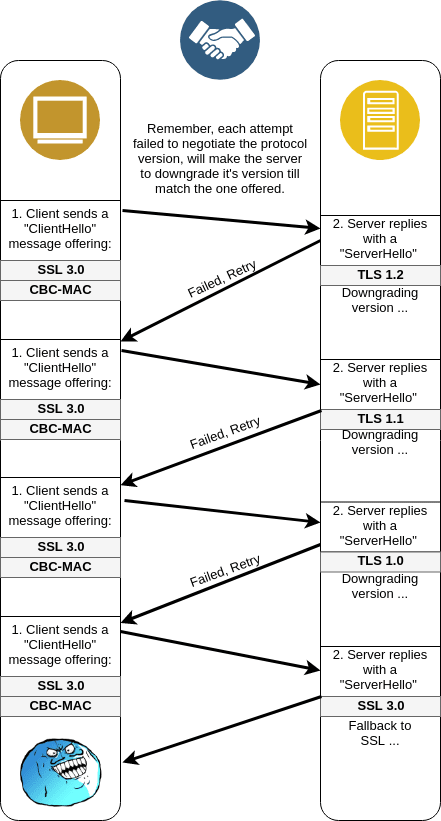
Figure 3. Protocol downgrading
Hope you didn’t miss the CBC-MAC under the protocol version, because
this is the most interesting part of this attack.
The reason behind the fallback advantage, is to force the client and the
server to use weak encryption. It won’t reveal the key, but it will
allow an attacker to eventually recreate cookies/session parameters by
intercepting the downgraded exchange channel, [2].
How does this works in SSL 3.0? Well, CBC works as expected, just
with one subtle difference, the
MAC is
done to check the authencity of a message, works like a charm on
fixed-length messages. But! not on variable-length messages as the
padding will fail to be fully verified when decrypting.
Remeber from that stupid analogy the gas vendor refilling it’s gas pipes
with water? Well, that’s what the padding is, although the CBC-MAC
algorithm won’t have any economic advantage, it just tries to handle
variable-length messages, by adding extra random characters to met the
needed multiple block-length, to get 8 or 16 bytes blocks depending on
the algorithm (DES, 3DES, AES). Taking advantage on this is ofently
called Padding Oracle Attack.
So, here is where the version downgrade lands. But let’s see it in
action with this simple example, i’m gonna use 8-bytes blocks to make it
short.
Let’s suppose we have already intercepted a client-server communication
and we have forced the use of SSL 3.0, now we are going to reveal the
encrypted messages while both are at the last step of the handshake.
Without too much details, the client sends a request to the server:

Figure 4. Http request
A message request from the client which is going to be encrypted with
DES using CBC-MAC mode. First at all, the MAC of the message
should be computed:
-
IVis full of 0’s -
XORwith each block of plaintext

Figure 5. Compute MAC
And append it to the end of the message, then check if the length of the
message is a multiple of 8 (block-size), if not, add random padding
characters at the end until it hits a multiple of the block-size and the
final byte becomes the length of the padding, which output is like this:

Figure 6. Padded message example with MAC code
Note
I will represent the random padding characters by “-“, don’t get
confused.
Then the process of encryption with CBC as described in the
BEAST article. Which output is:

Figure 7. Output of encrypted message
The message is then sent to the server, and now consider the decryption
process on the server:

Figure 8. CBC decryption
Taking on account that the exchange is being made with SSL 3.0 and the
fact that when a CBC encryption algorithm is used, SSL 3.0 does not
cover padding with MAC. Which means, that the mechanism used to verify
the authenticity of a message won’t be able to fully verify it while
decrypting it.
Did you spot something weird with this mechanism, but besides than the
stated flaw? No? Perhaps on encryption? Or before?
Well, if you didn’t, here is a clue: Authentication should be done after
encryption, NOT before. The
Authenticate-then-Encrypt
poses a problem, which by that time wasn’t that evident.

Figure 9. SSL blames SSL
So, to process each block of the ciphertext, denoted as C, the
recipient determines each block of the plaintext, denoted as P,
using the following mathematical formula, [3]:
Pi = Dk(Ci) XOR Ci-1
-
Where C0 is the
Initialization Vector (IV) -
C ranges from C1 to Cn.
-
P ranges from P1 to Pn.
-
Dk the block-cipher decryption using per-connection
key K or
This in simple words means, that each current block is XORed with the
previous block, then checks and removes the padding at the end, and
finally checks and removes the MAC.
So how does the attack use decryption to get the plaintext without the
key?
-
Considering our padding block
[------7], Cn. -
And the block we want to decrypt, Ci.
Replace Cn by Ci, usually this block
modification will be rejected, but only once on 256 request, it won’t,
the attacker will conclude that the last byte of Cn-1
XORed with Ci will yield, 7.
Mathematically speaking Dk(Ci)[7] XOR
Cn-1[7] = 7
As SSL 3.0 doesn’t care for the rest of bytes on the padding block,
less for the block-length, it will accept it. And thus that
Pi[7] = 7 XOR Cn-1[7] XOR Ci-1
a calculation which will reveal the bytes unknown on the block the
attacker wanted.
This can be seem like a duplication of certain block on the stream,
which will replace the last block, thus, the last byte will be XORed
with the last byte of the previous block, resulting in 7,
[3]. This is possible as the block is on the same
stream, thus when the message authentication is performed it will take
it as a valid block.
As stated before, this trick will be performed almost 256 request until
it’s accepted, each fail means the last byte has to be shifted.
Plus it has to be done byte by byte on the cipher stream or at least, in
each byte of the block the attacker wants to know.
Requirements
Although the attack seems quite similar with the BEAST attack, it
relies enterely on a flaw on SSL/TLS protocol.
The only requirements are:
-
Run a
Man-In-The-Middle Attackagainst the victim. -
Perform the Downgrade if
TLSis used.
Once an attacker has done it, it can steal the cookies/session from a
user.
Any patch?
Well, there is a funny quote by the researchers:
disabling the SSL 3.0 protocol in the client or in the server (or
both) will completely avoid it. If either side supports only SSL
3.0, then all hope is gone, and a serious update required to avoid
insecure encryption.
But there was and still exist an iniciative to disable
ssl from all browsers and on any servers using
it.
References
*** This is a Security Bloggers Network syndicated blog from Fluid Attacks RSS Feed authored by Daniel Yepes. Read the original post at: https://fluidattacks.com/blog/treacherous-poodle/
