

The SOAR Maintenance Tax: Why Playbook Inventories Don’t Scale in 2026

The Pattern: Coverage Equals Code, and Code Needs an Owner
There is a pattern SOC leaders will recognize. Year one with a playbook-based SOAR feels like a win. Phishing triage runs itself. Enrichment fires everywhere. The quick wins stack up fast.
Year three looks different. Hundreds of playbooks. Advanced logic living in Python scripts. Integrations that break the moment a vendor changes an API. Somewhere along the way, one of your engineers became the platform’s full-time owner. Not by job description. By necessity.
This is the operating model of an entire architecture class, not one product. Playbook-based SOARs scale coverage by scaling code. Every new use case adds a workflow. Advanced logic typically lands in Python. The estate grows, and so does the work to keep it healthy.
Reviewers across the SOAR category describe the burden in their own words. On one widely deployed platform, Gartner Peer Insights reviewers report a “high learning curve for those without Python experience, which tends to foster more reliance on professional services,” alongside “complex setup” and “expensive certification” (third-party reviews, retrieved June 2026). None of that means these products fail to work. It means the operating model carries a price the order form never shows. Coverage equals playbooks. Playbooks equal code. Code needs an owner.
The Maintenance Math: Playbooks x Integrations x API Churn
The cost compounds across three multipliers. Playbook count grows with every use case. Integration count grows with every connected tool. API churn grows with every vendor release that changes a schema or an endpoint. Multiply those together and you get the real maintenance load.
So ask the questions the order form does not. How many playbooks run in your estate today, and how many did you have a year ago? Who maintains them, and is that their actual job title? What happened the last time a vendor changed an API, and how long did the fix take?
There is one more question that reframes the renewal. If you doubled your use cases next year, what would that do to your playbook count and your maintenance hours? In a code-based estate, doubling coverage roughly doubles the inventory you must own. The dedicated resource who keeps it running is the hidden line item. That engineer is not on the order form, yet the estate cannot survive without them. The opportunity cost is everything else that person could be building instead.
The Architectural Answer: Investigation Without Prebuilt Workflows
There is another way to scale coverage, and it has to be chosen at the foundation. Investigation-first platforms remove the inventory problem at the root rather than automating around it.
Morpheus, D3 Security’s platform, was built ground-up as an autonomous SOC engine. Its investigation layer does not execute a prebuilt workflow, because there is not one. Attack Path Discovery traces the attack across identity, endpoint, cloud, and email infrastructure. It maps the blast radius, identifies the technique chain against MITRE ATT&CK, and drafts remediation. Up to 95% of alerts reach L2-analyst depth in under two minutes, with no prebuilt workflow involved.
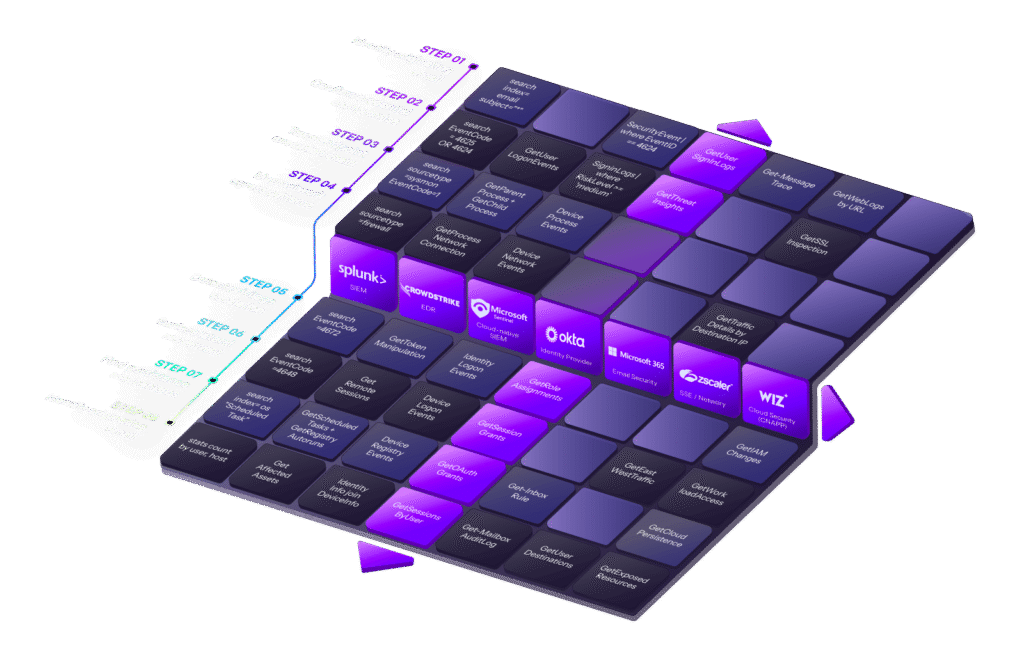
AI Adaptive Tasking plans the next investigative step in real time. It draws on the alert data, your analysts’ feedback, and the results of completed tasks. A new use case arrives, and there is nothing to script. The investigation engine handles it directly.
This breaks the scaling law. In the code-based model, coverage growth adds playbooks you must maintain. Here, coverage growth adds no code inventory at all. The Cybersecurity Triage Reasoning Graph learns from your analysts’ decisions, in your tenant, inside its gates. Coverage stops compounding your code.
Deterministic playbooks still matter for the work that should be deterministic. Containment steps, notification chains, and compliance workflows belong in code, because predictability is the point. D3 SOAR runs those on the same engine, built and maintained without a Python prerequisite. Determinism where determinism earns its place, and investigation everywhere else.
Self-Healing Integrations: The Connector Half of the Tax
Playbooks are only one half of the maintenance tax. Connectors are the other half, and they break on someone else’s schedule.
The industry norm to repair a broken SOAR connector runs 4 to 6 weeks of engineering time. In a script-based estate, that fix is Python work, queued behind everything else the maintenance owner already carries. During that window, the integration sits dark and the coverage it powered goes quiet.
Morpheus integrations self-heal. They detect API drift and auto-generate corrective code, with an 18-minute mean repair against the 4 to 6 week norm. The connector half of the tax does not disappear because someone worked harder. It disappears because the architecture absorbs the change instead of waiting for a person to fix a script.
What “Governed” Must Mean
Removing the playbook inventory cannot mean removing control. For regulated buyers, autonomy without governance is a non-starter. Governed has to mean something specific.
It means every LLM step is boxed inside deterministic playbooks, with validation gates before and after. It means every action is auto-tiered by command risk, which automatically drives approval gates. It means one audit trail that reads identically to a regulator across all four autonomy modes. And it means autonomy that maps to the frameworks your auditors care about, from SEC 1.05 to NYDFS 500, HIPAA, NERC CIP, NIS2, DORA, and EU AI Act Article 14.
The reasoning system learns from your analysts’ decisions and your threat-intel and vulnerability feeds. It learns, in your tenant, and it never acts outside its gates. That distinction matters: the platform produces evidence for the controls your auditors assess, rather than claiming to satisfy a regulation on its own.
For teams already carrying a maintenance burden, the move starts with discovery. A switch program inventories the playbook estate and splits it three ways: the playbooks that exist only to script investigation steps, which Attack Path Discovery and AI Adaptive Tasking handle with no playbook at all; the deterministic processes worth translating to D3 SOAR without a Python prerequisite; and the dead weight nobody will miss. Multiple enterprises have already made the switch. The consistent surprise is how large the first and third piles turn out to be.
So before the renewal, ask who maintains your playbooks, what your last broken connector cost in days, and what doubling coverage would do to both answers. Then bring us the numbers.
See the open, governed agentic SOC
See how Morpheus delivers the open, governed agentic SOC, or book a demo to watch it investigate live.
Frequently Asked Questions
Why do SOAR platforms require dedicated maintenance staff?
Playbook-based SOARs encode every use case as a workflow, with advanced logic typically in Python. As estates grow, playbook upkeep and connector repair consume engineering time; peer reviewers of several SOAR products report steep learning curves and professional-services reliance. Investigation-first platforms reduce the estate itself.
Can a SOC investigate alerts without prebuilt playbooks?
Yes. D3 Security’s Morpheus uses Attack Path Discovery to trace attacks across identity, endpoint, cloud, and email, mapping blast radius and MITRE ATT&CK techniques and drafting remediation, with up to 95% of alerts reaching L2+ depth in under 2 minutes. AI Adaptive Tasking then plans next investigative steps in real time, without prebuilt workflows.
What is an alternative to Swimlane that is easier to maintain?
Teams citing playbook-maintenance burden evaluate platforms that investigate without prebuilt workflows. D3 Security’s Morpheus pairs an autonomous investigation engine with a deterministic SOAR on one engine: self-healing integrations, no Python prerequisite, no AI prompt caps, priced as two platforms at one price. Multiple enterprises have switched from Swimlane SOAR to D3 SOAR.
Book your Morpheus Demo
Ready to see it on your own alerts? Request a demo and we’ll walk you through Morpheus end to end.
The post The SOAR Maintenance Tax: Why Playbook Inventories Don’t Scale in 2026 appeared first on D3 Security.
*** This is a Security Bloggers Network syndicated blog from D3 Security authored by D3 Security. Read the original post at: https://d3security.com/blog/soar-maintenance-tax/
