

Breaking the Patch Sound Barrier Part 2: So Is The Apocalypse Coming and What Is It?

So, you read my previous blog post about breaking the patch sound barrier, but it left you wanting more? Well, this is that “more.”
Here are three useful ideas to advance the conversation.
1. Defining the “Vulnerability Apocalypse”
People love to throw around terms like vulnerability apocalypse, but what does it actually mean? What is the crisp definition? Here:
Anton’s Vulnerability Apocalypse (VulnPocalypse) is …
… a rapid step increase in:
1. The number of software vulnerabilities (including zero-days i.e. vulnerabilities not known to defenders),
2. Speed of exploit development,
3. Volume of exploitation based on them,
4. Resulting incident damage.
With some help from the fine folks on Twitter and LinkedIn — and Gemini, naturally — this is what I got.
Note that for a situation to truly qualify as “an apocalypse”, all four of these factors must be present simultaneously:
- Massive Volume: A staggering influx of new vulnerabilities.
- Rapid Exploit Development: Attackers weaponizing flaws nearly immediately.
- Evident Exploitation: AI and automated tools scanning and exploiting at scale.
- Severe Incident Damage: Widespread, material business impact resulting directly from these compromises.
Let me highlight that fourth factor: incident damage. If you have a massive spike in vulnerabilities, but it doesn’t result in actual, widespread damage, it isn’t an apocalypse — it’s just a high-volume vuln Tuesday.
How do we track that this is indeed coming?
2. The Polarization of “Patch Faster”
Ever since advanced models capable of hunting down vulnerabilities emerged, the traditional advice of “just patch faster” has become incredibly polarizing. Ultimately, my take aligns closely with a recent Cloudflare post: “Patching faster does not change the shape of the pipeline that produces the patch. If regression testing takes a day, you cannot get to a two-hour SLA without skipping it, and the bugs you ship when you skip regression testing tend to be worse than the bugs you were trying to patch.”
So, yes, do patch faster. And, no, patch faster won’t save you.
What will? This!
3. A Thought Experiment: The 15-Minute Magic Wand
Let me leave you with a useful thought experiment I recently used in a presentation.
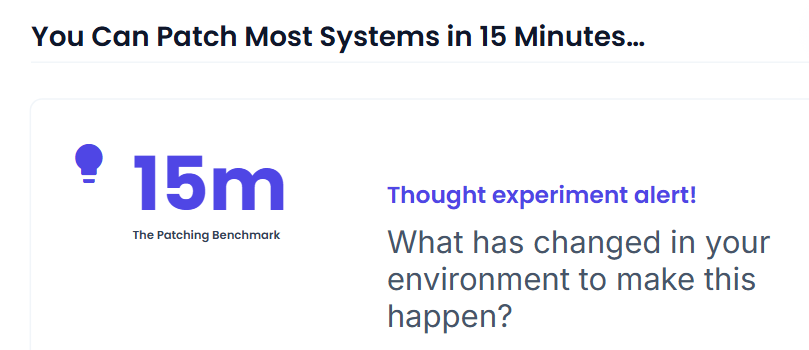
Imagine you wake up tomorrow morning and, by pure force of magic, any vulnerability in your systems, applications, and operating systems can be patched within 15 minutes of patch release. The dream has come true!
Now for the fun part: Reverse engineer that reality.
What fundamental changes had to happen in your environment to make that 15-minute window physically possible?
If you actually run through this exercise, you will discover a goldmine of hidden opportunities. You’ll identify exactly where you can streamline software updates, eliminate legacy roadblocks, and modernize your architecture.
Will it actually get your entire enterprise to a 15-minute patch cycle? No, probably not — and definitely not for every legacy application. But it will give you a concrete, actionable roadmap for modernizing your IT.
Let’s hope this was both fun and useful.
Related blog:
Breaking the Patch Sound Barrier Part 2: So Is The Apocalypse Coming and What Is It? was originally published in Anton on Security on Medium, where people are continuing the conversation by highlighting and responding to this story.
The post Breaking the Patch Sound Barrier Part 2: So Is The Apocalypse Coming and What Is It? appeared first on Stories by Anton Chuvakin on Medium.
*** This is a Security Bloggers Network syndicated blog from Stories by Anton Chuvakin on Medium authored by Anton Chuvakin. Read the original post at: https://medium.com/anton-on-security/breaking-the-patch-sound-barrier-part-2-so-is-the-apocalypse-coming-and-what-is-it-dff70b2f09bd?source=rss-11065c9e943e------2
