

What “Most Innovative Breach Readiness Solution” Actually Means

A transmission from the team…
Guys, the Attackers
Are Already Inside.
Are You Ready?
Breach readiness is not a posture you claim.
It is an architecture you prove, measured in seconds, not compliance checkboxes. In an era defined by digital acceleration and AI-enabled innovation, simply aiming for prevention is no longer sufficient. Enterprises must embrace a new operational approach of being breach ready. This is not a slogan or a checklist, but a strategic posture shift that delivers an “unaffected” digital business through cyber resilience and zero trust.
This shift is already redefining how cybersecurity is being measured. For years, ColorTokens has been building toward this approach, a direction now reflected across industry conversations and customer environments. We were recognized at RSAC 2026 as the “Most Innovative Breach Readiness Solution” by Cyber Defense Magazine, reinforcing the need for architectures that do more than prevent. They must contain, respond, and sustain operations in real time (read the full announcement here).
What breach readiness actually means?
Breach readiness means three things with absolute precision. First, visibility without blind spots. Every asset, every communication path, every identity, every vendor session, every supplier footprint, visible and understood. Second, reduce the elbow room for attackers to navigate paths that normal users do not embark on. Every reported anomaly, where necessary, is drawn into AI-engineered cyber deception environments. Third, enforcement without delay, the ability to isolate any compromised element of your environment in seconds, automatically, without a ticket, without a committee, without a phone call. Created with clear evidence, without scrambling a continuous, tamper-evident record of everything that happened, in a form that satisfies your auditors, your board, your regulators, and your own post-incident review.
That is what breach readiness means. Everything else is theater. The adversary does not send an appointment request. They are already inside, mapping your crown jewels while your SOC reviews last night’s false positives. 2026 is the year to transform cybersecurity investments to work tirelessly towards continuously evolving breach readiness, facing the next breach head-on. It does not matter if you have just started or have been around for years. It does not matter if you are “born on the cloud” or operate in brick and mortar. It does not matter whether you are set up locally or have a global supply chain. It also does not matter whether you have been breached.
The Question Nobody Is Asking Correctly
We have been asking the wrong question for years. The question was never “How do we prevent a breach?” Prevention is noble. Prevention is necessary. But prevention, in an era of AI-assisted adversaries, nation-state patience, and supply chains spanning 40 countries, is insufficient. The question, the only question that matters now, is:
“When the breach happens, what does our architecture do next?”
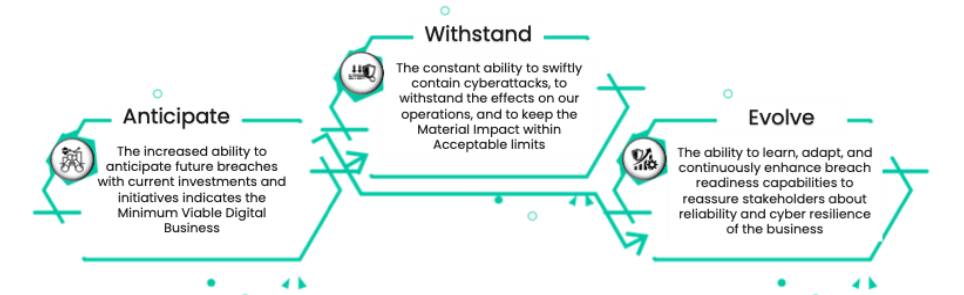
All that matters is that you have the intention to remain unaffected during unprecedented cyberattacks. Being breach-ready means you can anticipate the next breach, withstand its effects with grace and elegance, and evolve your breach exposure to come out stronger every time. Being breach ready is not about having an incident response plan gathering dust in a SharePoint folder. It is not about achieving a compliance certification that declares your controls adequate as of eighteen months ago. Breach readiness is a living, enforced, automated architectural state in which the moment an adversary gains a foothold, your environment responds, in milliseconds, with or without your team. Containing the blast radius before the attacker has had time to congratulate themselves.
2026 Will Not Be Business as Usual
The adversary landscape has transformed more dramatically in the last eighteen months than in the preceding decade.
- The AI acceleration problem
Your adversary now uses AI to compress reconnaissance, exploit selection, and lateral movement into minutes. Your defense must respond at the same speed — which means automation, not augmentation of human response. - The identity collapse
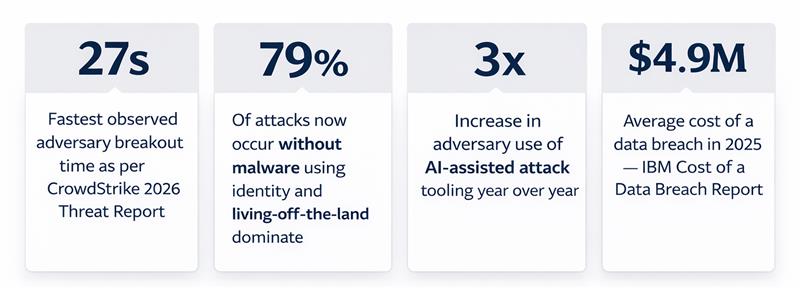
79% of attacks today use no malware at all. They use stolen, phished, or synthesized credentials to walk in through the front door as a trusted user. The only difference is that the adversary is not interested in filling out the form on your SAP application, but to find opportunities to attack and exfiltrate - The dwell time paradox
The one thing most people forget. The adversary is patient. They map your environment for weeks before acting. Every day of undetected dwell time is a day they get to understand your recovery process better than your own team does.
The enterprises that survive 2026 and beyond will not be the ones with the most comprehensive prevention stack. They will be the ones who have built a fundamentally different answer to the question, should an adversary get in, what will ensure critical business remains unaffected. In this reality, breach readiness is not an option, it is a business imperative. When a threat actor gains access to an environment, the ability to traverse east-west networks, move from server to server, or escalate privileges is what turns breaches into crises. And that is where microsegmentation comes in.
Microsegmentation: The Brains Behind Being Breach Ready
If you accept that a breach is inevitable, then the engineering question changes completely. From “how do we stop the next attack” to “how do we make the breach irrelevant?”
Microsegmentation is the foundational answer to that engineering question. Not the microsegmentation of ten years ago, which was VLAN-based, manually configured, a six-to-eight-month project, but the AI-driven, workload-aware, identity-enforced microsegmentation that ColorTokens Xshield delivers today in hours. ColorTokens Xshield is Zero Trust on steroids, trusting nothing, verifying every flow, enforcing every policy, while remaining disconnected from the action.
Traditional segmentation used to be a hand-drawn map. Xshield microsegmentation is a living policy — continuously learning the environment, automatically adjusting to every change, enforcing least-privilege access at the workload level with no dependency on the network perimeter’s continued integrity. As a healthcare pen tester expressed, “it seems that the critical infrastructures are ghosts in the system”. The pen tester could see the output of the processing but found no paths to the critical digital systems. The communication channel between the compromised workload and the crown jewels simply did not exist. It was never permitted. And should the adversary trigger an anomaly, an EDR signal, a suspicious authentication event, Xshield’s DEFCON mode activates: the entire microsegment is quarantined in seconds. The blast radius collapses.
The business keeps running “unaffected”. The production line does not stop.
Xshield does not just slow the adversary down. It removes the floor they were standing on. There is nowhere to pivot when there is no permitted path to pivot through.
Access the 2026 GigaOm Microsegmentation Report | ColorTokens Named a Leader and Outperformer Again. The Only solution among 15 to achieve a Perfect 5.0 Across Key Feature Categories.
Innovation at the Speed of Digital and AI
The enterprises we work with are not standing still. They are racing into AI. They are deploying LLM inference workloads at the edge. They are connecting manufacturing lines to cloud analytics platforms. They are enabling clinicians to access patient data from home. They are building a real-time trading infrastructure on a hybrid cloud. And every single one of these initiatives, everyone, expands the attack surface, often faster than the security architecture can respond.
ColorTokens Xshield was designed for exactly this reality. The Xshield AI Agent, announced in early 2026, brings LLM-driven intelligence to microsegmentation, allowing security operations teams to interrogate their environment in plain English, enrich the organization’s digital context with breach readiness intelligence within Xshield, connect to known attacker profiles on CISA, receive instant MITRE ATT&CK-mapped exposure assessments for new vulnerabilities, and generate enforcement-ready segmentation policies in minutes. The approach is an innovative, progressive microsegmentation program at machine speed. The Xshield AI Agent does not just help compliance and operations teams in the Office of the CISO. It also helps the CTO/CDO/CIO who wants to deploy a new AI workload without creating a new attack surface. It helps the OT engineer connect a new sensor without compromising the SCADA network. It helps the CISO who needs to answer the board’s question, ”Are we ready for the next breach?” with a clear articulation, not just a PowerPoint presentation.
And there is the innovation with partners. ColorTokens has built a world-class Breach Readiness Collective (BRC) of best-of-breed technologies to delay and deny attackers, giving you time to withstand the effects before you evict them. If you are thinking of an AI that leverages a closed loop, when every tool becomes smarter together, you are right. The Breach Readiness Collective has been formed through deep technology alliances across best-of-breed cybersecurity products, including vulnerability tools, EDR, Next-Generation Firewalls, OT cybersecurity, Secure Access Service Edge, and SIEM/SOAR, to establish Breach-Ready enterprises. ColorTokens innovation has always been pervasive across all possible points of breach, be it data centers, industrial OT, or the cloud. Technology integration is not new. But using bidirectional data flows to help enterprises move from detection to containment to evidence at machine speed is something the world has not yet seen. Here is a truth that vendor presentations often skip over: most enterprises are not building from a clean sheet. They are inheriting. If you are inheriting a Palo Alto firewall deployed seven years ago and a Splunk SIEM with 40,000 untuned rules, if you are inheriting an OT network designed in 2004, running Windows XP, and connecting to a cloud analytics platform deployed last year, ColorTokens Xshield Breach Readiness Collective is what you are looking for.
ColorTokens’ innovation is based on the engineering design of a digital terrain that can readjust already narrowed attack paths in response to varying breach indicators, creating innovative solutions for both new organizations and the inheriting enterprise. Because breach readiness is not a destination you reach only when everything is perfect. It is a state you achieve from wherever you are.
The Clock Is Already Ticking
The adversary did not wait for this blog post to be published. They did not wait for your board to approve the microsegmentation budget. They did not wait for your organization to finish its digital transformation. They are already inside the enterprise, mapping its environment, learning its patterns, and waiting for the moment of maximum impact. The question is, “When the moment comes, is your architecture responding faster than the attack?”. Breach readiness is the only honest answer to that question. Not because prevention has failed, but because prevention is still essential, and because prevention alone is no longer enough. The architecture that contains the breach, automatically, in seconds, while the business keeps running and the evidence assembles itself, is the architecture that determines whether a security incident becomes a headline.
I have always believed that you do not get to choose whether the adversary tries. You only get to choose how far they get when they do. But here is what you can do. ColorTokens offers a free Breach Readiness Impact Assessment that can tell you if you are attackable. Begin your breach readiness journey with the assessment. Breach readiness is a journey at machine speed.
And if you are visiting RSAC this year, drop by booth 1933 to experience the ColorTokens innovation in person!
The post What “Most Innovative Breach Readiness Solution” Actually Means appeared first on ColorTokens.
*** This is a Security Bloggers Network syndicated blog from ColorTokens authored by Agnidipta Sarkar. Read the original post at: https://colortokens.com/blogs/breach-readiness-innovation-microsegmentation-solution/
