

Okta vs Microsoft Entra ID: Which Enterprise SSO Platform Is Better?

Enterprise organizations rely on identity providers to manage authentication, secure access to applications, and automate identity lifecycle management.
Two of the most widely used enterprise identity platforms today are Okta and Microsoft Entra ID (formerly Azure Active Directory).
Both platforms provide enterprise capabilities such as:
-
single sign-on (SSO)
-
multi-factor authentication (MFA)
-
automated user provisioning
-
identity lifecycle management
-
access control policies
However, organizations evaluating identity solutions often ask:
-
Is Okta better than Microsoft Entra ID?
-
Which platform is better for enterprise SSO?
-
Should SaaS applications support Okta or Entra ID?
This guide compares Okta and Microsoft Entra ID across architecture, security, SaaS integration, and developer experience to help organizations choose the right enterprise identity platform.
Okta vs Microsoft Entra ID: Quick Comparison
|
Category |
Okta |
Microsoft Entra ID |
|---|---|---|
|
Platform Type |
Independent identity platform |
Microsoft ecosystem identity service |
|
Enterprise SSO |
Yes |
Yes |
|
Multi-Factor Authentication |
Yes |
Yes |
|
SCIM Provisioning |
Yes |
Yes |
|
Best For |
Multi-cloud SaaS environments |
Microsoft ecosystem organizations |
Both platforms are widely used in enterprise environments, but their strengths differ depending on infrastructure and identity requirements.
What Is an Enterprise Identity Provider?
An identity provider (IdP) is a platform that authenticates users and manages access to applications.
Enterprise identity providers enable organizations to:
-
authenticate employees and customers
-
enable single sign-on across multiple applications
-
enforce security policies like MFA
-
automate identity lifecycle management
Modern SaaS platforms typically integrate with identity providers using SAML SSO authentication or OpenID Connect identity federation.
These protocols allow organizations to centralize authentication while allowing employees to access multiple applications securely.
Overview of Okta
Okta is an independent identity and access management platform designed to manage both workforce and customer identities.
Okta is widely used by enterprises to centralize authentication and access control across cloud applications.
Key capabilities include:
-
enterprise SSO across thousands of SaaS applications
-
adaptive multi-factor authentication
-
identity lifecycle management
-
automated provisioning through SCIM
-
identity federation and API access management
Because Okta is independent of any specific cloud provider, it is often used by organizations that rely on multiple SaaS platforms.
Many companies integrate Okta with enterprise SSO platforms and SaaS authentication infrastructure to support secure login across applications.
Overview of Microsoft Entra ID
Microsoft Entra ID (formerly Azure Active Directory) is Microsoft’s cloud identity platform designed to manage workforce identities and secure access to applications.
It is widely adopted by enterprises already using Microsoft services such as:
-
Microsoft 365
-
Azure cloud infrastructure
-
Windows enterprise environments
Microsoft Entra ID provides features including:
-
enterprise SSO
-
conditional access policies
-
identity governance
-
automated user provisioning
-
directory synchronization
Because of its deep integration with Microsoft infrastructure, Entra ID is often the default identity provider for organizations operating within the Microsoft ecosystem.
Many enterprises rely on Entra ID as the foundation of their enterprise authentication infrastructure.
Okta vs Microsoft Entra ID: Feature Comparison
|
Feature |
Okta |
Microsoft Entra ID |
|---|---|---|
|
Enterprise SSO |
Yes |
Yes |
|
Multi-Factor Authentication |
Yes |
Yes |
|
SCIM Provisioning |
Yes |
Yes |
|
Identity Lifecycle Management |
Yes |
Yes |
|
Directory Integration |
Yes |
Yes |
Both platforms provide enterprise-grade identity services.
However, differences emerge in ecosystem integration and deployment scenarios.
Okta vs Entra ID Architecture
The architecture of these identity platforms reflects their design philosophies.
Okta is built as an independent identity platform, while Microsoft Entra ID is integrated with Microsoft’s cloud ecosystem.
Typical authentication architecture looks like this:
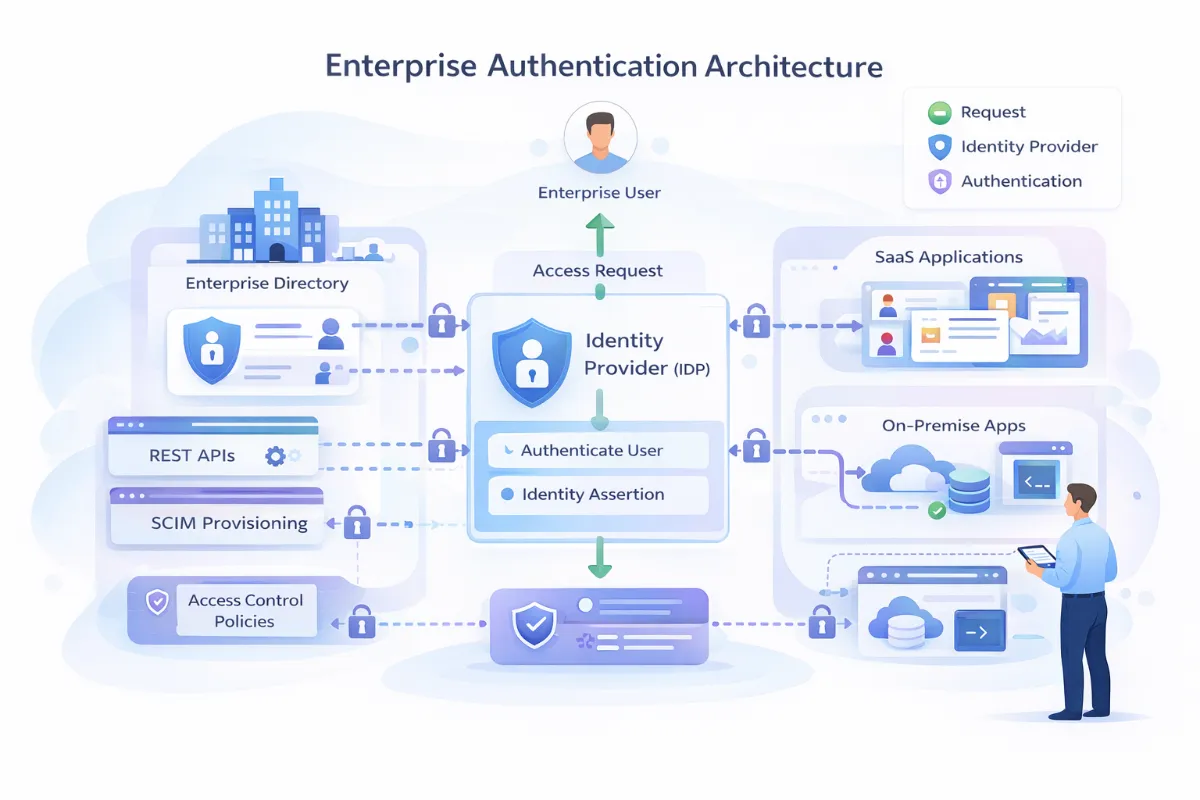
In this model:
-
the identity provider authenticates users
-
SaaS applications trust authentication assertions
-
user access is centrally managed
Developers implementing identity integrations often rely on SaaS identity federation guides and enterprise authentication architecture documentation.
Security Feature Comparison
Identity platforms must provide strong security protections to defend against account compromise and unauthorized access.
|
Security Feature |
Okta |
Microsoft Entra ID |
|---|---|---|
|
Multi-Factor Authentication |
Yes |
Yes |
|
Adaptive Authentication |
Yes |
Yes |
|
Conditional Access Policies |
Limited |
Strong |
|
Threat Detection |
Yes |
Yes |
Both platforms provide advanced identity protection mechanisms.
Okta Security Capabilities
-
adaptive multi-factor authentication
-
risk-based authentication policies
-
centralized identity security controls
Microsoft Entra ID Security Capabilities
-
conditional access policies
-
device-based authentication controls
-
identity protection analytics
These features help enterprises enforce strong authentication policies across applications.
Organizations often combine these capabilities with enterprise authentication security frameworks and identity access management platforms.
User Provisioning and Identity Lifecycle Management
Enterprise identity systems must manage the lifecycle of user accounts across applications.
Both Okta and Entra ID support automated provisioning using SCIM APIs, which allow identity providers to create, update, and deactivate users in connected applications.
Typical identity lifecycle workflows include:
-
onboarding employees
-
granting application access
-
updating user attributes
-
deactivating accounts when employees leave
Automated provisioning improves security and reduces administrative overhead.
Developers implementing provisioning workflows often reference SCIM provisioning integration guides and automated user lifecycle management documentation.
SaaS Integration Ecosystem
A key difference between Okta and Entra ID is their integration ecosystem.
Okta SaaS Integrations
Okta provides thousands of prebuilt integrations for SaaS applications through the Okta Integration Network.
Advantages include:
-
strong SaaS ecosystem
-
independent cloud identity platform
-
large library of application integrations
Microsoft Entra ID Integrations
Entra ID integrates deeply with Microsoft services and enterprise IT infrastructure.
Advantages include:
-
native Microsoft ecosystem integration
-
strong enterprise adoption
-
built-in directory synchronization
Many SaaS platforms support authentication from both identity providers through enterprise SSO integrations.
Okta vs Entra ID for SaaS Platforms
SaaS companies building enterprise-ready applications often need to support authentication from both Okta and Entra ID.
Enterprise customers typically require SaaS tools to integrate with their existing identity provider.
Common enterprise integration requirements include:
-
SAML SSO support
-
SCIM provisioning
-
identity federation
-
user lifecycle automation
Developers implementing these integrations frequently rely on SaaS identity infrastructure and enterprise authentication APIs.
Okta vs Microsoft Entra ID Pricing
Okta:
-
per-user pricing
-
additional features often sold separately
Entra ID:
-
often bundled with Microsoft 365
-
lower incremental cost for Microsoft customers
Microsoft’s identity platform is often cheaper for organizations already using Microsoft 365 subscriptions.
When Should Organizations Choose Okta?
Organizations may prefer Okta when:
-
they want an independent identity provider
-
they use multiple cloud providers
-
they rely heavily on SaaS applications
-
they want a dedicated identity management platform
Okta is particularly popular among organizations operating across diverse cloud environments.
When Should Organizations Choose Microsoft Entra ID?
Microsoft Entra ID is often the preferred choice when organizations:
-
already use Microsoft 365 extensively
-
rely on Azure infrastructure
-
want tight integration with Microsoft services
For many enterprises, Entra ID becomes the default identity provider due to its integration with existing Microsoft environments.
Identity Platforms for SaaS Developers
While Okta and Entra ID are widely used enterprise identity providers, SaaS developers often need additional infrastructure to integrate enterprise authentication features.
Platforms such as SSOJet help developers implement enterprise identity features including:
-
SAML SSO authentication
-
SCIM user provisioning
-
identity federation
-
enterprise login workflows
Developer-focused platforms allow SaaS teams to support enterprise identity requirements without building complex identity infrastructure internally.
Using enterprise SSO implementation guides and SaaS identity management platforms, developers can integrate authentication for multiple identity providers efficiently.
Okta vs Entra ID for SaaS Developers
SaaS platforms serving enterprise customers usually need to support authentication from both identity providers.
Developers must integrate:
-
SAML SSO
-
OpenID Connect
-
SCIM provisioning
Platforms like SSOJet help SaaS teams implement enterprise identity integrations without building the infrastructure internally.
Frequently Asked Questions
Is Okta better than Microsoft Entra ID?
Both platforms offer enterprise identity management capabilities. The best choice depends on the organization’s infrastructure and ecosystem.
Do enterprises use Okta or Entra ID more?
Many enterprises use Entra ID because of its integration with Microsoft services, while others choose Okta for its independent identity platform.
Do SaaS applications need to support both Okta and Entra ID?
Yes. SaaS platforms targeting enterprise customers typically support authentication from both identity providers.
What is the difference between Okta and Microsoft Entra ID?
Okta is an independent identity and access management platform designed to integrate with multiple cloud services and SaaS applications. Microsoft Entra ID is Microsoft’s identity platform integrated with the Microsoft ecosystem, including Azure and Microsoft 365.
Is Okta better than Microsoft Entra ID for enterprise SSO?
Both platforms provide enterprise-grade SSO capabilities. Okta is often preferred in multi-cloud environments, while Microsoft Entra ID is commonly used by organizations already using Microsoft infrastructure.
Do enterprises use Okta or Microsoft Entra ID more?
Many enterprises use Microsoft Entra ID because it is included with Microsoft 365 subscriptions. However, Okta is widely adopted by organizations that rely on multiple SaaS applications and want an independent identity provider.
Can Okta and Microsoft Entra ID both support SAML SSO?
Yes. Both platforms support SAML-based single sign-on and OpenID Connect authentication for SaaS applications.
Do Okta and Microsoft Entra ID support SCIM provisioning?
Yes. Both identity providers support SCIM provisioning, which allows automated user lifecycle management such as creating, updating, and deactivating user accounts across applications.
Can SaaS applications integrate with both Okta and Microsoft Entra ID?
Yes. Most enterprise SaaS platforms support authentication from both identity providers using SAML or OpenID Connect protocols.
Developers typically implement these integrations using enterprise SSO integration guides and SaaS identity federation platforms.
Which identity provider is easier for developers to integrate?
Both platforms provide APIs and developer documentation. However, SaaS developers often use identity infrastructure platforms to simplify integrations with enterprise identity providers.
Why do enterprises require SSO integration?
Enterprises require SSO integration so employees can access multiple applications using a single identity while IT teams maintain centralized access control and security policies.
What authentication protocols do Okta and Entra ID support?
Both platforms support modern authentication protocols including:
-
SAML
-
OpenID Connect (OIDC)
-
OAuth 2.0
-
SCIM for provisioning
These protocols enable secure authentication and identity federation between enterprise identity systems and SaaS applications.
Do SaaS companies need to support enterprise identity providers?
Yes. SaaS platforms targeting enterprise customers typically need to support identity providers such as Okta and Microsoft Entra ID.
Developers often implement these integrations using enterprise authentication infrastructure and SaaS identity management platforms.
Which platform is better for SaaS authentication?
Both Okta and Entra ID are widely supported by SaaS applications, and most enterprise SaaS platforms integrate with both providers.
Final Thoughts
Okta and Microsoft Entra ID are two of the most widely used enterprise identity platforms.
Both provide capabilities such as enterprise SSO, multi-factor authentication, automated provisioning, and identity lifecycle management.
The choice between them typically depends on organizational infrastructure and ecosystem integration.
For SaaS developers building enterprise-ready applications, supporting identity providers like Okta and Entra ID through enterprise authentication infrastructure and identity federation platforms is essential.
Developer-focused platforms like SSOJet help SaaS teams integrate enterprise authentication features quickly while maintaining secure and scalable identity systems.
*** This is a Security Bloggers Network syndicated blog from SSOJet - Enterprise SSO & Identity Solutions authored by SSOJet - Enterprise SSO & Identity Solutions. Read the original post at: https://ssojet.com/blog/okta-vs-microsoft-entra-id-enterprise-sso-comparison
