
Home » Security Bloggers Network » Master regulatory compliance: Dominate change before it dominates you

Master regulatory compliance: Dominate change before it dominates you

Change is no longer the exception; it’s the baseline. As we move into 2025, regulatory compliance is morphing faster than many organizations anticipated. New laws, shifting political priorities, disruptive technologies such as AI and IoT, and rising expectations from stakeholders are all combining to reshape what compliance looks like. For compliance leaders, legal teams, and executives, staying static means falling behind: missed deadlines, unexpected liabilities, and reputational risk are now real dangers.
This article walks through the evolving compliance landscape in 2025, showing how organizations can anticipate shifts, build resilient programs, and adapt not just to survive but to prosper in a world where regulatory uncertainty is the new normal.
What is regulatory compliance?
Regulatory compliance refers to the process of ensuring that an organization follows all laws, regulations, standards, and guidelines that apply to its industry and operations. These rules are typically set by government bodies, industry regulators, or international authorities to safeguard consumers, protect data, maintain fair markets, and uphold ethical practices.
For example, a healthcare provider must comply with patient privacy laws, a bank must follow anti-money laundering regulations, and a tech company may need to meet data protection standards like GDPR or CCPA.
Regulatory compliance is not just about avoiding penalties; it’s about building trust, managing risks, and ensuring that business practices align with legal and ethical expectations. Organizations often establish compliance programs, policies, internal audits, and monitoring systems to stay up to date with changing requirements and to demonstrate accountability.
Understanding regulatory compliance: definition and key concepts
Regulatory compliance refers to the process of adhering to laws, regulations, and guidelines set by governing bodies at local, national, and international levels. It involves implementing policies, procedures, and controls to ensure that organizations meet the required standards and operate within the legal framework. Compliance is essential for maintaining a company’s reputation, protecting stakeholders’ interests, and avoiding legal and financial penalties.
The following table offers a structured overview of regulatory compliance, helping organizations understand its purpose, components, and importance in managing risks and maintaining legal and ethical standards.
| Aspect | Description |
|---|---|
| Definition | Regulatory compliance is the practice of adhering to laws, regulations, guidelines, and specifications relevant to a business or industry. Failure to comply can result in legal penalties, fines, or reputational damage. |
| Purpose | Ensures that organizations operate within legal and ethical standards, protecting the rights of stakeholders, customers, and the public. Compliance also mitigates risks and enhances organizational integrity. |
| Key Regulations | Examples include GDPR (data privacy), HIPAA (healthcare information), SOX (financial reporting), and PCI-DSS (payment security). Each set of regulations has specific requirements to protect data and ensure transparency. |
| Risk Management | Regulatory compliance is closely tied to risk management, as it helps identify and mitigate potential legal, financial, and operational risks. This includes implementing controls to prevent non-compliance. |
| Compliance Programs | These are structured frameworks within organizations that include policies, training, monitoring, and reporting to ensure adherence to relevant regulations and standards. |
| Internal Controls | Internal controls are checks and balances that help monitor compliance processes, reduce risks, and ensure that organizational practices align with regulatory requirements. |
| Audit and Reporting | Regular audits and compliance reporting provide documentation of compliance status, helping organizations demonstrate adherence to regulations and identify areas needing improvement. |
| Continuous Improvement | Regulatory requirements and risks evolve, so compliance efforts require ongoing updates, training, and process improvements to stay current with regulatory changes. |
To effectively ensure regulatory compliance, organizations must understand key concepts such as regulatory requirements, industry-specific regulations, and compliance frameworks. Regulatory requirements vary across industries and jurisdictions, making it crucial for businesses to research and stay informed about the specific regulations that apply to their operations.
Read our “Heightened Regulatory Scrutiny: How to Meet Compliance Demands” article to learn more!
Why Is regulatory compliance so complex in 2025?
Regulatory compliance today is no longer just about checking boxes. With constant updates in data protection laws, cybersecurity mandates, and industry-specific regulations, companies face increasing pressure to stay compliant without slowing down innovation. Global operations, hybrid workforces, and cloud infrastructure have added layers of complexity.
For example, new AI and data privacy regulations require businesses to rethink their risk management strategies in real time. The consequences of non-compliance, like hefty fines, loss of customer trust, or legal battles, are too great to ignore. That’s why companies are turning to GRC automation platforms like TrustOps to centralize controls, monitor risk indicators, and ensure continuous compliance.
Understanding the complexity means understanding how policies, people, and technology interact. It also requires cross-functional collaboration between security, legal, and compliance teams. With the right framework and tools, organizations can adapt to regulatory shifts while maintaining operational resilience.
Common challenges
Maintaining regulatory compliance can pose significant challenges for businesses. Some of the common obstacles faced include:

- Complexity and volume of regulations
The sheer number of regulations and their complexity can make it difficult for organizations to interpret and implement them effectively. Businesses need to allocate resources and invest in compliance management systems to keep track of the ever-changing regulatory landscape. - Lack of awareness and understanding
Many organizations struggle with staying informed about regulatory changes and understanding how they impact their operations. This can result in non-compliance if businesses are not proactive in seeking out information and updates. - Limited resources
Small businesses and startups often face resource constraints when it comes to compliance management. They may find it challenging to allocate dedicated personnel or invest in compliance technology solutions, leading to increased compliance risks. - Data security and privacy
The increasing focus on data protection and privacy regulations poses additional challenges for organizations. Ensuring compliance with regulations such as the General Data Protection Regulation (GDPR) requires businesses to implement robust data management and protection measures.
The impact of technology on regulatory compliance
Technology plays a crucial role in simplifying and streamlining regulatory compliance processes. Organizations can leverage technology solutions to automate compliance tasks, enhance data management, and monitor regulatory changes. Here are some ways technology is transforming regulatory compliance:
- Compliance management systems
Compliance management software enables organizations to centralize compliance-related data, automate processes, and track regulatory changes. These systems provide real-time visibility into compliance status, reducing the risk of non-compliance. - Data analytics
Advanced analytics tools allow businesses to analyze large volumes of data, identify patterns, and detect potential compliance issues. By leveraging data analytics, organizations can proactively identify and address compliance risks. - Artificial Intelligence and machine learning
AI and ML technologies can automate repetitive compliance tasks, such as risk assessments and due diligence. These technologies can also help organizations identify potential compliance breaches by analyzing vast amounts of data and flagging anomalies.
Read our The Future of SLAs: Are We Measuring What Matters? article to learn more!
Strategies for ensuring regulatory compliance in a rapidly changing landscape
To navigate the rapidly changing regulatory landscape, organizations need to adopt effective strategies for ensuring compliance. Here are some key strategies to consider:
- Proactive compliance culture
organizations should foster a culture of compliance from top to bottom. This involves promoting awareness, providing regular training, and encouraging employees to report potential compliance issues. - Risk-based approach
Adopting a risk-based approach allows organizations to prioritize compliance efforts based on potential risks. Conducting risk assessments and identifying areas of high risk enables businesses to allocate resources effectively. - Continuous monitoring and auditing
Regular monitoring and auditing of compliance processes help organizations identify gaps and areas for improvement. Implementing automated monitoring systems can provide real-time visibility into compliance status and enable prompt corrective action. - Engagement with regulatory bodies
Organizations should actively engage with regulatory bodies and industry associations to stay informed about regulatory changes. Building relationships with regulators and participating in industry discussions can provide valuable insights and ensure proactive compliance.
Read our Data privacy compliance challenges: navigating the regulatory landscape article to learn more!
PULL AND PUSH DATA FROM 100+ CLOUD AND ON-PREMISES SOURCES
Hybrid data fabric aggregates and normalizes feeds to build an assurance and GRC data lake
Don’t struggle with 1000s of vulnerability smoke signals from your security tools. Aggregate feeds from your cloud, on-premises and bespoke apps, and combine them with inventories from your security tools and document repos to continuously measure the control effectiveness and operational status of your entire IT environment.
The role of risk management in maintaining regulatory compliance
Risk management is closely intertwined with regulatory compliance. Organizations need to identify, assess, and mitigate risks to ensure compliance with regulations. Here’s how risk management contributes to maintaining regulatory compliance:
- Risk identification
By conducting comprehensive risk assessments, organizations can identify potential compliance risks. This includes evaluating internal processes, external factors, and industry-specific risks. - Risk mitigation
Once risks are identified, businesses need to implement appropriate controls and measures to mitigate these risks. This may involve developing policies, implementing monitoring systems, and establishing clear accountability for compliance. - Risk monitoring and reporting
Regular monitoring of compliance risks allows organizations to track and report on their compliance efforts. This ensures that businesses can detect and address potential compliance breaches promptly.
Key regulatory compliance frameworks and standards
Organizations must navigate a complex web of compliance frameworks and standards to protect data, maintain trust, and avoid costly penalties. Each framework addresses unique risks, from safeguarding personal privacy to securing financial reporting and protecting sensitive health or payment data.
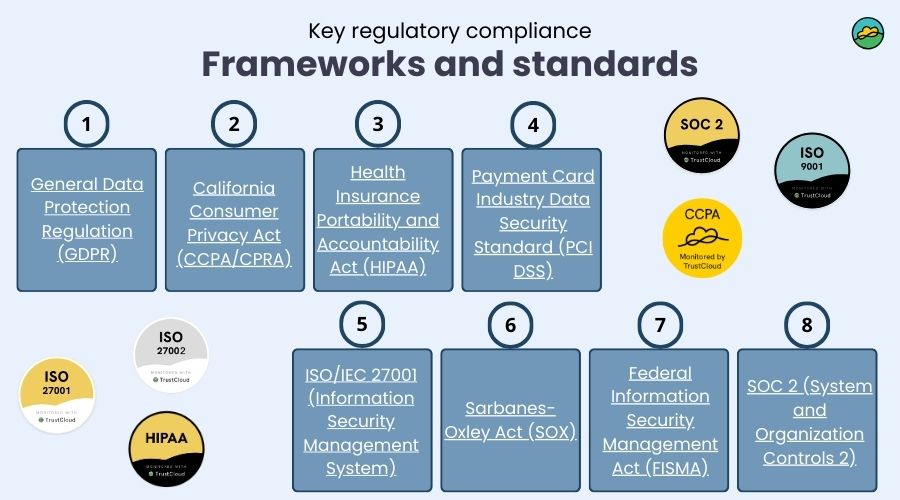
Understanding these requirements is essential for building resilient operations and demonstrating accountability to stakeholders. While some regulations are industry-specific, others provide global benchmarks for security and governance. Together, they form the foundation of responsible business practices, guiding companies toward stronger risk management, operational transparency, and long-term regulatory readiness.
Some of the key frameworks and standards include:
- General Data Protection Regulation (GDPR)
GDPR is the European Union’s comprehensive data protection law that governs how organizations collect, process, and store personal data of EU residents. It emphasizes user consent, data minimization, and breach notifications. Non-compliance can result in heavy fines. GDPR also grants individuals rights over their data, such as access, correction, portability, and the right to be forgotten. - California Consumer Privacy Act (CCPA/CPRA)
The CCPA, strengthened by the CPRA, sets privacy rights for California residents, including the right to know what data is collected, the right to delete personal data, and the right to opt out of data sales. Businesses must provide transparent privacy policies, handle data requests, and ensure secure processing, or face penalties from the California Privacy Protection Agency. - Health Insurance Portability and Accountability Act (HIPAA)
HIPAA regulates how healthcare organizations, insurers, and business associates protect sensitive health information (PHI). It requires administrative, technical, and physical safeguards, including access controls, encryption, and audit logs. HIPAA also enforces breach notification rules and penalties for violations. Its goal is to protect patient privacy while allowing secure and efficient exchange of health information in the U.S. - Payment Card Industry Data Security Standard (PCI DSS)
PCI DSS applies to any organization that stores, processes, or transmits credit card data. It requires strict security measures such as firewalls, encryption, access restrictions, and regular vulnerability scans. Compliance ensures protection against fraud and breaches. Non-compliance can result in hefty fines, loss of card-processing privileges, and reputational damage, making it a critical framework for retailers and banks. - ISO/IEC 27001 (Information Security Management System)
ISO 27001 is an international standard for building and maintaining an information security management system (ISMS). It provides a framework for identifying risks, implementing security controls, and ensuring continuous monitoring. Certification demonstrates strong data security practices and builds trust with clients and regulators. Its risk-based approach makes it adaptable across industries and highly relevant for global organizations. - Sarbanes-Oxley Act (SOX)
SOX is a U.S. law designed to protect investors by improving the accuracy of corporate disclosures. It enforces strict rules on financial reporting, internal controls, and auditor independence. Public companies must establish reliable processes for documenting and validating financial data. Non-compliance can result in fines or imprisonment for executives, ensuring accountability in corporate governance and financial transparency. - Federal Information Security Management Act (FISMA)
FISMA applies to U.S. federal agencies and their contractors, requiring them to protect government information systems against cyber threats. It mandates risk assessments, security controls, continuous monitoring, and regular audits. The National Institute of Standards and Technology (NIST) provides guidelines for compliance. FISMA’s goal is to secure sensitive government data, ensuring resilience against cyberattacks targeting federal systems. - SOC 2 (System and Organization Controls 2)
SOC 2 is a compliance standard developed by the AICPA, focusing on how service providers manage customer data. It assesses controls based on five trust principles: security, availability, processing integrity, confidentiality, and privacy. Widely used by SaaS and cloud providers, SOC 2 certification demonstrates strong data handling practices and reassures clients that their information is safeguarded.
Best practices
Implementing and maintaining regulatory compliance demands a structured, ongoing commitment across the entire organization. A successful compliance strategy integrates policies, procedures, and oversight mechanisms into everyday business operations. This means creating clear governance frameworks, embedding accountability at all levels, and ensuring continuous education for staff. Regular monitoring and audits help detect weaknesses before they escalate, while transparent reporting builds trust with regulators and stakeholders alike.
In addition, organizations must recognize that compliance extends beyond their walls: partners, vendors, and third parties all play a role in maintaining compliance standards. By combining internal discipline with external due diligence, companies can build resilient systems that not only satisfy legal requirements but also safeguard reputation, minimize risks, and create a culture of ethical responsibility.
Here are five detailed points about the best practices
- Develop a Comprehensive Compliance Program
Design a formal program that defines policies, procedures, and reporting structures tailored to your industry. It should include a compliance officer or team responsible for oversight. Regular reviews are essential to align with evolving laws, new technologies, and regulatory updates, ensuring the program remains both practical and enforceable across the organization. - Deliver Continuous Training and Education
Compliance should never be a one-time lesson. Employees at all levels need ongoing training to understand new regulations, company policies, and ethical responsibilities. Interactive workshops, e-learning modules, and scenario-based sessions can help employees internalize requirements and apply them in real-world situations, fostering accountability and preventing costly missteps. - Strengthen Internal Controls and Monitoring
Introduce checks and balances within business processes to ensure regulatory requirements are met consistently. Monitoring systems should track compliance metrics, while internal audits validate adherence to standards. Early detection mechanisms allow organizations to fix issues before they escalate into violations, safeguarding both operational integrity and stakeholder confidence. - Conduct Rigorous Third-Party Due Diligence
Vendors, contractors, and partners can pose compliance risks if not properly vetted. Conduct background checks, assess their data protection and security practices, and require evidence of compliance certifications. Establish contractual obligations that hold third parties accountable, and perform ongoing reviews to ensure they continue to meet your compliance expectations. - Foster a Culture of Compliance and Transparency
Beyond frameworks and audits, compliance must be ingrained into company culture. Encourage open communication, where employees feel safe reporting concerns without fear of retaliation. Recognize and reward compliance-oriented behavior. By making compliance part of daily values and leadership messaging, organizations strengthen trust internally and externally while reducing regulatory risk.
Read the “Building cyber resilience for your defense against online threats in 2025” article to learn more!
The role of automation and technology
Automation and technology solutions play a vital role in streamlining regulatory compliance processes. By leveraging these tools, organizations can improve efficiency, reduce compliance risks, and enhance overall compliance management. Here are some ways automation and technology can streamline compliance processes:
- Compliance management systems
Implementing compliance management software allows organizations to centralize compliance data, automate workflows, and track compliance activities. These systems provide real-time visibility into compliance status and enable proactive management. - Automated monitoring and reporting
Automation tools can continuously monitor compliance activities, detect anomalies, and generate real-time reports. This helps organizations identify potential compliance breaches and take prompt corrective actions. - Data analytics and AI
Advanced analytics and AI technologies can analyze large volumes of data to identify patterns and potential compliance issues. These tools can also automate risk assessments, due diligence, and compliance monitoring tasks.
Summin it up
Regulatory change is no longer occasional, it’s constant. Organizations that see compliance as a checkbox will find themselves scrambling when laws shift, technologies evolve, or market expectations rise. But those who embed agility, transparency, and foresight into their compliance programs gain far more than risk mitigation: they earn trust, competitive advantage, and long-term stability.
Moving forward, it’s essential to make regulatory compliance a living part of your organization not a periodic audit. Cultivate a compliance culture where policies evolve alongside strategy, risk assessments are continuous, and everyone understands their part. Leverage technology and data to forecast change, monitor compliance in real time, and respond with clarity and speed. At the end of the day, staying ahead of regulation is less about reacting and more about anticipating, aligning, and building systems that adapt. It’s in that mindset where compliance, governance, and strategy intersect, that organizations won’t just survive change, but lead through it.
FAQs
How can organizations build agility to respond quickly when regulations change?
Agility in regulatory compliance starts with continuous risk assessment, keeping track of new or changing laws, industry standards, and geopolitical shifts that may affect operations. Organizations should have a dedicated compliance team or function that monitors regulatory news and maintains a regulatory horizon scan.
Next, policies and procedures must be flexible: modular, version-controlled, and updated swiftly rather than awaiting annual revisions. Embedding regulatory obligations into business processes is essential so that change triggers ripple updates automatically in systems, workflows, documentation, and training. Finally, leadership support matters: empowerment and resource allocation allow teams to adapt without bureaucratic delay, ensuring that legal, IT, operations and security functions collaborate efficiently.
What are best practices for maintaining evidence and documentation to satisfy auditors and regulators?
Maintaining reliable evidence involves creating robust, auditable trails across all compliance-related processes. Every policy, procedure, control, or risk assessment should be documented, versioned, and stored securely. Use centralized systems (like compliance software or GRC platforms) so that status, exceptions, changes, and incidents are traceable.
Regular internal audits should verify that actual practices match documented policies. It’s important to track training completion, incident responses, and fixes or patches applied after discovery of vulnerabilities. Ensure that data is immutable (or versioned in an auditable way), with read-only logs where possible. Finally, schedule periodic reviews so that all documentation remains up to date with regulatory changes and business evolutions.
What role do leadership and culture play in achieving regulatory compliance in a rapidly changing environment?
Leadership and organizational culture are foundational; no regulatory framework alone can succeed without them. Senior leadership must visibly endorse compliance as a strategic priority, not just legal or operational overhead. They should allocate the budget, staff, and tools required to keep pace with regulatory change. Culture is about norms: when employees across levels believe compliance is part of daily work, report issues candidly, raise concerns, and ask questions, risks are detected earlier.
Regular training, transparent communication, and acknowledgment (or rewards) of compliance-mindful behaviors help. Also, failures or near misses should be treated as learning opportunities, not just blame events. In doing so, compliance becomes embedded rather than imposed, enabling the organization to adapt more confidently as regulation evolves.
The post Master regulatory compliance: Dominate change before it dominates you first appeared on TrustCloud.
*** This is a Security Bloggers Network syndicated blog from TrustCloud authored by Shweta Dhole. Read the original post at: https://www.trustcloud.ai/grc/master-regulatory-compliance-dominate-change-before-it-dominates-you/
